
Washer Throwing Error Codes? Here's What Was Really Wrong
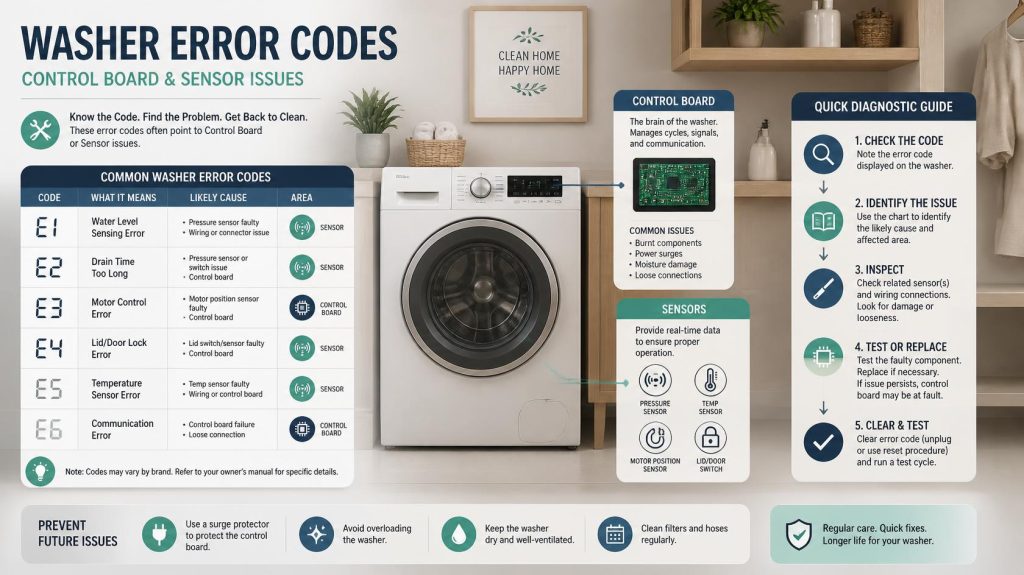
A step-by-step look at a real error code repair, from an intermittent stop mid-cycle to the fix
An error code usually means the control board is doing exactly what it’s supposed to, flagging a problem somewhere else. Here is the exact diagnostic process our certified technicians used to trace this one back to its actual source.
Case Snapshot
Symptom
Intermittent error, cycle halts mid-run
Appliance
Front-Load Washer
Location
Evergreen Park, IL
Diagnosis
Failing sensor, board reading it correctly
Time to Repair
Same visit, under 1 hour
Outcome
No more errors, cycles complete normally
The Problem
An Evergreen Park homeowner called Dara Appliance Repair about her washer randomly stopping mid-cycle with an error code on the display. It wasn't every load, and it didn't happen at the same point in the cycle each time, sometimes during fill, sometimes during spin, which made it hard for her to describe a clear pattern when she called.
She'd tried resetting the washer each time, which cleared the error temporarily, but it kept coming back on later loads.
The Diagnostic Process
Confirmed the intermittent pattern
Our technician reviewed what the homeowner had noticed, an error appearing unpredictably at different points in the cycle, which pointed toward a sensor or connection issue rather than a hard component failure that would fail the same way every time.
Checked wiring connections to the relevant sensors
All visible connections to the water level and cycle sensors were firmly seated with no corrosion or damage, ruling out a loose or damaged wire as the simple explanation.
Pulled the stored error history
Using the washer's built-in diagnostic mode, the technician retrieved a history of past error events, which consistently pointed to the same sensor circuit rather than jumping around between different systems.
Tested the water level sensor directly
Direct testing showed the sensor's readings drifting outside their expected range intermittently, consistent with a sensor that was failing rather than a wiring or board issue.
Confirmed the control board was functioning correctly
The technician also tested the board's handling of signals from properly working components, confirming it was processing everything correctly and had simply been accurately reporting the bad data it was receiving from the failing sensor.
The Root Cause
A failing water level sensor was sending intermittent, inconsistent readings, and the control board was correctly detecting that the data didn't make sense and halting the cycle to protect the machine, exactly what it's designed to do. The error code wasn't a sign the board itself was broken, it was the board doing its job well. Replacing the board without testing the sensor first would have left the actual problem in place.
The Fix
With the sensor confirmed as the cause, our technician completed the repair in a single visit:
- Replaced the faulty water level sensor with a manufacturer-spec part
- Cleared the washer's stored error history through diagnostic mode
- Left the control board untouched, since it had already tested as fully functional
- Ran multiple full test cycles, monitoring closely for any recurrence of the error
The Result
The washer now completes every cycle without interruption, with no recurrence of the error across multiple test loads. The $89 diagnostic fee was waived since the customer moved forward with the repair, and the repair is backed by our standard 3-month warranty. As a first-time customer, she also received 10% off the total repair cost.
Common Causes of Washer Error Codes
| Cause | Signs | DIY-Fixable? |
|---|---|---|
| Failing water level or pressure sensor | Intermittent error, often tied to the fill or spin stages | No, replacement required |
| Loose or corroded sensor wiring connection | Error appears after moving or servicing the washer, or intermittently | Sometimes, check visible connections first |
| Faulty control board | Errors across multiple unrelated systems, or the board fails to respond at all | No, replacement required |
| Door or lid switch fault | Error specifically tied to door or lid status | Sometimes, check the switch and alignment first |
| A one-off power fluctuation | A single error that doesn't recur on later loads | Often resolves on its own, note it if it happens again |
Brand-Specific Notes
PLACEHOLDER, pending Ben's input. This page deliberately avoids naming specific error codes since they vary by brand and model, worth adding a brand-by-brand code reference table here if useful. Reminder: for luxury brands (Sub-Zero, Viking, Thermador, Gaggenau, Miele, Fisher & Paykel), use "experience across [brand]" language only, never factory-certification claims.
How to Prevent This
Note the exact error code and which stage of the cycle it happened in, this speeds up diagnosis
Avoid repeatedly resetting the washer without addressing the underlying cause
Keep sensor and wiring harness areas free of moisture and corrosion
Address an intermittent error early, before it becomes a complete failure
Keep a record of recurring codes to share with a technician when you call
DIY vs. Call a Professional
Safe to Try Yourself
- Noting the exact error code and what stage of the cycle it happened during
- Checking visible, accessible wiring connections for obvious looseness or damage
- Resetting once to see if it's a one-off glitch, without repeating it as a habit
Call a Professional
- An error code that keeps recurring across multiple loads
- Using diagnostic mode to trace stored error history
- Sensor testing or replacement
- Control board diagnosis or replacement
Frequently Asked Questions
What does it mean when my washer shows an error code?
Should I worry if the error only happens sometimes?
Is it the sensor or the control board, and how can I tell?
Can resetting the washer fix an error code for good?
Should I write down the error code before calling for service?
How much does this repair cost?
How long does this repair take?
How can I prevent this from happening again?
Washer Throwing Error Codes?
Same-day washer repair across Chicago and the suburbs. $89 diagnostic fee, waived when you book the repair.
Book a Repair Call (773) 377-4212