
Washer Not Filling With Water? Here's What Was Really Wrong
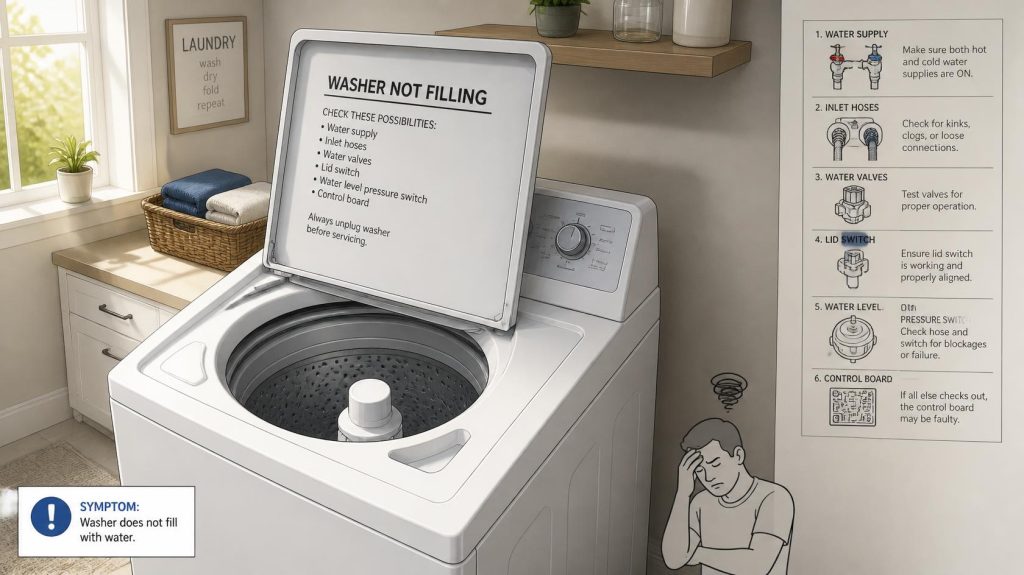
A step-by-step look at a real washer fill repair, from an empty tub to the fix
A washer that won’t fill isn’t always a valve problem, sometimes it’s mineral buildup, sometimes it’s the valve, and sometimes it’s both. Here is the exact diagnostic process our certified technicians used to work through it from the simplest cause to the actual fix.
Case Snapshot
Symptom
Won't fill, or fills very slowly
Appliance
Top-Load Washer
Location
Arlington Heights, IL
Diagnosis
Clogged inlet screens + failing valve solenoid
Time to Repair
Same visit, under 1 hour
Outcome
Fills reliably on every setting
The Problem
An Arlington Heights homeowner called Dara Appliance Repair after her top-load washer started a cycle and just sat there, barely any water entering the tub before the machine eventually stopped and displayed an error. It seemed to depend somewhat on which wash temperature she selected, though she wasn't entirely sure of the pattern.
She'd checked that the washer was plugged in and running, so the lack of water was clearly the actual issue.
The Diagnostic Process
Checked the water supply valves first
Our technician confirmed both the hot and cold supply valves behind the washer were fully open, ruling out the simplest possible explanation right away.
Inspected the inlet hose screens
The small mesh screens where the fill hoses connect to the washer were moderately clogged with mineral sediment, a common issue that restricts flow over time. The technician cleaned both thoroughly.
Retested fill performance
With clean screens, fill improved noticeably but was still inconsistent depending on the temperature setting selected, pointing to something beyond a simple screen clog.
Tested the water inlet valve
The inlet valve uses separate solenoids for hot and cold water. Testing revealed one solenoid wasn't opening reliably, explaining why fill performance varied by the temperature setting chosen.
Tested the pressure switch to rule it out
Since a faulty pressure switch can also cause fill problems by misreading water level, the technician tested it directly and confirmed it was sensing water level correctly, ruling it out as a contributing cause.
The Root Cause
Two factors compounding each other: mineral sediment restricting flow at the inlet screens, and a failing solenoid inside the water inlet valve that wasn't reliably opening for certain temperature settings. Clearing the screens alone improved things but didn't fully solve the inconsistent fill, since the valve itself was still the deeper issue. The pressure switch, a common suspect for fill problems, tested completely healthy.
The Fix
With both causes confirmed, our technician completed the repair in a single visit:
- Thoroughly cleaned both inlet hose screens, removing all mineral sediment
- Replaced the water inlet valve assembly with a manufacturer-spec part, covering both solenoids
- Left the pressure switch untouched, since it had already tested as fully functional
- Tested fill performance across hot, cold, and warm settings multiple times to confirm consistent, complete filling
The Result
The washer now fills fully and consistently no matter which temperature setting is selected. The $89 diagnostic fee was waived since the customer moved forward with the repair, and the repair is backed by our standard 3-month warranty. As a first-time customer, she also received 10% off the total repair cost.
Common Causes of a Washer Not Filling
| Cause | Signs | DIY-Fixable? |
|---|---|---|
| Closed or partially closed supply valve | No or very weak fill, the first thing worth checking | Yes, open the valve fully |
| Clogged inlet hose screens | Slow fill, often worsens gradually from mineral sediment | Yes, often an accessible cleanout |
| Failing water inlet valve (solenoid) | No fill, or fill only on certain temperature settings | No, replacement required |
| Faulty pressure switch | Washer may overfill, underfill, or not sense water level correctly | No, replacement required |
| Kinked or pinched fill hose | Slow fill, hose visibly bent behind the machine | Sometimes, reroute if accessible |
Brand-Specific Notes
PLACEHOLDER, pending Ben's input. Reminder: for luxury brands (Sub-Zero, Viking, Thermador, Gaggenau, Miele, Fisher & Paykel), use "experience across [brand]" language only, never factory-certification claims.
How to Prevent This
Periodically check and clean the inlet hose screens, especially in areas with hard water
Make sure supply valves are fully open, not just partially
Avoid kinking fill hoses when moving or reinstalling the washer
Address slow filling early, before it leads to a complete stoppage
Consider a water softener or filter if hard water is causing frequent sediment buildup
DIY vs. Call a Professional
Safe to Try Yourself
- Checking that both supply valves are fully open
- Cleaning the inlet hose screens (turn off the supply valves first)
- Checking for an obvious kink in the fill hose behind the machine
Call a Professional
- Fill problems continue after checking valves and cleaning the screens
- Water inlet valve testing or replacement
- Pressure switch diagnosis or replacement
- Fill issues tied to specific temperature settings
Frequently Asked Questions
Why won't my washer fill with water?
Could it just be a closed supply valve?
Why does my washer fill on some settings but not others?
Can I clean the inlet screens myself?
Is it the inlet valve or the pressure switch, and how can I tell?
How much does this repair cost?
How long does this repair take?
How can I prevent this from happening again?
Washer Not Filling With Water?
Same-day washer repair across Chicago and the suburbs. $89 diagnostic fee, waived when you book the repair.
Book a Repair Call (773) 377-4212