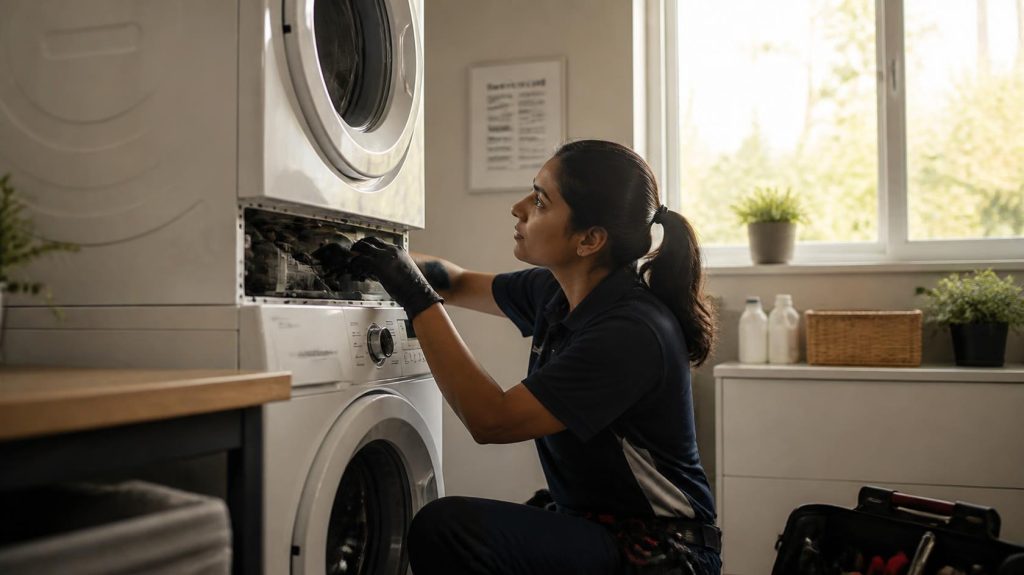
In a lot of Chicago condos and apartments, the laundry “room” is a closet. Sometimes it’s a hallway nook behind bifold doors, with a washer on the bottom, a dryer on top, and maybe two inches to spare on each side.
That setup saves floor space. It also changes how a repair works, from how a technician reaches the part to what happens if the washer leaks onto the unit below you.
This guide explains what’s different about stacked and compact laundry, the problems that show up most in tight spaces, and how to get your closet ready so the repair goes smoothly.
What’s Different About Stackable Washer Dryer Repair?
Expect more setup with stackable washer dryer repair than with a side-by-side pair. Technicians often need to pull the pair out of a tight closet, and some fixes mean lifting the dryer off the washer first. Compact and ventless models also have their own parts and maintenance needs, and a leak in a condo can affect neighbors below.
None of that means stacked units are bad machines. It just means the space around them matters as much as the parts inside them.
Which Kind of Stacked Laundry Do You Have?
“Stackable” covers a few different setups, and the type you own changes the repair. Check the model labels on each machine, or look at how the two are joined.
| Setup | How it’s built | Repair note |
|---|---|---|
| Stacked pair (full-size) | A separate front-load washer and dryer joined with a stacking kit | Some washer repairs need the dryer lifted off first |
| Laundry center (unitized) | One cabinet with a washer below and dryer above | Both machines share a frame, so access works differently than a stacked pair |
| Compact 24-inch stacked pair | Smaller European-style washer and dryer, often stacked in a closet | Often paired with a ventless dryer; parts can vary by brand |
| All-in-one washer-dryer combo | One drum that washes and dries | No stacking, but drying works like a ventless unit |
If you’re not sure which one you have, take a photo of the model labels before you call. It helps the technician bring the right tools and plan the job.
Why Chicago Closets Make Repairs Trickier
Chicago’s housing mix is a big part of this story. In many vintage courtyard buildings, two-flats, and older high-rises, in-unit laundry was added long after the building went up, wherever there was room. That’s how a lot of units end up in narrow closets with tight clearances.
Here’s what that means when something breaks.
Getting the machines out. In a tight closet, the technician may need to slide the pair forward, disconnect water and power, and sometimes separate the dryer from the washer. Trim, flooring edges, and doorframes can all get in the way.
Working at height. The dryer’s controls and top panel can sit well above shoulder height. Some dryer repairs can be done in place, while others are safer with the unit taken down.
Closet airflow. Dryers give off heat, and a closed closet traps it. One GE stacked-dryer manual we checked says closet doors must be louvered or otherwise ventilated, with at least 120 square inches of open area when the washer and dryer share a closet. Solid doors added during a remodel can make a dryer run hot.
Long or hidden vent runs. Vents in condos may run through walls or ceilings to reach an outside wall. Some buildings route dryer exhaust into a building duct that the association maintains. Either way, more vent length means more places for lint to build up.
The Problems We Check First on Stacked Units
Stacked and compact laundry can have the same problems as any washer or dryer. Tight spaces make a few of them more likely, or more urgent.
Vibration and walking. A stacked pair is tall, so an unbalanced washer can shake the whole tower. Worn feet, a floor that isn’t level, or a loose stacking kit can make it worse. The GE manual also warns that the dryer must be securely attached to the washer, and that a washer should never go on top of a dryer.
Leaks. In a single-family home, a slow washer leak might go unnoticed in the basement. In a condo or apartment, the water can reach the unit below. Check the hoses and the floor around the washer often, and know where your water shutoff valves are.
Slow drying. A vent hose behind a stacked unit can get crushed easily in a tight closet, because the machines get pushed back as far as they’ll go. The U.S. Fire Administration’s dryer safety flyer says to check the vent behind the dryer for crushing, damage, or blockages, and to make sure the outdoor vent flap opens while the dryer runs.
Overheating in the closet. Heat that can’t escape the closet can trip a dryer’s safety parts. If your dryer shuts off mid-cycle or the closet feels unusually hot, airflow is the first thing to check.
Ventless Dryers: Common in Condos, Different to Maintain
Many compact dryers are ventless, which suits condos and apartments that can’t run a vent to the outside. They come in two main types: condensing and heat pump.
ENERGY STAR notes that heat pump dryers don’t need an exterior vent and use around 70% less energy than conventional dryers. The tradeoff is that ventless models handle moisture differently, so they need their own kind of care.
- Clean every filter. Ventless dryers often have more than one lint filter. Check your manual for where they all are.
- Empty or check the water. Many ventless dryers collect water in a tank or send it to a drain. A full tank can stop the cycle.
- Clean the condenser. Some models have a condenser you rinse or wipe on a schedule. A clogged one makes drying slow.
- Expect longer cycles. Ventless dryers often take longer than vented ones. A cycle that’s suddenly much longer than usual is the real warning sign.
If a ventless dryer stops drying well after you’ve cleaned everything your manual lists, it’s time for a professional look.
How to Prepare for a Stacked Unit Repair
A little prep helps any appliance repair visit go faster, and it matters even more when there’s less room to work.
- Clear the path. Move shoes, baskets, and anything stored on top of or beside the machines. Leave a clear walkway from the door to the closet.
- Take off closet doors if you can. Bifold and louvered doors often lift off their tracks. If you’re not comfortable doing it, let us know when you book.
- Find the shutoffs. Know where the water valves and the electrical breaker for the laundry are.
- Note the model numbers. Photos of both labels help with planning and parts.
- Check building rules. Many high-rises and condo associations have rules for service visits, like reserving the service elevator or providing paperwork in advance. Ask your management office before the appointment and share what they require when you book.
- Renters, call your landlord first. If the laundry came with the unit, check your lease and talk to your landlord or property manager before booking a repair. Our post on refrigerator repair in a Chicago rental explains how that conversation usually works for building-supplied appliances.
Repair or Replace a Stacked Unit?
Replacing stacked laundry in a tight closet is rarely simple. New units have to fit the same width, height, and depth, and the old pair has to come out through the same hallways and doorways.
That’s one reason appliance repair is often worth a look first. A diagnosis tells you exactly what failed and what it will cost, so you can decide with real numbers instead of guesses.
For stackable washer dryer repair, our diagnostic fee is $89, waived when you go ahead with the repair. Most repairs fall between $129 and $400, and we quote the exact price before any work starts. Every repair comes with a warranty, and coverage depends on your appliance brand.
Frequently Asked Questions
Can you repair a stacked washer without unstacking it? Sometimes. It depends on the problem and the model. Some washer repairs can be done from the front, while others need the dryer lifted off first. A technician can usually tell you once they see the setup.
Why does my stacked washer shake so much? A tall stack magnifies vibration. Common causes include an unbalanced load, a floor or feet that aren’t level, a loose stacking kit, or worn parts inside the washer. Check the load and leveling first.
Are ventless dryers harder to repair? They’re not necessarily harder, but they’re different. They have condensers, water collection, and sometimes extra filters. Many slow-drying problems with ventless dryers come down to cleaning, so start with the steps in your manual.
Who pays for stackable washer dryer repair in a Chicago rental? That depends on your lease and who supplied the appliances. Talk to your landlord or property manager before you book. We can’t give legal advice, but your lease is the place to start.
Do you work in high-rise condo buildings? Yes. We service condos and apartments across Chicago. Check your building’s rules for service visits ahead of time so the appointment can start on schedule.
Can I replace my stacked laundry with a bigger set? Only if the space allows it. Measure the closet’s width, height, and depth, plus the doorways and hallways the machines will travel through. Check the new units’ manuals for the required clearances and closet ventilation.
Get Your Compact Laundry Running Again
Stacked and compact laundry make city living easier, right up until something stops working in a closet with no room to move. Knowing what kind of unit you have, keeping the vent and closet airflow clear, and prepping the space before a visit all make repairs simpler.
If you need stackable washer dryer repair anywhere in Chicago, from Rogers Park to Edgewater and across the city, we can help. You can also see our washer appliance repair and dryer appliance repair services.
Book online, contact our team, or call (773) 377-4212. We’re available seven days a week from 8 AM to 8 PM.