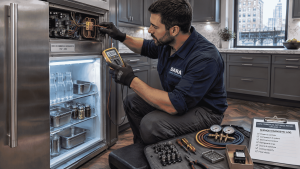
Frost is spreading across the back of your freezer, the fresh food side is creeping warmer, and you’ve already ruled out the door seal. Or maybe the opposite happened: the refrigerator suddenly went quiet and stopped cooling, even though the light still comes on.
Both can trace back to one small part, and both are common reasons Chicago homeowners call for appliance repair. On many frost-free refrigerators, a defrost timer decides when the appliance cools and when it defrosts. When that timer gets stuck, you get one of two very different problems.
This guide explains how the timer works, how to tell which way it failed, how to check it safely, and what the repair involves.
What Happens When a Refrigerator Defrost Timer Fails?
The defrost timer switches a frost-free refrigerator back and forth between cooling and defrosting. If it stops advancing while in cooling mode, frost builds on the evaporator coils until airflow is blocked. If it sticks in defrost mode, the compressor and fans stay off, so the refrigerator stops cooling altogether.
Either way, a refrigerator defrost timer failure looks like a cooling problem, but the cause is a timing problem. That difference matters, because the fix is usually one replaceable part, not the compressor or the sealed system.
How the Defrost Timer Runs the Cycle
A mechanical defrost timer is a small motor that slowly turns a set of contacts. As it turns, it sends power down one of two paths:
- Cooling mode. Power goes to the compressor and fans. The evaporator coils behind the freezer panel get cold, and the fan pushes that cold air through the freezer and into the fresh food section.
- Defrost mode. Power shifts to the defrost heater. The compressor and fans stop, the heater warms the coils, and the frost melts and drains away.
According to AppliancePartsPros’ refrigerator defrost guide, each timer cools for a set length of time and then defrosts for a shorter period, so ice never gets the chance to build up on the evaporator. On older models, it often sits behind the front kick panel. On many others, it’s in the control area inside the fresh food section.
Older refrigerators, the kind that often come with a rental or an older home, usually rely on this mechanical timer. Many newer models replace it with an electronic defrost control board that decides when to defrost on its own. The job is the same, so a defrost control failure on a newer fridge produces the same symptoms.
Two Ways a Defrost Timer Fails
The symptoms depend on where the timer stops.
Stuck in cooling mode
- Frost or solid ice builds on the back panel of the freezer.
- The fresh food section warms up gradually over days or weeks while the freezer stays frosty.
- The compressor keeps running, sometimes longer than usual.
- You may hear clicking or scraping as the fan blade hits ice.
Stuck in defrost mode
- The refrigerator stops cooling fairly suddenly.
- The compressor and fans go quiet, but the interior light still works.
- Both sections warm up together.
- You might hear dripping or a faint sizzle at first as the heater melts frost, then silence.
A timer can also fail in between, advancing some days and stalling on others. That’s why the problem sometimes seems to come and go before it gets worse.
If you’re seeing the frost pattern, our guide to evaporator coil frost buildup walks through how to read where the ice forms.
Is It the Timer or Something Else?
Several other parts can mimic a defrost timer failure, so it pays to rule out the look-alikes before you buy anything.
- Frost buildup, compressor running. The timer is a suspect, but so are the defrost heater and the defrost thermostat. All three stop the defrost cycle from melting the ice.
- No cooling, compressor silent. A timer stuck in defrost is one cause. A failed start relay or compressor is another, and that often comes with a repeating click. Here’s what a clicking sound before your fridge compressor starts can mean.
- Warm fridge, compressor running, little frost. That points away from the defrost system. Dusty coils are a common culprit, and our guide to dirty condenser coils shows how to clean them.
When your refrigerator defrost cycle is not working, the timer is only one of three possible parts. Guessing wrong means paying for a part that doesn’t solve the problem, which is how a simple appliance repair gets expensive.
How to Check a Mechanical Defrost Timer
If your refrigerator has a mechanical timer, two simple checks can point you in the right direction. Newer models with a control board don’t have a timer to turn, so skip ahead to the next section.
Safety first: Refrigerators run on household current. Work slowly, keep your hands away from wiring and terminals, and stop if you’re unsure. Unplug the refrigerator before removing any panel, and plug it back in only when the timer is exposed and nothing else is.
- Find the timer. Check your owner’s manual or search your model number online. Common spots are behind the front kick panel, inside the fresh food section near the temperature control, or at the back near the compressor.
- Find the advance slot. Most mechanical timers have a small slot or knob on the face that turns the timer by hand.
- Try the mark test. Make a small pencil mark on the slot and the housing, then check it again a few hours later. AppliancePartsPros notes that if the mark hasn’t moved, the timer’s motor or gears have likely failed and the timer is stuck.
- Try the advance test. With the refrigerator running, slowly turn the slot with a flat screwdriver in the direction it’s designed to turn until you hear a click. The compressor and fans should stop. Within a few minutes, you should hear the heater start working on the frost, often as a sizzle or crackle.
- Watch what happens next. A working timer moves back to cooling on its own after the defrost period, and the compressor starts again. If the refrigerator was not cooling and starts cooling again after you advance the timer out of defrost, a fridge defrost timer stuck in defrost is a strong suspect.
- Read the result honestly. If the compressor stops but the heater never comes on, the timer may be fine and the heater or defrost thermostat may be the problem. The advance test narrows things down. It doesn’t prove which part failed.
Don’t force the slot backward or turn it hard against resistance. That can break the timer.
Technicians can also test the timer’s internal contacts with a multimeter, using the wiring diagram for your model. Terminal layouts vary by brand, and the test involves removing the timer, so it’s a job best left to a technician unless you’re comfortable with appliance wiring.
What About Newer Refrigerators With a Control Board?
On many newer refrigerators, an electronic control board handles defrost instead of a mechanical timer. There’s no slot to turn and no mark to watch.
Some models include a diagnostic or forced-defrost mode, entered with a specific button sequence listed in the technical sheet for that model. Others need a technician’s tools to test. Control boards also cost more than mechanical timers, so replacing one on a hunch is an expensive way to guess.
If your refrigerator has a control board and shows the frost pattern or the sudden no-cooling pattern above, let a technician confirm the fault before any part is ordered.
What a Defrost Timer Repair Involves
When the timer really is the problem, the repair is usually straightforward:
- Confirm the diagnosis. The technician checks the timer, heater and defrost thermostat to make sure the right part gets replaced.
- Match the part. Defrost timers vary by model, so the replacement is matched to your refrigerator’s model number.
- Swap the timer. With the power off, the wires move from the old timer to the new one in the same positions.
- Clear the ice. If the evaporator coils are packed with ice, they need to be fully cleared. A new timer can’t restore airflow through coils that are still frozen solid.
- Test a full cycle. The technician confirms the refrigerator enters defrost, the heater works, and cooling resumes afterward.
Chicago’s humid summers put more moisture inside every refrigerator, so a defrost timer failure tends to show up faster when the air is muggy. A healthy timer and heater keep up with that extra frost. A stalled one falls behind quickly.
How Dara Handles Defrost Timer Failure
When you book appliance repair for a suspected defrost timer failure, tell us which pattern you’re seeing: frost building up, or a sudden stop in cooling. If you’ve tried the mark test or the advance test, tell us what happened. That information helps our technician get to the cause faster.
Darkhan, Dara’s owner, still goes out on repair calls himself, along with technicians like Sam and Dan. Whoever comes to your home will test the timer or control board, the defrost heater and the defrost thermostat before recommending a part, then explain what they found in plain English. You can see how our team works through a frost problem in our excessive frost buildup case study.
You’ll get the price before any work starts. Most repairs fall between $129 and $400, and your exact price depends on the issue. Every repair is backed by a warranty, with coverage terms that depend on your appliance brand.
Our refrigerator repair service covers all major and luxury appliance brands across Chicago and the surrounding suburbs, seven days a week from 8 AM to 8 PM.
Frequently Asked Questions
Can a bad defrost timer stop my refrigerator from cooling?
Yes. If the timer sticks in defrost mode, the compressor and fans stay off, so neither section gets cold air.
Does every refrigerator have a defrost timer?
No. Manual-defrost refrigerators and freezers don’t have one, and many newer frost-free models use an electronic control board instead of a mechanical timer.
Can I fix a stuck timer by turning it by hand?
Turning it can get the refrigerator through one cycle, but a timer that has stopped advancing will usually stick again. It’s a test, not a repair.
What’s the difference between a defrost timer and a defrost control board?
Both decide when the refrigerator defrosts. A timer does it mechanically on a fixed schedule. A control board does it electronically and may adjust the timing on its own.
Is a defrost timer repair worth it?
Often, yes. It’s a single replaceable part, and most repairs fall between $129 and $400. Your exact price depends on your model and what the technician finds.
Get the Right Part the First Time
Frost that keeps building, or a refrigerator that suddenly goes quiet, doesn’t have to mean a new appliance. Of all the problems a frost-free refrigerator can have, a defrost timer failure is one of the more fixable ones, as long as the diagnosis is right. Book online and we’ll find the part that failed, or contact our team if you have questions first.