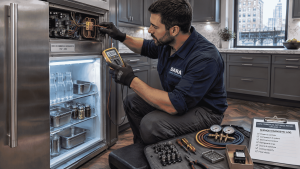

You defrosted the freezer last month. Maybe last week. The ice is already creeping back across the back panel, the ice cream is going soft, and the fresh food side feels warmer than it should. This is a refrigerator evaporator coil frost buildup.
If you’re stuck in that loop, the ice isn’t really the problem. It’s the evidence. When a frost-free refrigerator keeps icing up, you’re usually looking at evaporator coil frost buildup caused by a defrost system that has stopped doing its job, and no amount of manual defrosting will repair it.
This guide explains what the defrost system does, which parts fail, how to defrost safely in the meantime, and how to tell when it’s time for a real repair.
Why Do My Refrigerator’s Evaporator Coils Keep Icing Over?
On a frost-free refrigerator, the evaporator coils behind the freezer’s back panel collect frost whenever the compressor runs. A built-in defrost system melts it automatically. When the defrost heater, defrost thermostat, or the timer or control board running the cycle fails, frost keeps building until the coils freeze solid and block the cold air.
Manual defrosting melts that ice, so the fridge cools again for a while. But the failed part is still failed, so the ice comes back.
What the Evaporator Coils and Defrost System Do
The evaporator coils are the coldest part of your refrigerator. They sit behind a panel at the back of the freezer, where a small fan blows air across them and pushes that cold air into the freezer. On most frost-free models, some of it also travels through a vent into the fresh food section.
Every time the door opens, warm, moist air gets in. That moisture freezes onto the coils as a thin layer of frost. This part is normal.
The defrost system handles it. Every so often, cooling pauses, a heater warms the coils, and the frost melts. The water runs down a drain to a pan under the refrigerator, where it evaporates. When everything works, you never see it happen.
That’s why a refrigerator with a warm fresh food section and a frosty freezer is such a common complaint. The fresh food side depends on cold air passing through the coils, so it’s the first to suffer when ice blocks the way.
The Three Defrost Parts That Usually Fail
When the defrost system quits, one of three parts is usually behind it. All three produce the same symptom: evaporator coil frost buildup that returns after every defrost. That’s exactly why this problem gets misdiagnosed.
The Defrost Heater
The heater is a heating element mounted on or under the evaporator coils. During each defrost cycle, it warms up and melts the frost. If the element burns out, the cycle still starts on schedule, but nothing melts. Frost builds a little more each time, until the coils are buried.
The Defrost Thermostat or Sensor
This small part clips onto the coils and tells the system how cold they are. Depending on the model, it lets power reach the heater only when the coils are cold, then cuts power once they warm up. If it fails, the heater may never get power, even though the heater itself is fine.
The Defrost Timer or Control Board
Something has to decide when a defrost cycle starts and how long it runs. Older refrigerators use a mechanical defrost timer. Many newer models use an electronic control board instead. If the timer stops advancing or the board stops calling for defrost, the heater never gets the signal to turn on.
A Frozen Drain Can Mimic the Problem
Sometimes the defrost cycle works, but the meltwater has nowhere to go. If the drain clogs or freezes, the water pools and refreezes in the bottom of the freezer. On some models it can drip into the fresh food section instead. The fix is different, so it helps to know which pattern you’re seeing.
How to Read the Frost: Defrost Failure or Something Else?
Where the ice forms tells you a lot. Before you blame the defrost system, compare what you see with these patterns:
- Thick, even frost or solid ice on the back panel, with the fresh food side warming up. This points to the defrost system: the heater, the thermostat or sensor, or the timer or control board.
- A sheet of ice on the freezer floor, or water under the crisper drawers. This usually points to a clogged or frozen drain.
- Frost near the door edges, on the gasket or on the outside of food packages. This usually means humid air is getting in through a worn door seal, a door left ajar, or frequent openings. Our guide to basement freezers frosting over covers seal checks in detail.
- Frost around one vent, with uneven temperatures. Blocked airflow can cause this. The DOE’s Building America Solution Center notes in its refrigerator temperature guide that a frosted-over freezer vent can throw off temperatures.
- Clicking, scraping or ticking from the back of the freezer. That’s often the fan blade hitting ice that has grown into its path.
Chicago’s humid summers add moisture to every refrigerator. Whirlpool’s guide to condensation and frost notes that some frost is normal in humid months, especially in homes without air conditioning. But humidity alone doesn’t cause evaporator coil frost buildup that packs the coils solid. A working defrost system clears normal frost. When ice keeps winning, the defrost cycle isn’t keeping up.
Why Manual Defrosting Isn’t a Real Fix
Defrosting by hand clears evaporator coil frost buildup for now and resets the clock. Then the same failed part lets the ice build again.
If your freezer needs defrosting constantly, the timing is actually useful. When the refrigerator cools normally after a full defrost and then slowly loses ground over the next few days or weeks, that pattern points toward a defrost part. It tells a technician the cooling side of the system is probably doing its job.
Living with the workaround has real costs, though. Food sits in coolers while you wait for the ice to melt. Meltwater ends up on the floor. And the temptation to speed things up with a knife or screwdriver can puncture the coils, which turns a defrost repair into a refrigerant leak.
How to Manually Defrost a Frost-Free Freezer Safely
If you need the refrigerator working until an appliance repair visit, a careful manual defrost buys time. Here’s how to do it without causing new damage.
What you’ll need:
- Coolers and ice packs for your food
- Old towels and a couple of shallow pans
- A heatproof bowl of hot tap water
- A fan
- An appliance thermometer
Safety first: Unplug the refrigerator or switch off its breaker before you start. Keep cords and outlets away from meltwater. Don’t remove the back panel inside the freezer: there’s wiring and sharp metal behind it.
- Move your food to coolers. Pack frozen food tightly with ice packs so it stays as cold as possible.
- Cut the power. Unplug the fridge or turn off its breaker.
- Prop both doors open. Take out the freezer shelves and bins you can remove easily.
- Protect the floor. Lay towels on the floor in front of the fridge and on the bottom of the freezer, and set shallow pans where water collects.
- Speed things up safely. Set a bowl of hot tap water on a towel inside the freezer and close the door for a few minutes, then refill it as it cools. A fan aimed into the open freezer also helps.
- Don’t chip, pry or heat. Never use knives, screwdrivers or ice picks on the ice. Skip heat guns, open flames and hair dryers, which can warp plastic liners and bring electricity close to water.
- Wait until every bit of ice is gone. Ice behind the panel melts last. Depending on how much there is, this can take several hours or run overnight. A partial defrost brings the ice back faster.
- Dry everything. Wipe up the water, wring out the towels and dry the shelves before putting them back.
- Power up and let it cool. Plug the fridge back in and let it cool down before restocking. Use a thermometer: the PNNL guide recommends 0°F or lower for the freezer and below 40°F for the fresh food side.
- Write down the date. If the ice comes back, how quickly it returns is useful information for a technician.
When Icing Means It’s Time for a Real Repair
A manual defrost is a stopgap. Call for appliance repair when you notice any of these:
- Ice returns within days or weeks after a complete defrost.
- The fresh food section warms up while the freezer stays frosty.
- You hear clicking, scraping or buzzing from behind the freezer panel.
- Water collects on the freezer floor or under the crisper drawers.
- The ice keeps forming even after you’ve checked the door seal and changed door habits.
- You smell burning or the breaker trips. Unplug the refrigerator and leave it off.
Finding the failed part means testing the heater, the thermostat or sensor, and the timer or control board, usually behind the freezer panel near live wiring. That’s a job for a technician. It also saves money: since all three parts cause the same ice, replacing parts by guesswork often means buying the wrong one first.
How Dara Diagnoses Refrigerator Evaporator Coil Frost Buildup
When you book, tell us when you last defrosted and how fast the ice came back. That timeline helps our technician focus on evaporator coil frost buildup instead of starting from scratch.
Darkhan, Dara’s owner, still goes out on repair calls himself, along with technicians like Sam and Dan. Whoever comes to your home will check the defrost heater, the thermostat or sensor, the timer or control board, and the drain, rather than just melting the ice and leaving. You can see that process step by step in our excessive frost buildup case study.
You’ll get the price before any work starts. Most repairs fall between $129 and $400, and your exact price depends on the issue. Every repair is backed by a warranty, with coverage terms that depend on your appliance brand.
Our freezer repair service covers all major and luxury appliance brands across Chicago and the surrounding suburbs, seven days a week from 8 AM to 8 PM. For refrigerators with a warm fresh food side, see our refrigerator repair service too.
Frequently Asked Questions
Is some frost in a frost-free freezer normal?
A thin, light layer that comes and goes can be normal, especially in humid weather. Thick frost or solid ice on the back panel isn’t.
Can I just keep defrosting the freezer myself?
You can as a short-term workaround, but the failed part stays failed and the ice will return. Each round puts food at risk, and chipping at the ice can damage the coils.
Why are my freezer coils frozen solid when the freezer still feels cold?
The area near the coils can stay very cold even while ice chokes off the airflow. That’s why the fresh food section usually warms up first.
How long does a manual defrost take?
It depends on how much ice has built up. Plan on several hours, and sometimes overnight, so all the ice behind the panel melts.
Does Chicago humidity cause refrigerator ice buildup on the evaporator?
Humidity adds moisture, so you’ll see more frost in summer. A working defrost system still clears it. Ice that keeps building points to a defrost problem, not just the weather.
Stop Defrosting, Start Fixing
If you’ve been fighting evaporator coil frost buildup on a schedule, your refrigerator has been telling you something. Ice that keeps returning is a parts problem, and it’s usually a fixable appliance repair. Book online and we’ll find the part that failed, or contact our team with questions first.