
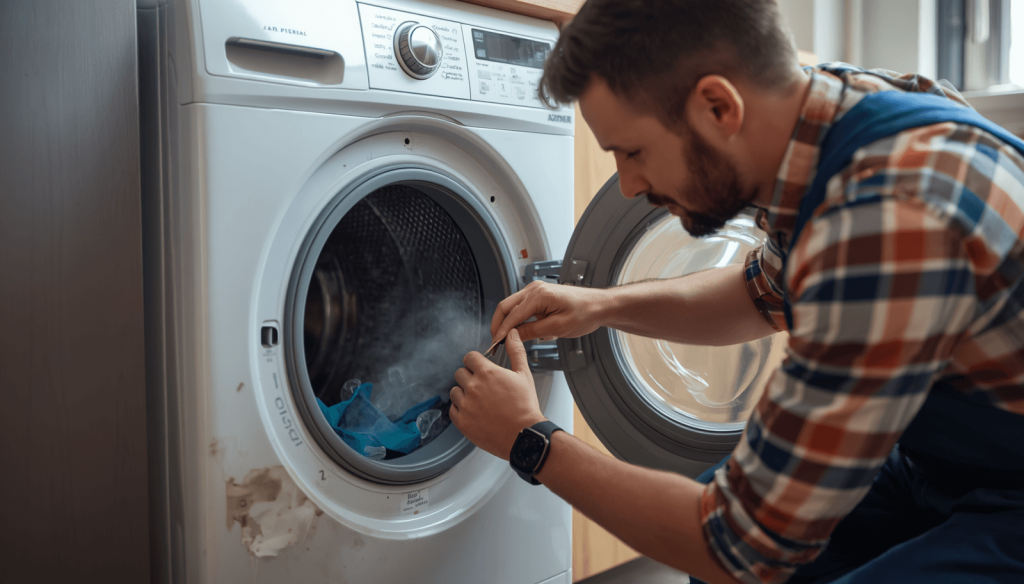
By the Dara Appliance Repair Team | Certified appliance technicians serving Chicago and the surrounding suburbs, 4.9 stars on Google
If your washing machine smells musty every time you open the door, you are not imagining it, and you are not the only one dealing with it. Washing machine smells musty Chicago complaints spike every year between June and August, and it is not a coincidence. Chicago’s humid summers combine with how front-load washers are built to create exactly the damp, sealed, dark environment mold and mildew need to grow. The good news is that most of this is fixable with a cleaning routine most owners never knew they needed. The less good news is that sometimes the smell is not about cleaning at all. It is a seal or drain problem, and this guide will help you tell the difference.
Quick Answer: A musty washing machine smell in Chicago is usually caused by trapped moisture in the door gasket and detergent drawer, made worse by summer humidity and closing the washer door right after a cycle. Wiping the gasket dry, running a monthly hot cleaning cycle, and leaving the door open between loads solves it in most homes. If the smell persists after a consistent cleaning routine, or comes with visible water pooling, a torn gasket, or standing water in the drum, that points to a seal or drain problem that needs a professional repair rather than another cleaning cycle.
Chicago Weather Fact: Chicago’s average summer relative humidity runs around 68 percent, with individual July days commonly climbing into the high 70s and 80s. The EPA’s own guidance identifies humidity above 60 percent as the threshold where indoor mold risk rises sharply. Most Chicago summer days sit above that line, which is exactly why front-load washers here develop odor faster than the same machine would in a drier climate.
In This Guide
- Why Chicago’s Humid Summers Make This Worse
- Why Front-Load Washers Are More Prone to Odor
- The Monthly Cleaning Routine That Fixes Most Musty Smells
- Habits That Make the Smell Worse
- Brand-Specific Notes: LG, Samsung, Whirlpool, and Maytag
- When It’s Not the Cleaning: Signs of a Failing Seal or Drain Issue
- DIY Fix vs. Professional Repair
- What We See Across Chicago Homes
- Prevention Checklist
- FAQ
Why Chicago’s Humid Summers Make This Worse
Mold and mildew need three things to grow: moisture, warmth, and a lack of airflow. A front-load washer sitting in a Chicago laundry room in July provides all three at once. The EPA’s guidance on mold and moisture is direct about this: indoor mold risk increases substantially once relative humidity climbs above 60 percent, and ideally indoor humidity should stay between 30 and 50 percent. Chicago’s summer air regularly runs well past that threshold, and most laundry rooms and basements, especially in older two-flats and bungalows without dedicated dehumidification, hold onto that moisture even more than the rest of the house.
Add a washer that traps water inside a rubber gasket and a sealed drum, and close the door right after the cycle ends, and you have created a small, warm, dark, humid box. That is a mold incubator, not a design flaw exactly, but a predictable outcome of pairing this appliance design with this climate.
It’s worth being direct about one thing: routine mold and mildew inside a washer is an odor and appliance maintenance issue for almost everyone, but if mold growth is heavy, visible beyond the gasket, or a household member has asthma, allergies, or a compromised immune system, that is worth mentioning to a doctor rather than assuming a cleaning routine has fully addressed it.
Why Front-Load Washers Are More Prone to Odor
Top-load washers rarely have this problem, and the reason comes down to basic design. A top-load drum sits open to the air and drains by gravity with no rubber seal holding water against the drum. A front-load washer relies on a rubber door gasket to create a watertight seal during the cycle, and that same gasket has folds and creases that trap water, lint, hair, and detergent residue after the cycle ends.
Every fold in that gasket becomes a place where a thin film of water sits undisturbed for hours or days, especially if the door gets closed right away. Combine that with modern low-water, cold-wash cycles that use less water and lower temperatures than washers did a generation ago, and there is simply less hot water flowing through the machine to rinse away detergent film and biofilm on a regular basis. Front-load washers are more water and energy efficient, but that efficiency is part of why they need a specific cleaning routine that top-load owners never had to think about.
The Monthly Cleaning Routine That Fixes Most Musty Smells
This routine resolves the large majority of musty smell complaints without needing a technician.
After every wash:
- Wipe the inside of the rubber door gasket dry with a clean cloth, paying attention to the folds where water collects.
- Remove the detergent and fabric softener drawer and let it air dry separately rather than pushing it back in wet.
- Leave the washer door open for at least a few hours, or until the drum is fully dry, instead of closing it right after unloading.
Once a month:
- Run an empty cycle on the hottest setting with either a washing-machine cleaning tablet or two cups of white vinegar poured directly into the drum.
- If odor is already noticeable, follow with a second empty hot cycle using a quarter cup of baking soda. This second pass dissolves detergent film and biofilm built up on the drum, gasket, and drain pump that the first cycle and normal washes do not fully clear.
Most manufacturers recommend this monthly cleaning cycle regardless of climate. In Chicago, given the added humidity load in summer, doing it every two to three weeks from June through August keeps most machines odor-free through the season.
Still smelling musty after a full cleaning cycle? Call (773) 377-4212 for a same-day diagnostic.
Habits That Make the Smell Worse
A few common habits quietly work against everything above, even in an otherwise well-maintained washer:
- Using too much detergent. Modern high-efficiency detergent is concentrated, and using a regular amount leaves excess residue that does not fully rinse out, feeding mold and mildew in the gasket and drum.
- Washing exclusively on cold, low-water cycles. These cycles are efficient but do not generate enough heat or water volume to rinse away biofilm the way a periodic hot cycle does.
- Leaving wet laundry in the drum for hours. A forgotten load sitting damp in a sealed, humid Chicago laundry room is one of the fastest ways to develop odor, sometimes within a single afternoon in peak summer humidity.
- Skipping the drawer. The detergent and fabric softener dispenser is one of the most overlooked odor sources because it is out of sight, and it is also one of the easiest to clean since most models pull out by hand for a simple rinse.
Brand-Specific Notes: LG, Samsung, Whirlpool, and Maytag
Front-load brands handle odor prevention differently, and knowing your machine’s specific behavior can save a diagnostic call.
LG and Samsung front-loaders typically include a self-clean or “tub clean” cycle built into the control panel, along with a vent light or indicator that reminds owners to run it periodically. Many models also prompt owners to leave the door and detergent drawer open after each cycle directly on the display. If that light or reminder keeps appearing shortly after you’ve run the cycle, it usually means the cycle is being skipped or the drawer isn’t being left open, not that the machine has a mechanical fault.
Whirlpool and Maytag front-loaders are the two brands most associated with Affresh, a widely available washer-cleaning tablet designed specifically for their drum and gasket design. Both manufacturers recommend running an Affresh cycle monthly, and in Chicago’s summer humidity, the two to three week interval mentioned above applies especially to these machines.
Across all brands, a persistent odor warning that returns shortly after a cleaning cycle is a signal worth treating seriously rather than dismissing as a sensor quirk.
When It’s Not the Cleaning: Signs of a Failing Seal or Drain Issue
If you have kept up with the routine above and the smell keeps coming back, or shows up alongside other symptoms, the cause has likely moved past routine mold and mildew into a mechanical problem. Here is what to watch for:
- The gasket looks torn, cracked, or has a section that will not seal fully. A damaged gasket trades a controllable moisture problem for a chronic one, since water sits against a compromised seal every single cycle and cannot be reliably wiped dry.
- Water pools underneath the washer after cycles. This usually points to a failing door seal, a cracked drain hose, or a clogged drain pump filter, all of which leave standing water somewhere it should not be.
- Standing water remains in the drum or the rubber gasket folds even after the cycle finishes. A properly draining washer should leave the drum essentially dry within a short window after the final spin. Water that lingers usually means the drain pump or drain hose is partially blocked.
- The smell returns within a day or two of a thorough cleaning, every time. Fast-returning odor after a real cleaning effort usually means water is getting trapped somewhere the cleaning routine cannot reach, most often inside the drain pump filter or a low point in the drain hose.
- You hear a different sound during drain or spin, such as gurgling, straining, or a rattle. This often accompanies a drain blockage or a pump working harder than it should against debris.
Unlike surface mold on the gasket, a failing seal or a clogged drain filter is not something a vinegar cycle can fix, since the moisture source is mechanical rather than a coating that needs dissolving. At that point, professional washer repair in Chicago addresses the actual source instead of masking it for a few days at a time.
DIY Fix vs. Professional Repair
| Symptom | Try This Yourself | Call for Repair |
| Musty smell after normal use | Wipe gasket dry, leave door open, run monthly hot cleaning cycle | Not yet |
| Smell persists after 2-3 cleaning cycles | Clean detergent drawer, switch some loads to hot | If unresolved after a full month |
| Water pooling under the washer | Check for a loose drain hose connection | Yes, likely a seal or hose issue |
| Gasket visibly torn or cracked | None, a damaged gasket cannot be repaired with cleaning | Yes |
| Standing water in drum after cycle ends | Check and clear the drain pump filter if accessible | If filter is clear and water still remains |
| Smell returns within a day or two, repeatedly | None, this signals a mechanical moisture source | Yes |
When the source of moisture has moved from the surface of the gasket to the drain system or the seal itself, professional washer repair in Chicago is the point where the problem actually gets fixed, rather than temporarily masked for a few days.
Water pooling, a torn gasket, or a smell that won’t go away? Our certified technicians offer same-day diagnostics across Chicago. Call (773) 377-4212 or book a diagnostic with our washer repair team.
What We See Across Chicago Homes
Across repair calls in neighborhoods like Portage Park, Albany Park, and Lincoln Square, our technicians see the same pattern every summer: a homeowner has been closing the washer door right after each load for months without issue, and then Chicago’s July humidity pushes an already-marginal moisture situation into a persistent odor problem seemingly overnight. In most of these calls, the fix is the cleaning routine above. In a smaller but consistent share, the technician finds a gasket that has already started to crack from age, usually in machines seven to ten years old, where the rubber has lost enough flexibility that it can no longer fully dry out between uses. At that point, cleaning products only mask the smell for a day or two before it returns, and gasket replacement is the actual fix.
Humidity is not limited to washing machines. It is worth knowing that the same seasonal moisture load affects other water-using appliances too, and if you are also noticing white film or spotting on dishes, that is a related but separate hard water issue covered in our complete guide to dishwasher hard water in Chicago.
Prevention Checklist
Bookmark this list for the summer months, when the odor risk is highest:
- Door gasket wiped dry after every wash
- Detergent and fabric softener drawer removed and air-dried after every wash
- Washer door left open between loads
- Monthly hot cleaning cycle, or every 2 to 3 weeks in peak summer humidity
- Detergent amount checked against the high-efficiency line, not the regular-detergent line
- Gasket visually checked for cracks or tears every few months
- Drain pump filter checked if the model has an accessible one
FAQ: Washing Machine Smells Musty Chicago Questions
Why does my washing machine smell musty even though I clean it? The most common reason is that the cleaning covers the drum but skips the gasket folds and detergent drawer, which are the two spots where water most often gets trapped. Add both to a full cleaning routine before assuming the machine has a mechanical problem.
Does vinegar actually get rid of washing machine odor? Yes, for surface mold and mildew. A cup or two of white vinegar run on an empty hot cycle dissolves biofilm and detergent residue effectively. It will not fix odor caused by a torn gasket or a clogged drain, since those are mechanical moisture sources rather than a coating vinegar can dissolve.
Is it safe to leave my washer door open between loads? Yes, and manufacturers generally recommend it. Leaving the door open lets the drum and gasket dry out fully between uses, which is one of the simplest and most effective ways to prevent mold growth in the first place.
Can a musty smell in the washer transfer to my clothes? Yes. If the drum, gasket, or dispenser has mold or mildew growing in it, that odor transfers to fabric during the wash cycle, which is often the first sign homeowners notice before they realize the machine itself is the source.
Is a moldy washing machine bad for my health? For most households, washer mold is a cleaning and maintenance issue rather than a health emergency, and the routine in this guide resolves it. That said, if mold growth is visible and extensive, or if someone in the home has asthma, allergies, or a weakened immune system, it is worth mentioning to a doctor and treating the cleaning as a priority rather than an optional chore.
How often should I run a cleaning cycle in the summer? Most manufacturers recommend monthly. In Chicago’s high summer humidity, every two to three weeks from June through August keeps most machines from developing odor in the first place.
What does it mean if water is left in the drum after the cycle finishes? This usually means the drain pump filter is partially clogged or the drain hose has a kink or blockage, preventing the washer from fully draining. It’s a mechanical issue, not a cleaning issue, and it’s worth checking the filter before assuming it needs a technician.
When should I call for washer repair instead of continuing to clean it myself? If the smell returns within a day or two of a thorough cleaning routine on a repeated basis, if you see water pooling under the washer, or if the door gasket is visibly torn or cracked, the moisture source has moved past what cleaning can fix and it’s time for a professional diagnostic.
Our certified appliance technicians serve Chicago and the surrounding suburbs, including Evanston, Skokie, Park Ridge, Niles, Glenview, Wilmette, Northbrook, Deerfield, Highland Park, Des Plaines, Oak Park, Berwyn, Cicero, and Lincoln Park. The business holds a 4.9-star Google rating, and the $89 diagnostic fee is waived with any completed repair. Call (773) 377-4212 or visit dara-repairllc.com to schedule.