Every Chicago Homeowner Has Been There
It’s 9 PM, the fridge is humming louder than usual, and you’re three tabs deep into “how to fix my fridge” instead of calling anyone. That instinct isn’t wrong. This guide breaks down the five DIY refrigerator repair Chicago homeowners attempt most often, tells you honestly which fixes are safe, and draws a clear line at the point where trying it yourself turns risky for your appliance, your warranty, and sometimes your safety.
In This Article
- Problem 1: The Door Seal (Safe to DIY)
- Problem 2: Dirty Condenser Coils (Safe to DIY)
- Problem 3: The Thermostat Reset (Safe, With Limits)
- Problem 4: The Water Filter (Safe to DIY)
- Problem 5: Leveling the Refrigerator (Safe to DIY)
- DIY Refrigerator Repair Chicago Homeowners Can Trust: A Comparison Table
- Why Chicago’s Water and Weather Make This Worse
- Brand-Specific Warranty Warnings
- Prevention Checklist
- FAQs
Chicago Homeowners Are Dealing With Harder Water Than They Think
Chicago’s tap water runs hard: roughly 130 to 150 ppm, or about 7.6 to 8.8 grains per gallon, drawn from Lake Michigan City of Chicago Department of Water Management. That mineral load doesn’t just build up in coffee makers. It scales up inside water filters and ice maker lines, which is exactly why replacing the water filter is one of the most common appliance repair jobs Chicago households attempt themselves, and one of the few that’s genuinely safe to handle without a technician.
Problem 1: The Door Seal, Safe to DIY
A worn door gasket is one of the most common reasons a refrigerator runs constantly but never quite feels cold enough. When the seal fails, cold air leaks out, warm air leaks in, and the compressor has to work overtime to compensate. This is often the first thing homeowners search for when troubleshooting refrigerator repair at home.
How to check it: Close the door on a dollar bill so it’s half in, half out. If it slides out with little resistance, the seal isn’t doing its job. ENERGY STAR-style efficiency guidance recommends running this test at several points around the door frame, since gaskets often wear unevenly at the corners before the rest of the seal shows damage.
What’s safe to DIY:
- Testing the seal with the dollar-bill method
- Cleaning the gasket with warm water and mild soap to remove grime and food residue
- Ordering a manufacturer-specific replacement gasket and snapping it into the retaining channel (most modern gaskets are designed for tool-free replacement)
When to stop: If the door itself is warped, if the hinges are misaligned, or if the seal looks fine but the fridge still won’t hold temperature, the problem usually isn’t the gasket at all. It may be a refrigerator not cooling issue with the sealed system.
Problem 2: Dirty Condenser Coils, Safe to DIY
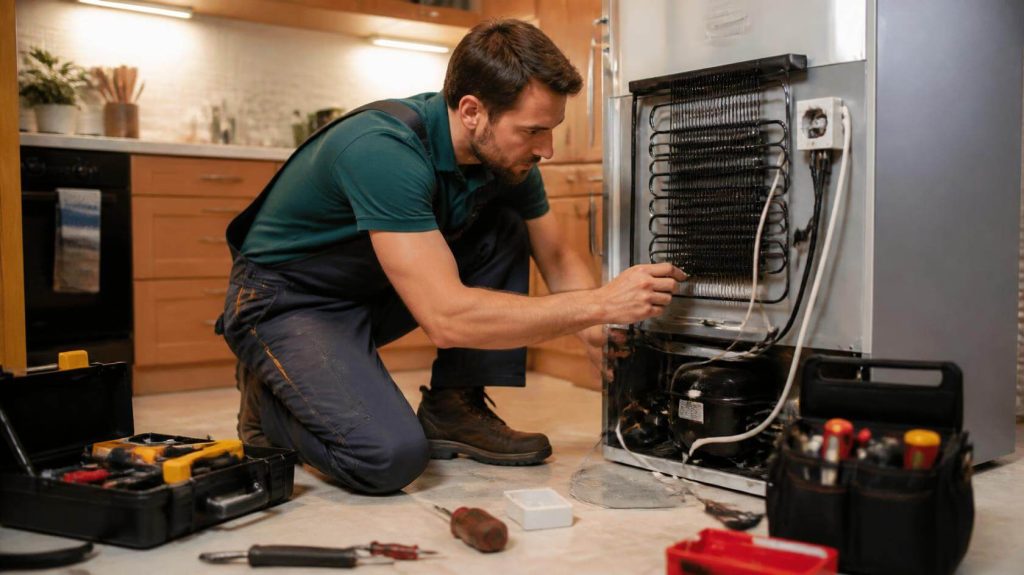
Condenser coils sit either behind the refrigerator or along the bottom, and their job is to release the heat that gets pulled out of the fridge’s interior. In Chicago apartments and older homes, dust, pet hair, and lint build up fast, especially in units tucked into tight kitchen nooks with poor airflow. Dirty coils force the compressor to run longer and hotter, which is one of the most common root causes behind an appliance repair call that could have been avoided.
What’s safe to DIY:
- Unplugging the unit before doing anything
- Pulling the fridge away from the wall and vacuuming the coils with a brush attachment or a dedicated coil-cleaning brush
- Doing this twice a year, more often if you have pets
When to stop: If the coils are clean but the compressor still runs constantly, or if you notice a burning smell, oil residue near the coils, or the compressor cycling on and off rapidly, that points toward a compressor or refrigerant issue. Those repairs require EPA Section 608 certification to legally handle, since they involve opening a sealed refrigerant system. This is not a DIY job, full stop.
Problem 3: The Thermostat Reset, Safe With Limits
A refrigerator that’s running warm is often blamed on the thermostat first, and sometimes that’s the actual fix. Bumping the dial, power-cycling the unit, or resetting it through the digital control panel resolves a surprising number of temperature complaints, especially after a power outage or a breaker trip, something Chicago homeowners deal with more than most during summer storm season.
What’s safe to DIY:
- Adjusting the temperature dial or digital control to the manufacturer-recommended range (typically 37°F for the fridge, 0°F for the freezer)
- Unplugging the unit for 60 seconds and plugging it back in to force a full reset
- Waiting 24 hours after any adjustment before troubleshooting further, since refrigerators take time to stabilize
When to stop: If you’ve reset the thermostat and waited a full day and the temperature still won’t hold, the thermostat itself may have failed, or the compressor, evaporator fan, or defrost system may be the real culprit. Diagnosing which one requires pulling panels and testing electrical components, and at that point, guessing tends to turn a manageable repair into a far bigger one.
Problem 4: The Water Filter, Safe to DIY
Given how hard Chicago’s water runs, water filters clog faster here than in a lot of other markets. A clogged filter shows up as slow ice production, a weak water dispenser stream, or water that tastes off. This is about as low-risk as refrigerator maintenance gets.
What’s safe to DIY:
- Locating the filter (usually in the grille, the upper right interior corner, or the back panel, depending on the model)
- Twisting or pulling it out per the manufacturer’s release mechanism
- Replacing it with the correct manufacturer-specified filter every 6 months, sooner given Chicago’s mineral content
- Flushing a few gallons of water through the new filter before drinking from it, to clear out carbon dust
When to stop: If you’ve replaced the filter and the ice maker still isn’t producing, or the ice maker cycles but never fills, the issue is likely a frozen or clogged water line, sometimes fixable with a controlled defrost, but sometimes a sign of a failing inlet valve.
Problem 5: Leveling the Refrigerator, Safe to DIY
An unlevel refrigerator doesn’t just look off. It causes doors that don’t seal properly, water that pools instead of draining, and compressors that run harder than they should. Chicago’s older housing stock, with its settled floors and uneven subflooring, makes this more common than people expect.
What’s safe to DIY:
- Using a bubble level across the top of the fridge, front-to-back and side-to-side
- Adjusting the front leveling legs (usually turned by hand or with a wrench) until the unit is level, with a very slight backward tilt so the doors swing shut on their own
- Rechecking after any flooring work or appliance move
When to stop: If the fridge is level but still leaking water onto the floor, the problem is more likely a clogged defrost drain or a failing water line than a leveling issue, and chasing it further without the right tools tends to just move the mess around.
DIY Refrigerator Repair Chicago Homeowners Can Trust: A Comparison Table
The table below sums up which of these jobs belong on a DIY list and which ones belong to a certified appliance technician.
| Repair | Safe to DIY? | Risk of DIY | When It Needs a Pro |
| Door seal / gasket | Yes | Low | Warped door, hinges misaligned, seal fine but fridge still won’t cool |
| Condenser coil cleaning | Yes | Low | Compressor runs constantly after cleaning, burning smell, oil residue |
| Thermostat reset | Yes | Low | No change after 24 hours, error codes persist |
| Water filter replacement | Yes | Low | Ice maker still fails after new filter, frozen water line |
| Leveling | Yes | Low | Level but still leaking, suggesting a drain or valve issue |
| Compressor repair or replacement | No | High: voids warranty, and refrigerant handling requires EPA certification | Always |
| Refrigerant line work (recharging, sealing leaks) | No | High: illegal without EPA Section 608 certification | Always |
| Evaporator/condenser fan motor replacement | No | Medium-High: electrical risk, easy to damage surrounding components | Recommended |
| Defrost heater or control board repair | No | Medium-High: electrical risk, misdiagnosis is common | Recommended |
| Ice maker module replacement (built-in units) | Caution | Medium: often tied into water line and electrical | Recommended for premium/built-in units |
Why Chicago’s Water and Weather Make This Worse
Two local factors push Chicago refrigerators into trouble faster than average. First, the hard water discussed above accelerates filter clogging and can contribute to mineral buildup around water lines and ice maker components over time. Second, Chicago’s humid summers and dry winters put extra strain on door seals: heat and humidity soften and warp rubber gaskets faster, while winter’s dry indoor heat can make them brittle. Together, these two factors are exactly why DIY refrigerator repair Chicago homeowners attempt often needs to happen on a shorter cycle than the same maintenance would in a milder, drier climate.
Brand-Specific Warranty Warnings
Not every refrigerator brand treats DIY repair the same way, and this is where a lot of well-intentioned homeowners accidentally put their coverage at risk.
- Samsung and LG: Both brands’ standard warranties typically cover parts and labor for a set period, but that coverage is voided the moment a non-authorized technician opens the sealed refrigerant system or replaces a compressor. Door seals, water filters, and coil cleaning are generally fine.
- Whirlpool, GE, Maytag: Similar structure. Cosmetic and maintenance-level fixes are safe, but any repair involving the compressor, sealed system, or main control board should go through an authorized technician while the unit is under warranty.
- Sub-Zero and Viking: These dual-refrigeration systems are more complex than standard units, and warranty terms are often stricter about who can touch internal components. Even filter and gasket work should follow the manufacturer’s documented process closely.
If your refrigerator is still under manufacturer warranty, it’s worth reading the fine print before attempting anything beyond the five DIY-safe fixes above. A repair you handle yourself in the wrong spot can end up voiding coverage on a much larger refrigerator warranty repair down the road.
Prevention Checklist: Keep the DIY List Short
- [ ] Vacuum condenser coils every 6 months
- [ ] Run the dollar-bill door seal test seasonally, especially after summer humidity and winter dry heat
- [ ] Replace the water filter every 6 months (sooner in hard-water areas like Chicago)
- [ ] Recheck leveling after any flooring work, moves, or appliance shifts
- [ ] Keep the fridge stocked at roughly 75% capacity; it helps hold temperature more efficiently
- [ ] Leave a few inches of clearance behind and above the unit for airflow
- [ ] Note any error codes and the approximate date they started, so a technician has a head start if you do need to call one
Frequently Asked Questions
Which DIY refrigerator repair Chicago jobs are safe to attempt? Five of them are genuinely low-risk: door seal replacement, condenser coil cleaning, thermostat resets, water filter swaps, and leveling. None of these involve the sealed refrigerant system or main electrical components, so they carry low risk to you and the appliance.
What refrigerator repairs void the manufacturer warranty? Almost anything involving the sealed refrigerant system (compressor, condenser, evaporator, refrigerant lines) done by someone without proper certification. Most manufacturers also flag unauthorized repairs to the main control board or electrical components as a refrigerator warranty repair violation. Door seals, filters, and coil cleaning are typically exempt.
Why is my refrigerator running but not cooling? A refrigerator not cooling properly can stem from several causes: dirty coils, a bad door seal, a failed thermostat, or a more serious compressor or refrigerant issue. Start with the safe DIY checks in this guide; if none of them resolve it, the cause is likely deeper in the sealed system.
Can I recharge my own refrigerator’s refrigerant? No. Handling refrigerant requires EPA Section 608 certification by federal law, regardless of your comfort level with other appliance repairs. This isn’t a gray area. It applies to anyone opening a sealed refrigerant system, DIYer or not.
How do I know if my door seal actually needs replacing? Run the dollar-bill test at several points around the door, not just one spot. If the bill slides out easily anywhere along the perimeter, especially at the corners, the seal needs attention. A visual check for cracking, flattening, or mold is worth doing alongside it.
Is it worth replacing the water filter myself, or should I call someone? Filter replacement is one of the safest, lowest-risk fixes on this list. It typically takes under five minutes and doesn’t require tools for most models. This is a solid one to always DIY.
My refrigerator is leaking water. Is that a DIY fix? Sometimes. If it’s due to being unlevel, a quick adjustment with a bubble level usually solves it. If it’s a clogged defrost drain or a failing water inlet valve, it’s a more involved repair that’s easy to make worse without the right approach.
When should I just call a professional instead of troubleshooting further? Once you’ve worked through the five safe DIY checks in this guide and the problem persists, or if you notice burning smells, oil near the coils, rapid compressor cycling, or error codes that don’t clear, that’s the point where continuing to troubleshoot risks turning a moderate repair into a total loss.
When You’ve Hit Your Limit, We’re One Call Away
Trying the safe fixes first is smart, not something to feel behind on. But once a refrigerator problem crosses into the sealed system, the compressor, or the electrical components behind the control panel, that’s exactly the point where trying more DIY refrigerator repair Chicago fixes stops helping and starts putting your appliance and your warranty at risk. Dara Appliance Repair serves Chicago and 14 surrounding suburbs, including Evanston, Skokie, Park Ridge, and Oak Park, with certified appliance technicians who diagnose the problem correctly the first time. Diagnostic visits are $89, waived when you move forward with the repair, and first-time customers get 10% off their first repair. Schedule your appointment or call (773) 377-4212.