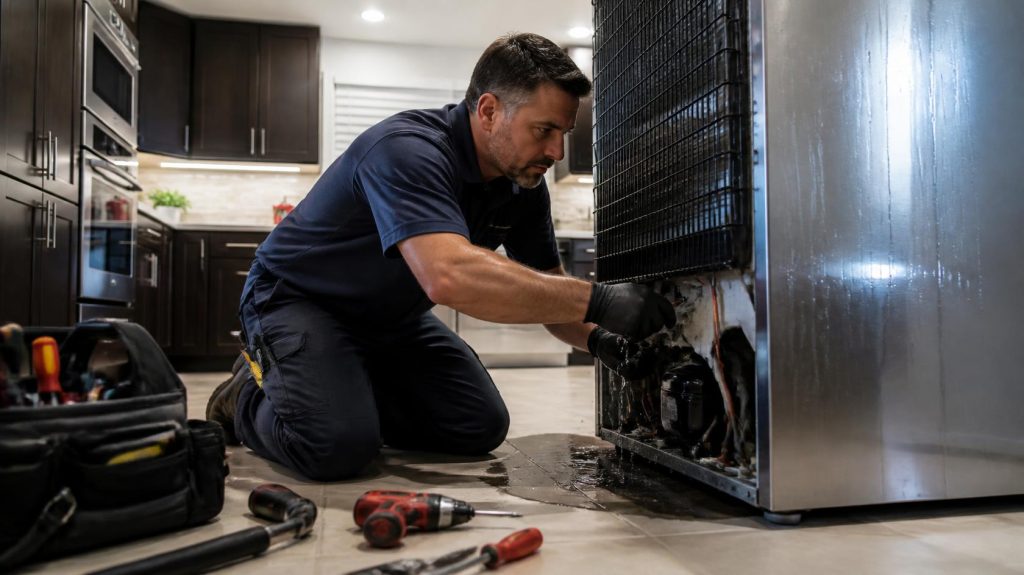
Why a Refrigerant Leak Doesn’t Behave Like a Normal Repair
Most refrigerator problems announce themselves clearly. A door seal fails and warm air pours in. A fan motor dies and the freezer goes silent. A refrigerant leak is different. It rarely causes a sudden breakdown. Instead, it shows up as a slow fade: the fridge that was fine last month is just a little less cold this month, and a little less cold the month after that.
That gradual pattern is exactly why a refrigerator refrigerant leak Chicago homeowners deal with so often gets written off as “the fridge just needs adjusting.” A refrigerator not cooling gradually, rather than all at once, is behaving like it’s failing in slow motion, and it’s worth reading through the signs below before assuming it’s a simple part failure.
4 Signs of a Refrigerator Refrigerant Leak
1. Oily Residue Near the Compressor or Refrigerant Lines
Refrigerant systems carry a small amount of lubricating oil along with the refrigerant itself. When a line or fitting develops a leak, that oil often escapes with it and leaves a faint, greasy film on or around the compressor, the coils, or the copper lines running behind and underneath the unit. If you spot an oily residue in one of these spots, it’s one of the more reliable visual signs that fridge losing refrigerant is the actual problem, rather than a control or fan issue.
2. A Faint Hissing or Bubbling Sound
Refrigerant escaping through a small crack or pinhole leak can produce a quiet hissing sound, sometimes described as a soft bubbling or gurgling, especially right after the compressor kicks on. It’s easy to miss over the normal hum of a running fridge, but if you put your ear near the back panel or the compressor compartment and catch something that sounds like escaping gas, that’s worth noting for whoever diagnoses it.
3. Slow, Gradual Cooling Decline
This is the signature symptom of a refrigerator refrigerant leak most often described to us: not a fridge that suddenly stops cooling, but one that’s been drifting a few degrees warmer every few weeks. Milk spoils a day or two sooner than it used to. Ice cream gets slightly softer than it should. A slow refrigerant leak is one of the top explanations behind this pattern, since the system loses a little more pressure and cooling capacity as more refrigerant escapes.
4. Uneven Cooling Between the Fridge and Freezer
On many refrigerators, especially older single-compressor models, the freezer will hold its temperature noticeably better than the fresh food section as a leak progresses, since the freezer evaporator sits closer to where refrigerant is still circulating. If your freezer still seems to be working fine while the fridge section runs warm, that mismatch is a useful clue for diagnosis.
What’s Actually in Your Refrigerator (It’s Probably Not “Freon”)
A lot of homeowners searching for a refrigerator freon leak are using outdated terminology without realizing it. “Freon” is a brand name that referred to older refrigerants like R-12 and R-22, both of which were phased out of new refrigerator production decades ago. Most refrigerators built in the last 15-20 years use R-134a instead, and many newer models, particularly those manufactured in the last several years, use R-600a, a small charge of isobutane.
That distinction matters for two reasons. First, R-600a is flammable in a way older refrigerants weren’t, which changes how a technician safely handles a leak or recharge. Second, whichever refrigerant is actually in your unit, it’s still a federally regulated substance, and “Freon” or not, the same EPA rules apply to anyone servicing the sealed system.
Why the EPA Regulates Refrigerant Handling
Refrigerant handling isn’t loosely regulated advice, it’s federal law. Under Section 608 of the Clean Air Act, anyone who maintains, services, repairs, or disposes of equipment containing regulated refrigerant has to hold EPA certification, and household refrigerators fall under this rule as “small appliances,” meaning units factory-sealed with five pounds of refrigerant or less.
That certification exists because refrigerants, whether older ozone-depleting substances or their modern substitutes, can seriously harm the atmosphere if released carelessly. The rule covers the specific tasks involved in a refrigerator repair that touches the sealed system: attaching or detaching hoses and gauges, adding or removing refrigerant, and cutting or opening a refrigerant line. Doing any of that without certification is not just discouraged, it’s a violation of federal law, and the EPA has the authority to issue substantial fines for it. It’s what separates sealed-system work from routine appliance repair, and why the EPA treats it as its own category under the law.
Why DIY Recharge Isn’t Possible or Legal for Most Homeowners
Even setting the legal requirement aside, a DIY recharge kit from a hardware store won’t actually fix a refrigerator refrigerant leak Chicago homeowners are dealing with. Here’s why:
- You can’t legally buy the refrigerant. Purchasing regulated refrigerant requires EPA certification. Most consumer-facing “recharge kits” sold for cars and small appliances use different, less-regulated substances that aren’t a proper match for your refrigerator’s system.
- Adding refrigerant doesn’t fix the leak. If refrigerant is escaping through a crack or failed fitting, simply adding more without repairing the leak just delays the problem, and wastes the refrigerant you added.
- The equipment matters. Diagnosing and repairing a sealed system properly requires recovery equipment, leak detection tools, and a vacuum pump to evacuate and properly recharge the system, none of which are part of a homeowner’s typical toolkit.
- R-600a systems carry a flammability risk. If your fridge uses isobutane, mishandling it isn’t just a compliance issue, it’s a genuine safety concern in an enclosed kitchen space.
This is one of the few refrigerator problems where “just try it yourself first” genuinely isn’t good advice. It’s also one of the clearest examples of when a homeowner needs certified appliance repair support rather than a weekend project.
What a Professional Repair Actually Involves
When a certified technician diagnoses a suspected refrigerant leak, the process typically looks like this:
- Leak detection. Using an electronic leak detector or a UV dye method to pinpoint exactly where refrigerant is escaping, rather than guessing.
- Evaluating repair versus replacement. On an older unit, the cost of a proper sealed-system repair sometimes approaches the cost of a new refrigerator, so a technician should walk you through both options honestly.
- Recovery and repair. If repair makes sense, the remaining refrigerant is recovered, the leak point is repaired (often by replacing or resealing the affected line or fitting), and the system is pressure-tested.
- Evacuation and recharge. The system is evacuated with a vacuum pump to remove air and moisture, then recharged with the correct type and amount of refrigerant for that specific model.
- Verification. The unit is monitored to confirm it’s cycling normally and holding temperature before the job is considered complete.
This is a meaningfully different process than most refrigerator repair calls, which is part of why sealed-system work tends to cost more and take longer than swapping a part.
Diagnostic Checklist
| Symptom | Likely Explanation | DIY-Fixable? |
| Oily film near compressor or copper lines | Refrigerant leak at a line or fitting | No |
| Faint hissing near the back panel | Active refrigerant leak | No |
| Cooling has drifted warmer gradually over weeks | Refrigerant leak (slow) or failing compressor | No |
| Freezer fine, fridge section running warm | Refrigerant leak affecting circulation | No |
| Sudden total loss of cooling | Likely not a leak. Check power, thermostat, or compressor first | Sometimes |
| Compressor runs constantly but cooling still lags | Could be low refrigerant, not just dirty coils | No |
Brand-Specific Notes
- Older units (15+ years) are more likely to use R-134a and are also more likely to have simply aged into a leak at a solder joint or fitting after years of vibration and thermal cycling.
- Newer refrigerators using R-600a require technicians to follow flammable-refrigerant safety protocols during diagnosis and repair, which not every general appliance technician is equipped to handle.
- Built-in and cabinet-depth models often route refrigerant lines through tighter spaces, which can make leak points harder to access and slightly increase repair labor time.
Whatever the brand or refrigerant type, our certified appliance technicians carry EPA-compliant recovery and leak-detection equipment, so a suspected leak gets diagnosed correctly the first time.
FAQs
1. How can I tell a refrigerant leak apart from a normal part failure? The biggest tell is the timeline. A failed fan, thermostat, or door seal usually causes a fairly quick and noticeable change. A refrigerant leak tends to show up as a slow, gradual decline in cooling over weeks, sometimes alongside an oily residue or a faint hissing sound.
2. Is it safe to keep using my refrigerator if I suspect a leak? Short-term, yes, but food safety becomes a growing concern as cooling weakens. If your refrigerator is not cooling gradually and getting worse, it’s best to get it inspected before food starts spoiling faster than expected.
3. Can I just add refrigerant myself to fix it? No. You can’t legally purchase regulated refrigerant without EPA certification, and adding more refrigerant without repairing the actual leak doesn’t solve the problem. It also doesn’t address whatever caused the leak in the first place.
4. Does my refrigerator actually use Freon? Almost certainly not. “Freon” refers to older refrigerants phased out of new refrigerator production long ago. Most refrigerators today use R-134a or R-600a, but both are still federally regulated substances that require certified handling.
5. Why do I need an EPA-certified technician for this? Section 608 of the Clean Air Act requires certification for anyone who services equipment containing regulated refrigerant, including the “small appliance” category that covers household refrigerators. It’s a federal legal requirement, not just a best practice.
6. Is a refrigerant leak always fixable? Usually, yes, but on older units the repair cost can approach the price of a new refrigerator. A good technician should give you a clear repair-versus-replace comparison before starting work.
7. What causes a refrigerator refrigerant leak in the first place? Common causes include corrosion at a fitting or joint, a manufacturing defect in a weld, or physical damage to a line from moving the fridge, pest damage, or years of vibration.
8. How much does refrigerant leak repair typically involve compared to other refrigerator repair work? It’s more involved than most part replacements, since it requires leak detection, evacuation, recovery, and recharge with specialized equipment, which is part of why it’s priced and scheduled differently than a straightforward appliance repair.
When to Call a Certified Technician
If you’re noticing an oily residue, a faint hissing sound, or a refrigerator that’s been drifting warmer for weeks rather than failing all at once, it’s time to get it looked at. A refrigerator refrigerant leak Chicago homeowners catch early is far cheaper to fix than one that’s been left to worsen, and it’s never a project to take on without EPA certification and the right recovery equipment.
Dara Appliance Repair has been serving Chicago and the surrounding suburbs since September 2019, with a 4.9-star rating from local customers. Our certified appliance technicians carry EPA-compliant leak detection and recovery equipment, so you get an honest diagnosis and a clear repair-or-replace recommendation, not guesswork.
Notice your fridge slowly losing its cool? 📞 Call (773) 377-4212 🌐 Book online now: $89 diagnostic fee, waived with repair 💰 Ask about 10% Off Your First Repair
We serve Chicago, Evanston, Skokie, Park Ridge, Niles, Glenview, Wilmette, Northbrook, Deerfield, Highland Park, Des Plaines, Oak Park, Berwyn, Cicero, and Lincoln Park.