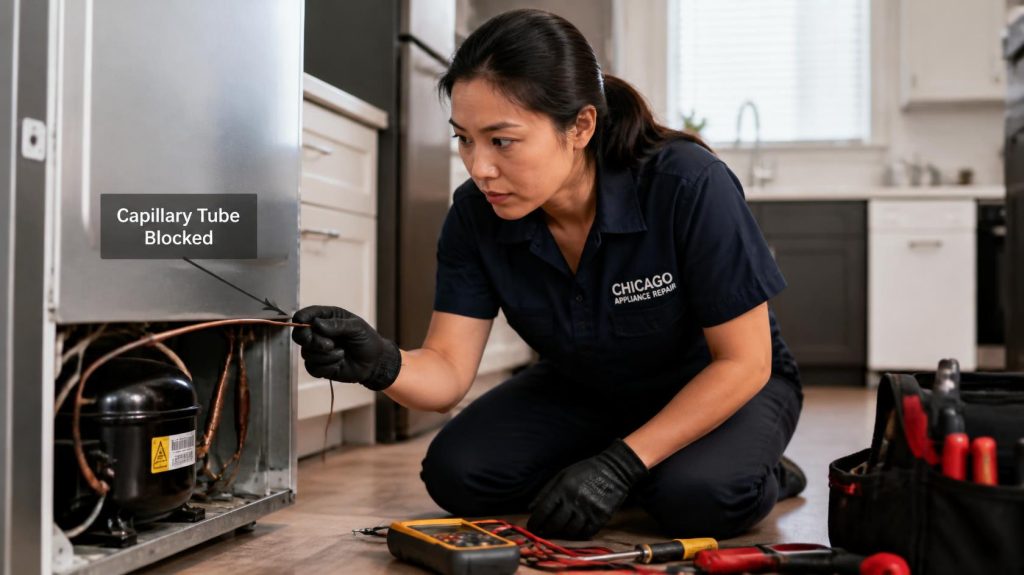
Why This Cause Gets Missed
Most refrigerator troubleshooting guides stop at the usual suspects: dirty coils, a worn door seal, a failing thermostat. Those cover the majority of cooling complaints, which is exactly why a refrigerator capillary tube blockages Chicago repair techs diagnose so often gets overlooked. It’s not the first thing anyone checks, it goes well beyond a typical appliance repair visit, and it’s not something a homeowner can see or test without opening the sealed system.
If you’ve already cleaned the coils, checked the door seal, and confirmed the thermostat is working, but you’re still dealing with a fridge not cooling after coil cleaning, a capillary tube problem is worth putting on the list. It’s less common than the causes we’ve covered in earlier posts on this topic, but it’s real, and it explains a lot of “we tried everything and nothing worked” situations.
What a Capillary Tube Actually Does
The capillary tube is a long, extremely thin coil of copper tubing, often no wider than a strand of spaghetti, that sits between the condenser and the evaporator. Its job is to meter refrigerant flow and create a precise pressure drop as refrigerant moves from the high-pressure side of the system to the low-pressure side, where it can absorb heat and cool the interior.
Because the tube’s inner bore is so narrow, it doesn’t take much to restrict it. A tube that’s even partially blocked can starve the evaporator of refrigerant, and a refrigerator running on a partially blocked capillary tube behaves a lot like one with low refrigerant, except the refrigerant charge itself is often still intact. It just can’t get where it needs to go.
What Causes a Blockage
Moisture and Ice
If moisture gets into the sealed system, whether from an incomplete evacuation during a prior repair or from a slow refrigerant leak that let humid air in, that moisture travels through the system until it reaches the capillary tube. Because the tube is where the sharpest temperature and pressure drop happens, it’s also where moisture is most likely to freeze into a tiny ice plug, restricting or fully blocking refrigerant flow. This is what people usually mean when they search for a capillary tube frozen.
Debris and Sludge
If a compressor has started to wear out internally, it can shed tiny metal particles or oil sludge into the refrigerant stream. That debris circulates through the system and, like moisture, tends to collect right at the narrowest point: the capillary tube. When this is the cause, the tube blockage is really a symptom of a bigger compressor problem, not an isolated issue on its own.
Contamination From a Previous Repair
A sealed system that’s been opened and improperly evacuated, flushed, or recharged during an earlier repair can introduce contaminants that eventually settle in the capillary tube. This is one of several reasons refrigerator sealed system repair work needs to be done to a specific standard, not just “good enough.”
Signs of a Capillary Tube Blockage
These are the signs of a refrigerator capillary tube blockage Chicago technicians look for during an advanced sealed-system diagnostic, especially once the easier explanations have already been ruled out:
- An abnormal frost pattern. Instead of even frost across the evaporator coil, you may see frost concentrated right at the capillary tube inlet, or a frost line that stops abruptly partway along the coil instead of covering it evenly.
- Cooling that comes and goes. With a frozen capillary tube specifically, the fridge may cool normally for a while, then gradually lose cooling as the ice plug builds up, then cool again briefly after the compressor’s off-cycle allows the ice to partially melt. This on-again, off-again pattern is a strong clue.
- A faint hissing sound at the tube itself, distinct from a hissing sound near the compressor or a line fitting elsewhere in the system.
- No improvement after the obvious fixes. If you’ve already ruled out dirty coils, a bad door seal, and a failing thermostat, and you’re still troubleshooting a fridge not cooling after coil cleaning, a capillary tube blockage moves up the list of likely explanations.
- The compressor runs, but cooling stays weak or uneven, since the compressor itself is often fine; it’s the metering of refrigerant downstream that’s restricted.
Frozen vs. Debris-Clogged: Two Different Problems
| Frozen (Moisture) | Debris-Clogged | |
|---|---|---|
| Cause | Moisture trapped in the system | Metal particles or sludge from a worn compressor |
| Pattern | Cooling cycles on and off as ice builds and partially melts | Cooling is consistently weak or absent, without much cycling |
| Underlying issue | Usually isolated to the tube itself | Often a sign the compressor is also failing |
| Typical fix | Full evacuation, moisture removal, and recharge | Tube replacement or flush, sometimes alongside compressor evaluation |
Why This Requires Professional Sealed-System Service
Diagnosing a refrigerator capillary tube blockage Chicago homeowners can trust starts with confirming it’s actually the capillary tube and not a different refrigerator repair issue altogether, since this cannot be diagnosed or repaired without opening the sealed system, and that’s regulated the same way a refrigerant leak repair is. Under EPA Section 608 of the Clean Air Act, anyone who services equipment containing regulated refrigerant, including the “small appliance” category that covers household refrigerators, needs to hold EPA certification to legally attach hoses, recover refrigerant, or open a refrigerant line.
Beyond the legal requirement, the repair itself calls for tools most homeowners don’t own: recovery equipment, a vacuum pump for evacuation, and either a flushing setup or a replacement capillary tube sized correctly for that specific model. Getting the tube length and bore size wrong changes the system’s pressure characteristics and can cause new problems even if the blockage itself is cleared. This is precision work, not a bolt-on part swap, which is part of why it falls outside routine appliance repair and into specialized refrigerator sealed system repair.
What a Professional Repair Involves
- Diagnosis. Confirming the capillary tube, rather than the compressor, refrigerant charge, or a control component, is actually the source of the problem. This usually involves checking pressures on both sides of the system and looking for the frost pattern described above.
- Recovery. Removing the remaining refrigerant from the system using EPA-compliant recovery equipment.
- Clearing or replacing the tube. A partial blockage from moisture may be cleared with a proper flush and drying process. A debris-clogged tube, or one that’s been damaged, is typically replaced outright.
- Addressing the root cause. If debris from a worn compressor caused the blockage, the technician needs to evaluate whether the compressor itself needs attention too, or the same problem will recur.
- Evacuation and recharge. The system is evacuated to remove air and moisture, then recharged with the correct type and amount of refrigerant.
- Verification. Monitoring the unit through a full cycle to confirm normal frost patterns and consistent cooling before calling the job done.
This is a more involved process than most refrigerator repair calls, and it’s one of the reasons sealed-system diagnostics take longer than swapping a fan motor or a door gasket.
Diagnostic Checklist
| Symptom | Likely Explanation | DIY-Fixable? |
|---|---|---|
| Frost stops abruptly partway along the evaporator coil | Capillary tube blockage | No |
| Cooling cycles on and off over hours rather than staying consistent | Capillary tube frozen (moisture) | No |
| Cooling has been weak since a recent repair or recharge | Contamination or improper evacuation | No |
| No improvement after cleaning coils, checking seals, and replacing the thermostat | Deeper sealed-system issue, possibly capillary tube | No |
| Hissing sound near the thin tubing between condenser and evaporator | Restricted or partially blocked capillary tube | No |
| Compressor runs fine, but cooling is consistently weak | Refrigerant not reaching the evaporator properly | No |
Brand-Specific Notes
- Older refrigerators (10+ years) are somewhat more likely to develop a capillary tube issue tied to compressor wear, since aging compressors are the more common source of circulating debris.
- Units that have had a previous sealed-system repair carry a slightly higher risk of contamination-related blockages if that earlier repair wasn’t evacuated and recharged to spec.
- Built-in and cabinet-depth models route the capillary tube through tighter spaces alongside other lines, which can make access and replacement more labor-intensive.
Whatever the brand or history, our certified appliance technicians carry the recovery, evacuation, and diagnostic equipment needed to confirm a capillary tube issue rather than guessing based on symptoms alone.
FAQs
1. What is a capillary tube and why does it matter? It’s a thin length of copper tubing that meters refrigerant flow between the condenser and evaporator. Because its bore is so narrow, even a small blockage can significantly reduce or stop cooling, even though the rest of the system may be fine, which is exactly why a refrigerator capillary tube blockage Chicago technicians investigate so often gets misdiagnosed as something simpler.
2. How do I know if it’s a capillary tube issue and not just low refrigerant? The clearest clue is the frost pattern: an abrupt stopping point along the evaporator coil rather than even frost, along with cooling that cycles on and off rather than declining steadily the way a slow refrigerant leak typically does.
3. Can a capillary tube blockage be cleared without replacing it? Sometimes. A blockage caused by moisture can occasionally be cleared with a proper flush and full evacuation. A blockage caused by compressor debris more often requires replacing the tube outright, since flushing alone may not fully remove metal particles.
4. My fridge isn’t cooling even after I cleaned the coils. Could this be why? It’s possible. A fridge not cooling after coil cleaning has already ruled out the most common cause, so a technician should check the sealed system next, including the capillary tube, rather than starting over with easier fixes.
5. Is this the same kind of repair as a refrigerant leak fix? It’s similar in that both require opening the sealed system under EPA regulations, but a capillary tube repair often involves replacing a component rather than sealing a leak point, and sometimes requires evaluating the compressor as well if debris is the cause.
6. Can I try to unblock the tube myself? No. Opening the sealed system to access the capillary tube requires EPA certification to handle the refrigerant legally, plus recovery, evacuation, and recharge equipment. There’s also a real risk of damaging the tube or introducing new contamination without the right tools and training.
7. If the capillary tube is blocked, does that mean my compressor is also failing? Not always, but it’s worth checking. A frozen tube from trapped moisture is often an isolated issue. A tube clogged with metal debris is more often a sign the compressor itself is wearing out, which changes the repair recommendation.
8. How much more involved is this than a typical refrigerator repair? It’s more involved than most part replacements. It requires recovery, evacuation, and recharge in addition to diagnosing and addressing the tube itself, which is why sealed-system work like this is priced and scheduled differently than routine appliance repair.
When to Call a Certified Technician
If you’ve already tried the obvious fixes and you’re still dealing with weak or inconsistent cooling, especially with an unusual frost pattern or cooling that comes and goes, it’s time to get the sealed system checked. A refrigerator capillary tube blockage isn’t something to keep chasing with guesswork, and it’s not a repair that can be done without opening the system under EPA regulations.
Dara Appliance Repair has been serving Chicago and the surrounding suburbs since September 2019, with a 4.9-star rating from local customers. Our certified appliance technicians carry the diagnostic and recovery equipment to confirm whether a capillary tube blockage, a refrigerant leak, or something else entirely is behind a cooling problem that won’t resolve with the basics.
Still not cooling after trying everything else? 📞 Call (773) 377-4212 🌐 Book online now: $89 diagnostic fee, waived with repair 💰 Ask about 10% Off Your First Repair
We serve Chicago, Evanston, Skokie, Park Ridge, Niles, Glenview, Wilmette, Northbrook, Deerfield, Highland Park, Des Plaines, Oak Park, Berwyn, Cicero, and Lincoln Park.