A Chicago Homeowner’s Guide to Diagnosing These Two Parts
Every week, our technicians diagnose cases of refrigerator start relay failure Chicago homeowners were told meant a dead compressor, and almost every time, that is exactly what it looks like at first glance. That is exactly why this guide exists.
If a repair estimate just told you the compressor is dead, take a breath before you approve that quote. In the vast majority of cases we see, a case of refrigerator start relay failure Chicago homeowners deal with gets mistaken for a failed compressor, and the actual fix costs a fraction of a full replacement. Two small parts sit right on top of the compressor and are wired in series with it: the start relay and the overload protector. When either one fails, the compressor cannot start, the fridge goes silent or hums without cooling, and it looks exactly like the compressor itself has died. This is one area where a proper appliance repair diagnosis, rather than a rushed quote, can save homeowners hundreds of dollars.
Quick Answer: A failed start relay or overload protector is one of the most commonly misdiagnosed refrigerator problems in Chicago. Both parts sit on the compressor and control whether it starts and stays running. A relay or protector swap typically runs $150 to $300 installed, compared to $1,200 or more for a full compressor replacement. Testing takes minutes with a multimeter, and if either part is bad, most refrigerators are saved from an unnecessary compressor swap. Book a diagnostic and our certified technicians will confirm which part is at fault before any bigger repair is recommended.
Jump to a section:
- What the Start Relay Actually Does
- What the Overload Protector Actually Does
- Why These Two Parts Get Confused With a Dead Compressor
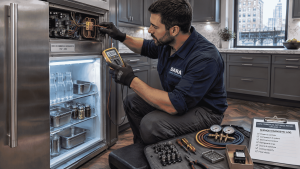
- How Technicians Test a Start Relay vs. an Overload Protector
- Signs the Compressor Won’t Kick On Because of These Parts
- Part Replacement Cost vs. Compressor Replacement Cost
- Brand-Specific Notes
- Prevention Checklist
- FAQs
What the Start Relay Actually Does
The start relay is a small plug-in component, usually mounted to the side of the compressor near the bottom of the fridge, behind a rear access panel. Its job is to give the compressor motor a jolt of extra current for a split second when it first starts up, then get out of the way once the motor is running at speed. Most residential refrigerators use a PTC (positive temperature coefficient) relay, which is a solid-state part with no moving pieces, or an older-style current relay with an internal coil.
Think of the start relay as a running start. A compressor motor cannot get moving on regular household current alone; it needs that brief extra push. Without a working relay, the compressor will try to start, draw current, and then shut back off, over and over, without ever actually turning. That repeating click or hum every few minutes is one of the clearest signs of relay failure, and it is often mistaken for a dying compressor.
What the Overload Protector Actually Does
The overload protector is wired in series with the start relay and sits directly on the compressor housing, usually held on by a metal clip. Inside is a bimetallic strip and a heating element. Its entire purpose is to protect the compressor motor from overheating or drawing excessive current. If the compressor draws too much current for too long, whether from a failed start attempt, a voltage issue, or age-related winding wear, the bimetallic strip inside the protector heats up, bends, and breaks the electrical circuit. This shuts the compressor down before it can burn out.
A refrigerator overload protector resets itself once it cools down, which is why some refrigerators seem to work fine for a while, then go quiet, then start again a few minutes later in an endless loop. That cycling pattern is one of the most reliable clues that the protector, not the compressor, is the actual problem.
Why Refrigerator Start Relay Failure Chicago Homeowners Face Looks Like a Dead Compressor
Homeowners and even some less experienced technicians will hear a refrigerator that hums, clicks, or stays silent and jump straight to “the compressor is shot.” That assumption is understandable. A failed compressor produces almost identical symptoms on the surface: no cooling, no obvious airflow, and a fridge that feels warm inside within a few hours. But the compressor itself is the most expensive part in the entire appliance, and it is also, in our experience, one of the least likely parts to actually fail compared to the small relay and protector sitting right beside it.
In our experience, instances of refrigerator start relay failure Chicago homeowners run into tend to show up more often in units that are 8 to 15 years old, in homes with older wiring or voltage fluctuations, and after power outages or surges. Because the relay and protector are cheap, small, and hidden behind a rear panel, they get overlooked, while the compressor gets blamed simply because it is the part that is not spinning.
How Technicians Test a Start Relay vs. an Overload Protector
A proper diagnosis does not involve guessing. Our certified technicians handle refrigerator repair by following a specific test sequence to confirm which part, if any, has actually failed before recommending a repair.
Step 1: Visual and physical inspection. The technician pulls the rear access panel and physically inspects the relay and protector for scorch marks, a rattling sound when shaken (a sign of internal damage), or a burnt smell, which often points to compressor winding failure rather than the relay itself.
Step 2: Multimeter continuity test on the overload protector. With power disconnected, the technician checks for continuity across the protector terminals. No continuity when the compressor is cool means the protector has failed and needs replacement.
Step 3: Multimeter resistance test on the start relay. A PTC relay is tested for a low, stable resistance reading. A reading of zero or infinite resistance confirms the relay has failed.
Step 4: Compressor winding test. This is the step that actually separates a relay or protector issue from true compressor failure. The technician tests resistance between the compressor’s run, start, and common terminals. If those readings fall within a normal range, the compressor windings are intact and the problem is isolated to the relay or protector, not the compressor itself.
Step 5: Amp draw test on start-up. With a known-good relay temporarily in place, the technician checks the compressor’s amp draw on startup. Excessive or erratic draw can point to a compressor that truly is failing, while normal draw confirms the compressor is fine and the original relay or protector was the cause.
This sequence is what allows a technician to tell a homeowner with confidence whether a $200 part will fix the fridge, or whether compressor replacement is genuinely necessary.
Signs the Compressor Won’t Kick On Because of These Parts
If your compressor won’t kick on, these patterns point toward the relay or protector rather than the compressor itself:
- A single loud click every few minutes, with no hum or run cycle following it
- A repeating cycle of clicking, a brief hum, then silence, over and over
- The fridge runs for a few minutes, shuts off, and restarts on its own after cooling
- Interior light and control panel work fine, but there is no compressor sound at all
- The compressor was working normally before a power outage or surge
- A faint burning smell near the rear access panel without visible smoke
Part Replacement Cost vs. Compressor Replacement Cost
This is the number that matters most if you have already received a compressor replacement quote. A start relay or overload protector replacement, including the diagnostic visit, typically lands in the $150 to $300 range for most standard refrigerators, depending on the brand and part availability. A full compressor replacement, by comparison, usually runs well over $1,200 once you factor in the part itself, refrigerant recovery and recharge, and labor, and on many older units it is not even cost-effective compared to replacing the appliance.
That gap is exactly why a proper diagnostic step matters before anyone commits to compressor replacement. Our technicians confirm cases of refrigerator start relay failure Chicago homeowners assumed meant a dead compressor often enough that skipping the test and jumping straight to compressor replacement can mean paying four to eight times more than necessary for what turns out to be a small part.
Brand-Specific Notes
Relay and protector styles vary by brand and by compressor manufacturer, which affects both diagnosis time and part cost in any appliance repair visit.
GE, Whirlpool, Kenmore, Frigidaire: These commonly use standard PTC relays that are widely stocked, which usually means same-day or next-day part availability and lower part costs.
LG, Samsung: Many newer models use inverter-driven compressors that do not rely on a traditional separate start relay in the same way, so a “won’t kick on” complaint on these units is more likely tied to the control board or the compressor’s inverter module. Our certified technicians test accordingly rather than assuming a standard relay is the cause.
Sub-Zero, Viking, Thermador, Gaggenau, Miele: These premium builds often use higher-end compressor and relay assemblies from specialty manufacturers. Our certified appliance technicians have experience diagnosing and repairing these systems, though part sourcing can add a day or two compared to standard residential brands.
Prevention Checklist
- Keep the rear access panel area clear of dust buildup, since heat trapped near the compressor accelerates wear on the relay and protector
- Use a surge protector or whole-home surge protection, since power surges are one of the most common causes of premature relay failure
- Avoid rapid power cycling; if the fridge trips a breaker or loses power, wait a few minutes before restoring power rather than flipping it on and off repeatedly
- Schedule a maintenance check every year or two if your unit is over 8 years old, since these parts are cheap to replace proactively compared to an emergency after-hours call
- Listen for early warning clicks or short hum-and-stop cycles and call for refrigerator repair before the fridge stops cooling completely and food is lost
- Keep a record of any past refrigerator repair visits, since a technician can diagnose faster when they know the unit’s repair history
Frequently Asked Questions
1. How do I know if it’s the start relay or the overload protector? You generally cannot tell just by listening, since both parts produce similar clicking or cycling symptoms. A multimeter test on each part, done during a diagnostic visit, is the only reliable way to confirm which one has actually failed.
2. Can I do a fridge relay replacement myself? Both parts are technically accessible without special tools, but confirming which one is bad, sourcing the correct part number for your exact compressor, and ruling out a genuine compressor issue first requires testing equipment most homeowners do not have on hand. A misdiagnosis means paying for a part that does not fix the problem.
3. Why does my fridge click every few minutes but never turn on? This repeating click, sometimes called short cycling, is one of the clearest signs of a failed start relay or overload protector. The compressor is attempting to start, tripping the protection circuit, and trying again on a loop.
4. Is a clicking refrigerator dangerous? It is not typically an immediate safety hazard, but it does mean the compressor is repeatedly drawing startup current without completing a run cycle, which can add wear over time. It is worth having it checked promptly rather than letting it click for days.
5. What does it typically cost to fix a refrigerator start relay failure Chicago technicians confirm? Most relay or overload protector replacements run $150 to $300 installed, including the diagnostic visit, though exact pricing depends on the brand and part availability.
6. Will a bad relay eventually damage the compressor itself? Yes, this is one of the main reasons to address it quickly. A compressor that repeatedly attempts to start without success is under more electrical stress than one starting normally, and prolonged short cycling can eventually contribute to true compressor failure.
7. My repair quote said I need a new compressor. Should I get a second opinion? It is reasonable to ask whether the relay and overload protector were tested with a multimeter before compressor replacement was recommended, since these parts are the most commonly misdiagnosed cause of a “dead” compressor.
8. How long does this kind of repair take? Once the correct part is on hand, replacing a start relay or overload protector is usually a same-visit repair. If a part needs to be ordered for a less common brand, it typically arrives within a day or two.
Get It Diagnosed Before You Pay for a Compressor
Dara Appliance Repair has been serving Chicago and the surrounding suburbs since 2019, with a 4.9-star rating built on honest diagnostics before expensive recommendations. Before you approve a compressor quote based on refrigerator start relay failure Chicago techs haven’t actually confirmed, a quick multimeter test is worth requesting. Our certified technicians carry the multimeters and testing equipment to confirm in one visit whether your issue is a $200 part or something bigger, so you are never guessing or overpaying. We serve Chicago, Evanston, Skokie, Park Ridge, Niles, Glenview, Wilmette, Northbrook, Deerfield, Highland Park, Des Plaines, Oak Park, Berwyn, Cicero, and Lincoln Park.
The $89 diagnostic fee is waived with any completed repair, and first-time customers get 10% off their first repair. If your refrigerator is clicking, humming, or silent, book your diagnostic online or contact us before approving a compressor replacement quote. Call (773) 377-4212, available 8AM to 8PM, seven days a week.