If you’re shopping for a new washer, or staring at a broken one and wondering whether to fix it, the repair question matters. Some washers are simply easier and cheaper to work on than others.
Here’s the honest answer from a Chicago repair team, plus the data that helps you weigh front load vs top load washer repair cost against what each machine costs to own.
Which is cheaper to repair, a front-load or top-load washer?
Top-load washers are generally cheaper to repair. They have simpler mechanics, fewer seals, and parts that are easier to reach. Front-load washers can cost more to fix because of door gaskets, drum bearings, and control boards, but they use far less energy and water, so a repair often still makes sense.
At Dara Appliance Repair, most repairs fall between $129 and $400, and that range covers both types. Where a specific repair lands depends on the part that failed, not just the style of washer.
At a glance: how the two compare
| Factor | Top-load washer | Front-load washer |
|---|---|---|
| Repair complexity | Simpler, fewer sealed parts | More complex, more seals and electronics |
| Common repairs | Lid switch, drive belt, drain pump, agitator | Door gasket, door lock, drain pump, drum bearings, control board |
| Parts access | Usually easier | Some repairs require deeper disassembly |
| Energy and water use | Higher, especially agitator models | Lowest of any washer type |
| Upfront purchase price | Usually lower | Usually higher |
| Typical Dara repair range | $129 to $400 | $129 to $400 |
The table tells the short story. The sections below explain why each difference exists, and how it should shape a repair or buying decision.
Why top-load washers usually cost less to repair
Top-load washers come in two styles. Agitator models have the tall center post, and high-efficiency (HE) top-loaders use a low-profile impeller at the bottom of the tub instead.
Both styles share a practical advantage: most of the parts that fail are reachable without taking the whole machine apart. The repairs we see most often include:
- Lid switch or lid lock: A failed switch can stop the washer from spinning or starting at all. It’s usually a quick, affordable fix.
- Drive belt: Worn or broken belts cause a washer that fills but won’t agitate or spin.
- Drain pump: A clogged or failed pump leaves water sitting in the tub.
- Agitator parts: Worn agitator components can cause poor cleaning or grinding noises.
Because the design is simpler and there are fewer watertight seals involved, top-load repairs tend to take less labor. That’s the main reason they usually land toward the lower end of the range.
Why front-load washers can cost more to repair
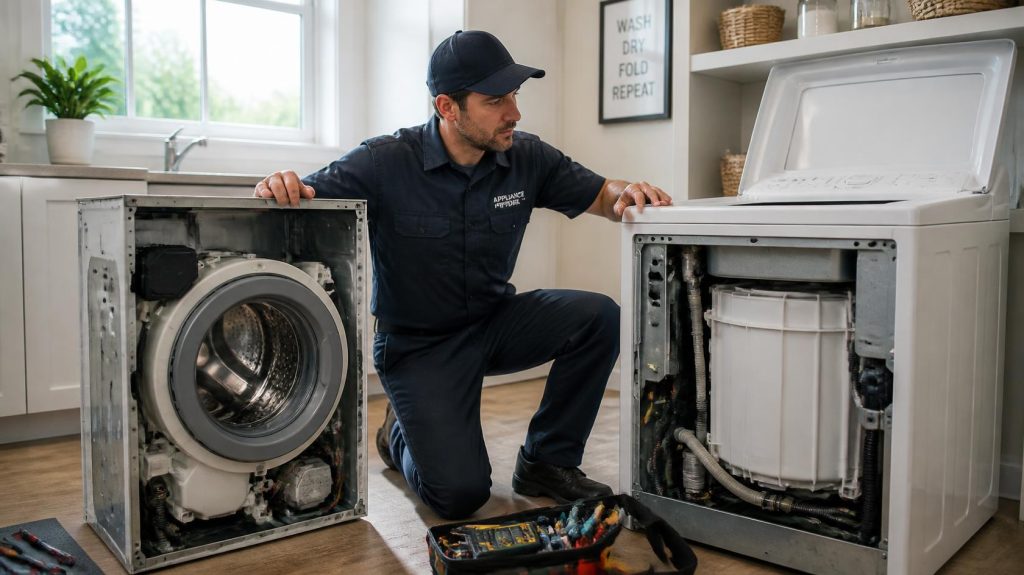
Front-loaders tumble clothes through a small amount of water in a horizontal drum. That design is efficient, but it depends on parts that top-loaders don’t need as much.
- Door gasket (boot seal): The rubber seal keeps water inside the drum. Tears, mold, and wear are common, and replacing it takes careful work to get a proper seal.
- Door lock: Front-loaders won’t start if the door doesn’t lock, so a failed lock stops the machine completely.
- Drain pump and filter: Coins, bobby pins, and other small objects often end up here and can jam or damage the pump.
- Drum bearings: Worn bearings cause loud grinding or roaring during the spin cycle. Replacing them usually means taking the drum assembly apart, which makes it one of the bigger washer jobs.
- Control boards: Front-loaders rely heavily on electronics to manage spin speeds, balance, and water levels.
Not every front-load repair is expensive. A door lock or drain pump can be a straightforward fix. The difference is that front-loaders have more of the costly failures, like bearings and boards, on the table.
Why the cheaper repair isn’t always the cheaper washer
Repair cost is only part of the picture. What a washer costs to run every month matters too, and this is where front-loaders pull ahead.
According to ENERGY STAR’s guide to choosing a front-load or top-load washer, certified front-load washers use about 45% less energy and 50% less water than a top-load agitator washer. Even compared with an HE impeller top-loader, front-loaders come out about 25% more efficient.
That changes the math on a repair. If you fix a front-loader, you keep those lower utility bills. If you replace it with a cheaper agitator model to avoid a repair, you may save today and pay more every month after.
So when you weigh front load vs top load washer repair cost, look at the repair invoice and the running cost together.
Reliability depends on the brand, not just the type
If you’re still shopping, the washer type is only half the reliability question. Consumer Reports’ brand reliability rankings are built from member surveys asking whether their washers broke or stopped working properly, and CR ranks brands separately within each washer type: front-loaders, HE top-loaders, agitator top-loaders, and compacts.
In other words, a well-built front-loader can be a better bet than a poorly rated top-loader, and the reverse is true too. Checking brand reliability for the specific type you want is one of the easiest ways to avoid future appliance repair bills.
Repair or replace? The honest framework
Whichever type you own, the same rules of thumb apply. These are the guidelines we use when giving customers an honest recommendation.
Repair is usually worth it if:
- The washer is less than about 10 years old
- Only one component has failed, like a pump, lock, belt, or gasket
- The repair costs less than half the price of a comparable new washer
Replacement is worth considering if:
- Several components are failing at the same time
- The repair would cost more than a new machine
- The washer is older and has a major failure, such as worn drum bearings on an aging front-loader
There’s one extra wrinkle when comparing front load vs top load washer repair cost. Because front-loaders cost more to buy and less to run, a repair on a newer front-loader often clears the bar even when the bill is on the higher side. Basic agitator top-loaders are cheaper to replace, so the bar for an expensive repair is higher.
Our washer repair service starts with a diagnosis and an upfront estimate, so you have the numbers before you decide. The $89 diagnostic fee is waived when you go ahead with the repair.
If you’re buying: what this means for you
If you’re comparing front load vs top load washer repair cost before you buy, here’s the practical takeaway.
If low repair costs and simplicity matter most, a top-load washer, especially a basic agitator model, is the more forgiving machine to own. It also usually costs less to buy.
If lower utility bills, larger capacity, or stacking matter more, a front-loader is usually the better long-term value, as long as you’re prepared for occasional pricier repairs and a little extra upkeep, like drying the door gasket between loads.
Either way, how you use the machine affects repair costs as much as the design does. Overloading, using too much detergent, and skipping the pocket check wear out parts on both types.
Frequently asked questions
Are front-load washers more expensive to repair?
Often, yes. Front-loaders have more seals, bearings, and electronics that can fail, and some of those repairs take more labor. Many common front-load repairs, like a door lock or drain pump, are still straightforward fixes.
Is it worth repairing a 10-year-old front-load washer?
It depends on what failed. A single part like a pump or door lock is usually worth fixing. Worn drum bearings or multiple failing components on a machine that age often make replacement the better call.
What is the most expensive washer repair?
Drum bearing replacement and control board failures tend to be among the biggest washer jobs, especially on front-loaders, because they involve major components and more labor. A diagnosis will tell you exactly what you’re dealing with before you commit.
Do top-load washers last longer than front-load washers?
There’s no simple answer by type alone. Lifespan depends heavily on the brand, the specific model, and how the machine is used and maintained. That’s why checking brand reliability data for the type you’re considering is worth the time.
How much does washer repair cost in Chicago?
At Dara Appliance Repair, most repairs fall between $129 and $400, and the gap in front load vs top load washer repair cost mostly comes down to which part failed. We charge an $89 diagnostic fee, which is waived if you go ahead with the repair, and you get an upfront estimate before any work begins.
Get an honest answer about your washer
The cheaper washer to repair isn’t always the cheaper washer to own. The right call depends on the machine’s age, what failed, and what it costs to run.
If your washer is acting up, our certified appliance technicians can diagnose the problem and give you a straight recommendation, whether that’s a repair or telling you it’s time to replace. We offer appliance repair across Chicago and the North Shore, 7 days a week, and first-time customers get 10% off their first repair.
Book your appointment online or contact us to get your washer checked.