By the Dara Appliance Repair Team | Serving Chicago and the North Shore
Heating repair calls in Chicago spike every November — and by then, every technician in the city is fully booked. The homeowners who stay warm all winter are the ones who called in October. Here is what you need to check before the temperature drops and the queue closes.
There is an appliance in your home that you almost never think about. You do not see it working. You do not hear it running. You only notice it when it stops — at which point it is 14 degrees outside, it is 2 AM, and every heating repair technician in Chicago is already scheduled three days out.
That appliance is your heating system. And unlike a noisy dishwasher or a refrigerator that starts running warm, a heating system gives very little warning before it fails completely. One October morning it fires up fine. One November night it does not. The gap between those two moments is the only window you have to act.
This is not a post about fear. It is a post about timing. Chicago winters are not forgiving, and heating system failures do not schedule themselves conveniently. The homeowners who treat October as their annual heating check window are the ones who never experience the panic of a cold house and a three-day wait for a technician. This post explains exactly what to check, what the warning signs look like, and when to pick up the phone before winter closes the door on your options.
Why November Is Already Too Late for Heating Repair in Chicago
Every year, heating repair calls in Chicago follow the same pattern. October is quiet — a handful of proactive homeowners, the occasional early breakdown. Then the first sustained cold snap arrives in early to mid-November, and the phones ring all at once.
By the time overnight lows are consistently dropping below 30 degrees, technicians across the city are booked days in advance. Parts that need ordering add more time. Emergency service rates apply. The homeowners who delayed a pre-season check are now competing for the same limited availability as everyone else whose system failed on the same cold night.
At Dara Appliance Repair, our heating repair service in Chicago runs seven days a week, 8 AM to 8 PM — but availability in November and December reflects demand, not our schedule preferences. The homeowners who call in September and October get convenient morning appointments, standard rates, and enough lead time to source any parts before the cold arrives. The homeowners who call in November get whatever slot is left.
Why Chicago Homes Are Especially Vulnerable to Heating System Failure
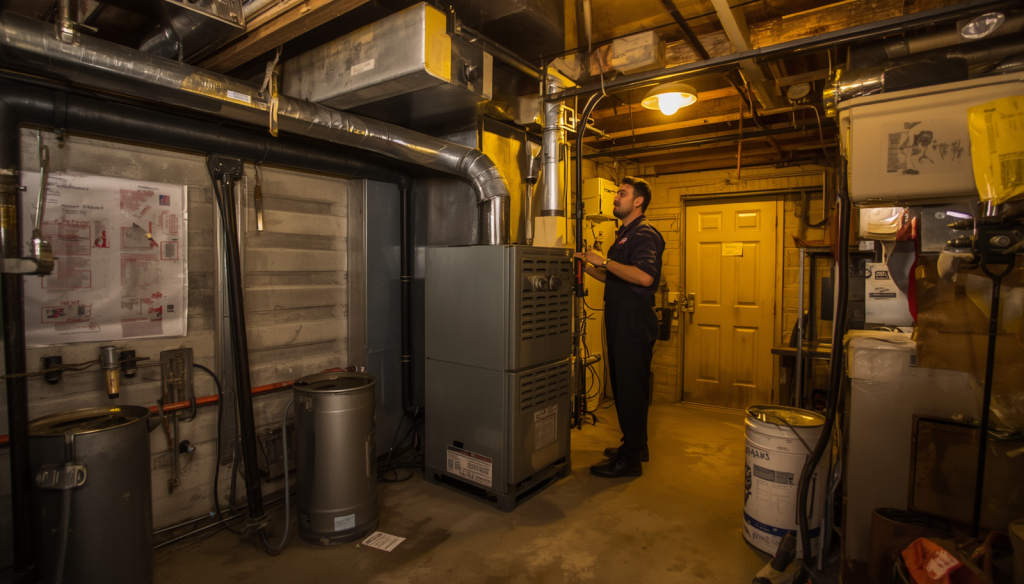
Chicago’s housing stock is old. The city has more pre-war bungalows, two-flats, and greystones than almost any other major American city — and most of them are running heating systems that have been in service for decades. A furnace installed in a Rogers Park two-flat in 1995 is 30 years old. A boiler in a Lincoln Square greystone may be older than the homeowner.
Age alone is not the problem. Properly maintained older heating systems can run reliably for 25 to 30 years. The problem is what Chicago winters do to systems that have been neglected: a cracked heat exchanger from years of thermal cycling, a draft inducer motor weakened by pulling against a dirty filter for two winters in a row, a pilot assembly that has been borderline since last February but nobody called.
Chicago’s climate creates a specific seasonal stress that Sun Belt homeowners never experience: six months of total idle time followed by an immediate full-load startup. The day you flip the thermostat from cool to heat in late October is the highest-stress moment of the heating season. Systems that were marginal going into summer often do not survive that first firing.
Homeowners in Skokie, Park Ridge, and Des Plaines with homes built before 1980 are running systems that see this cycle every year. For most of them, the heating system has never been professionally inspected. That changes the risk profile significantly.
Warning Signs Your Heating System Is Telling You Something Right Now
Most heating systems do not fail without warning. They send signals for weeks or months before the final breakdown — and most homeowners either do not recognize them or decide to wait and see. By the time waiting-and-seeing ends badly, it is January.
Here are the warning signs that mean your heating system needs a technician before winter arrives, not after:
- The system takes longer to bring the house to temperature than it used to. This is one of the earliest and most consistent signs of declining efficiency. If your home used to reach 68 degrees within 20 minutes of the thermostat firing and now it takes 45, something is wrong — dirty heat exchanger, restricted airflow, or a failing blower motor are the most common causes.
- You smell something burning when the heat first comes on in the season. A brief dust-burn smell on the very first firing of the season is normal — dust that accumulated on the heat exchanger over summer burning off. A burning smell that persists past the first 10 minutes, or returns every time the system runs, is not normal and needs immediate attention.
- The system is short-cycling — turning on and off every few minutes. Short-cycling is one of the fastest ways to accelerate wear on a heating system. It usually signals an overheating issue, a failing limit switch, or a heat exchanger problem. None of these resolve themselves.
- You are hearing new noises — banging, rattling, or a high-pitched squeal. Banging on startup is often a delayed ignition issue, which means gas is accumulating before it ignites — a safety concern. Rattling can indicate loose panels or a failing blower wheel. Squealing usually means a failing blower motor bearing.
- Your gas bill spiked last winter without a corresponding change in usage. A heating system running at declining efficiency consumes more fuel to deliver the same output. If your gas bills were noticeably higher last winter, your system is working harder than it should be.
- The pilot light or ignitor has needed attention more than once in the past two years. Repeated ignition issues are a sign of a system that is approaching the end of its reliable service life. Each repair buys time, but the underlying trajectory does not reverse.
- The system is more than 15 years old and has never been professionally serviced. Age plus deferred maintenance is the highest-risk combination in Chicago heating. If you do not know the last time the system was inspected, cleaned, and tested, schedule that now — before winter makes the answer irrelevant.
If any of these descriptions match your heating system, do not wait for a cold snap to confirm the diagnosis. The cost of a pre-season inspection is a fraction of the cost of an emergency repair — or worse, a full system replacement under pressure in December. Our heating system inspection covers every component listed above and gives you a written estimate before any repair work begins.
What a Pre-Season Heating Inspection Actually Covers
A pre-season heating inspection is not a sales call. At Dara Appliance Repair, it is a diagnostic that tells you exactly what condition your system is in before you need it to run for four months straight. Here is what Sam and Dan check during a heating inspection:
For Forced-Air Furnaces
- Heat exchanger inspection for cracks or deterioration — the single most important safety check, as a cracked heat exchanger can allow carbon monoxide to enter living spaces
- Burner and ignition system inspection and cleaning
- Blower motor and belt inspection — lubrication and tension check
- Filter check and replacement recommendation
- Flue and venting inspection for blockages, corrosion, or improper slope
- Thermostat calibration and response test
- Carbon monoxide test at supply registers
For homes with radiators — most common in Chicago bungalows and greystones built before 1960 — the inspection covers a different set of components:
For Boilers and Radiator Systems
- Pressure relief valve test
- Expansion tank inspection
- Circulator pump operation check
- Zone valve function test (for multi-zone systems)
- Flue and combustion analysis
- Bleed radiators that are cold at the top or slow to heat
- Check for water leaks around fittings, valves, and the boiler body
The inspection takes roughly one to two hours depending on the system type and age. If any issues are found, you receive a clear written estimate before any repair work begins. No surprise charges, no pressure — just the information you need to make a decision before winter forces one on you.
Repair vs. Replace: How to Think About an Aging Heating System in Chicago
If a pre-season inspection reveals a significant problem, you may face a repair-or-replace decision. Here is a straightforward framework for making that call before winter makes it for you:
- Any age with carbon monoxide detection events: Replace immediately and do not run the system until a new one is installed. This is a safety issue, not a cost calculation.
- Over 20 years old with heat exchanger damage: Replace. A cracked heat exchanger is a carbon monoxide risk, and heat exchanger replacement on an old furnace often costs nearly as much as a new unit. This is the one situation where immediate replacement is the right answer regardless of cost comparison.
- 15 to 20 years old, multiple issues or declining efficiency: Evaluate carefully. If repair costs exceed 40 to 50 percent of replacement cost, a new system is often the smarter financial decision — especially given the efficiency improvements in modern equipment.
- Under 15 years old, single component failure: Repair. Ignitors, limit switches, draft inducer motors, and pressure switches are all standard repairs on a mid-life system. The system has years of reliable service left if maintained going forward.
- Good condition, routine maintenance only: Clean, inspect, and keep running. A well-maintained furnace or boiler in good condition has no reason not to run another five to ten years.
Our technicians, Sam and Dan, have built a 4.9-star reputation across Chicago by giving homeowners straight answers after every inspection. If your system needs replacing, we will tell you why and what your options are. If it does not, we will tell you that too. You can also review our AC repair service page for more information on how we approach seasonal system evaluations across all appliance types.
A Note for Chicago Bungalow and Two-Flat Owners Specifically
Chicago’s bungalow belt — the arc of single-story brick homes running through neighborhoods like Portage Park, Jefferson Park, Avondale, Brighton Park, and Beverly — represents one of the city’s most consistent heating repair challenges. These homes were built primarily between 1910 and 1940, and many of them are still running the same style of forced-air or steam system they were built around, updated but never fundamentally changed.
Bungalow owners face a specific set of heating considerations:
- Basement furnaces in bungalows often vent through original clay flue liners that have degraded over decades. A flue inspection is not optional in a home this age — it is a carbon monoxide safety issue.
- Many Chicago bungalows have uninsulated or poorly insulated rim joists and knee walls, which means the heating system is working against significant heat loss regardless of how well it functions. Addressing insulation before winter reduces demand on the system and extends its life.
- Two-flat owners face an additional layer of complexity: if heating is shared between units, a failure affects both tenants simultaneously. Pre-season inspection is not just a convenience — it is a landlord responsibility that avoids emergency repair calls, rent disputes, and city code violations. If you manage a two-flat or multi-unit building, appliance maintenance extends beyond the heating system. Our guide to refrigerator repair and Chicago winters covers another appliance that two-flat owners frequently overlook.
- Older bungalows and two-flats may still have original cast-iron radiators connected to a steam or hot-water boiler. These systems are remarkably durable but require specific maintenance — annual bleeding, pressure checks, and trap inspection — that general HVAC technicians often do not perform correctly. Make sure your technician has boiler experience before booking.
Dara Appliance Repair serves neighborhoods across Chicago including Evanston, Oak Park, and Berwyn — all communities with large concentrations of older housing stock where heating system age and maintenance history vary widely. Sam and Dan are familiar with the specific system types common in this housing stock and what they need heading into winter.
October Is the Right Time. November Is the Wrong One.
Chicago winters do not negotiate. A heating system that fails in November is a problem that plays out at the worst possible time — in the cold, with limited technician availability, under time pressure, and with fewer options than you would have had a month earlier.
A pre-season heating inspection costs $89 for the diagnostic, waived if a repair is completed. It takes one to two hours. It tells you exactly what condition your system is in before you need it. And it gives you options: repair now at a standard rate, replace on your timeline, or head into winter with confidence that the system is ready.
Call Sam or Dan directly at (773) 377-4212 to schedule your heating inspection in Chicago before October fills up. Same-day and next-day appointments are available now. That changes in November.
Dara Appliance Repair serves Chicago, Evanston, Skokie, Park Ridge, Niles, Glenview, Wilmette, Northbrook, Deerfield, Highland Park, Des Plaines, Oak Park, Berwyn, and Cicero. We offer same-day and next-day availability, a 15% discount on your first repair, and a flat $89 diagnostic fee that is waived when a repair is completed. Monday through Sunday, 8 AM to 8 PM.
Call (773) 377-4212 or email dara.repairllc@gmail.com.
Frequently Asked Questions
When should I schedule a heating repair or inspection in Chicago?
The best window is late September through mid-October — before the first sustained cold snap and before technician demand spikes in November. Scheduling in this window gives you the best availability, standard service rates, and enough lead time to order any parts before temperatures drop. By mid-November, same-day availability is typically gone and wait times extend to three or more days.
How much does heating repair cost in Chicago?
Heating repair costs in Chicago vary by system type and the specific issue. Minor repairs such as ignitor replacement, limit switch replacement, or thermostat calibration typically run $150 to $300 including parts and labor. Blower motor replacement runs $250 to $450. Heat exchanger issues on furnaces are the most significant, often $400 to $700 or more — at which point replacement becomes worth evaluating. Dara Appliance Repair charges an $89 diagnostic fee that is waived when a repair is completed.
How long do furnaces last in Chicago?
A well-maintained gas furnace typically lasts 18 to 25 years. Chicago’s climate — six months of idle time followed by four months of heavy use — creates more seasonal stress than climates where heating systems run year-round. Annual pre-season maintenance is the single most effective way to reach the higher end of that lifespan. Furnaces that miss routine maintenance tend to fail between years 14 and 18. Boilers are more durable and can last 30 years or longer with proper maintenance.
Is it safe to run my heating system if I smell something burning?
It depends on when and how the smell occurs. A brief burning smell on the very first startup of the season — typically lasting 5 to 10 minutes — is normal and caused by dust burning off the heat exchanger after sitting idle all summer. A burning smell that returns every time the system runs, persists longer than 10 to 15 minutes, or smells like burning plastic or electrical components is not normal. In those cases, turn the system off and call a technician before running it again. A persistent burning smell from a heating system can indicate a cracked heat exchanger, an overheating blower motor, or an electrical fault — all of which are safety concerns that should not be ignored.
Is a heating inspection worth it if my system seems to be working fine?
Yes — and this is especially true for systems over 12 years old. Most heating system failures do not announce themselves clearly until they fail completely. A cracked heat exchanger, a failing draft inducer motor, and a deteriorating flue liner can all be invisible to a homeowner while running normally right up until they do not. A pre-season inspection catches these issues at a stage when repair is straightforward and affordable. Waiting until the system fails means dealing with the same issue under time pressure, in the cold, at emergency rates.
Does Dara Appliance Repair handle heating system repair in Chicago suburbs?
Yes. Dara Appliance Repair makes same-day and next-day heating repair service calls throughout Chicago and all surrounding suburbs, including Evanston, Skokie, Park Ridge, Niles, Glenview, Wilmette, Northbrook, Deerfield, Highland Park, Des Plaines, Oak Park, Berwyn, and Cicero. Call (773) 377-4212 to check availability in your area.
What is the difference between a furnace and a boiler, and which does my Chicago home have?
A furnace heats air and distributes it through ductwork and vents. A boiler heats water and distributes heat through radiators or radiant floor systems. In Chicago, forced-air furnaces are most common in homes built after 1960. Older bungalows, greystones, and two-flats built before 1950 often have steam or hot-water boiler systems with cast-iron radiators. If your home has metal registers in the floor or ceiling, you have a furnace system. If you have cast-iron radiators in each room, you have a boiler. Both systems benefit from annual pre-season inspection.