By the Dara Appliance Repair Team | Serving Chicago and the North Shore
Oven appliance repair in Chicago is one of the most common service calls we handle — and one of the most frequently delayed. Most homeowners wait months before calling, compensating with adjusted cook times or simply avoiding the oven. This guide covers everything you need to know before you book a repair: what the most common oven problems are, what professional repair costs in Chicago, what happens during a service visit, and how to decide whether your oven is worth repairing at all.
Your oven is the appliance most likely to fail at the worst possible moment. Not on a quiet Tuesday in February, but the night before Thanksgiving, the afternoon of a birthday dinner, or mid-recipe on a Sunday when everything else is already in motion. Oven appliance repair in Chicago follows a predictable seasonal pattern: calls taper off in summer, then spike sharply in October and November as holiday cooking begins and homeowners discover their oven has been quietly degrading since last spring.
The homeowners who avoid that situation are the ones who acted on the early warning signs — the oven running slightly cool, food taking longer than it should, a door that requires extra force to close — rather than adjusting around them. This guide is designed to give Chicago homeowners the information they need to make that call confidently: what the problem likely is, what fixing it costs, and whether their specific oven is worth repairing at all.
The Most Common Oven Problems That Require Professional Repair in Chicago
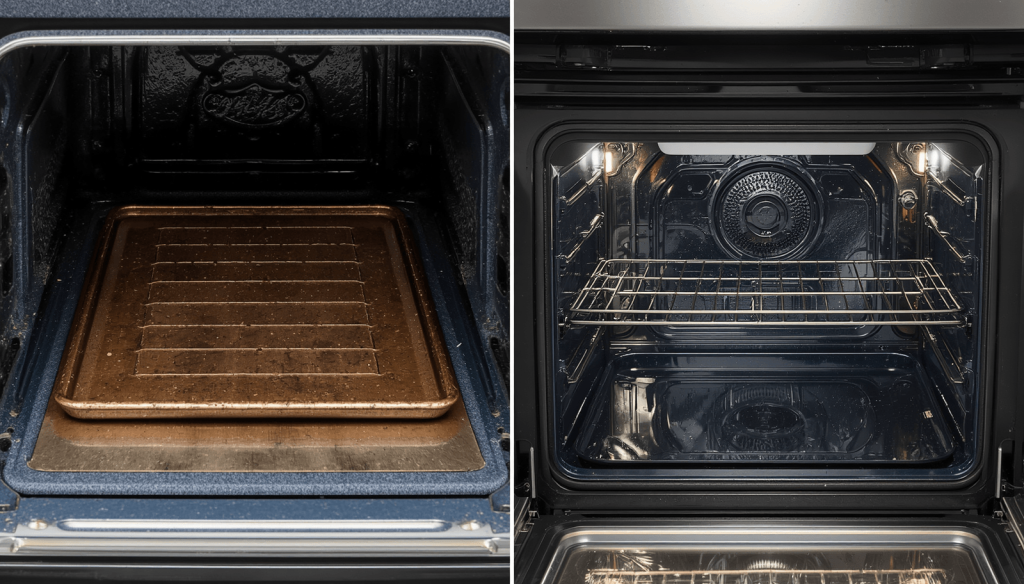
Across hundreds of oven repair calls in Chicago and the North Shore, the same problems appear repeatedly. Understanding them by name and symptom is the first step toward knowing whether you need a technician today or can wait until a scheduled appointment.
Bake Element Failure (Electric Ovens)
The bake element is the heating coil at the bottom of an electric oven cavity. It is the component that fails most frequently in electric ovens — typically after 5 to 7 years of regular use. A failing bake element produces uneven heat distribution before it fails completely: food burns on the bottom or on one side, the oven takes significantly longer to preheat, or the element develops a visible hot spot or discoloration.
When the element fails completely, the oven will not heat at all or will only heat from the broil element at the top — a clear diagnostic sign that the bake element specifically has failed rather than the entire electrical system. This is one of the most straightforward oven repairs a technician makes.
Igniter Failure (Gas Ovens)
The gas oven igniter is the component that heats to a high temperature, opens the gas safety valve, and ignites the gas that flows into the oven burner. A weakening igniter takes longer to reach the temperature needed to open the valve — which means the oven takes significantly longer to preheat, runs at a lower temperature than set, or fails to heat at all while the burner occasionally lights briefly and then goes out.
Igniter failure is the most common gas oven repair we perform across Chicago. It affects every major brand and is particularly common in ovens over 7 years old. The igniter is a wear component with a finite service life, and Chicago’s year-round cooking demands — amplified significantly during the winter holiday months — accelerate that wear.
Temperature Sensor Failure
The oven temperature sensor is a small probe, usually located at the upper back of the oven cavity, that continuously monitors internal temperature and communicates with the control board to regulate heating cycles. When the sensor drifts or fails, the oven runs at temperatures that do not match the set temperature — sometimes 25 to 75 degrees off in either direction.
This is the problem most commonly dismissed as “the oven just runs hot” or compensated for with longer cook times. An oven thermometer test (set to 350 degrees, read after full preheat) is the fastest way to confirm a sensor issue. A reading more than 25 degrees off in either direction warrants a technician call.
Control Board Failure
The oven control board manages every electronic function: temperature regulation, timer, self-clean cycle, convection mode, and display. A failing control board typically presents as a combination of secondary function failures before it affects primary heating — the self-clean cycle stops working, the timer becomes unreliable, or the display shows error codes that reappear after clearing.
When multiple electronic functions fail in a short period, the control board is almost always the common cause. Control board replacement is one of the more expensive oven repairs but extends functional life significantly when performed on a unit that is otherwise in good condition.
Door Gasket and Hinge Failure
The oven door gasket is the heat-resistant seal around the door frame that prevents hot air from escaping during cooking. A worn or damaged gasket causes the oven to lose heat continuously, forcing the heating element to run longer to compensate, increasing energy consumption, and making accurate temperature regulation impossible regardless of how well the element itself is functioning.
A bent or broken door hinge prevents the door from closing completely, with the same result. Both are among the least expensive oven repairs — gasket replacement typically costs $50 to $100 and hinge replacement runs $80 to $160 — and among the most impactful for restoring accurate cooking performance.
What Oven Appliance Repair in Chicago Costs: Real Numbers by Problem
Oven repair costs in Chicago vary by the specific component, the oven brand and model, and the parts availability for that unit. The following ranges represent typical total costs including parts and labor, based on Dara Appliance Repair service calls across Chicago and the North Shore.
OVEN REPAIR COST REFERENCE (Chicago, parts + labor)
Bake or broil element replacement (electric): $150 to $250
Igniter replacement (gas oven): $120 to $200
Temperature sensor replacement: $100 to $180
Door gasket replacement: $50 to $100
Door hinge replacement: $80 to $160
Infinite switch / burner switch replacement: $100 to $200
Control board replacement: $200 to $400
Gas valve replacement: $150 to $280
Diagnostic fee (waived with repair): $89
A few important notes on these ranges: premium brands (Viking, Thermador, Sub-Zero, JennAir) typically run 20 to 40 percent higher on parts cost due to proprietary components. Older models where parts must be sourced from specialty suppliers can extend the higher end of these ranges. Models where the control board is integrated into the display panel rather than a standalone component typically run toward the higher end of the control board range.
FIRST-REPAIR DISCOUNT: First-time Dara Appliance Repair customers receive 15% off their first repair. Our $89 diagnostic fee is waived when a repair is completed on the same visit — so you pay only for the work, not for finding out what the work is.
Before You Call: What to Check Yourself First
Professional oven repair is the right call for most oven problems. But a handful of checks take less than five minutes and can either resolve the issue entirely or give the technician precise information that makes the service visit faster and more efficient.
For Any Oven That Is Not Heating Correctly
- Verify the circuit breaker for the oven has not tripped (electric ovens) or the gas supply valve is fully open (gas ovens). Both are the first checks before any component diagnosis.
- Place an inexpensive oven thermometer on the center rack. Set the oven to 350 degrees and allow it to fully preheat. A reading more than 25 degrees above or below 350 confirms a temperature inaccuracy that warrants repair rather than recipe adjustment.
- For electric ovens: visually inspect the bake element at the bottom of the oven cavity (with the oven off and cool). A visible break, blister, or dark burn mark on the element confirms it has failed. If the element looks intact but the oven is not heating, the issue is the temperature sensor, control board, or wiring.
- For gas ovens: turn the oven on and listen for igniter clicking followed by a soft whomp of gas catching. If you hear clicking but no ignition after 30 to 60 seconds, the igniter is weakening. If there is no clicking at all, the igniter or its circuit has failed completely.
For an Oven Door That Is Not Sealing
- Close the oven door on a single sheet of paper. Try to pull it out with the door closed. If the paper slides out with minimal resistance, the door gasket has lost its seal and needs replacement.
- With the oven off and cool, open the door fully and examine the hinges on both sides. A hinge that is bent, cracked, or sitting unevenly in its bracket has failed. Both hinges should hold the door parallel to the oven frame with equal tension.
- Inspect the gasket around the door frame for tears, compression, or sections that have separated from the door. A gasket in good condition is uniformly attached and springs back when pressed. A failing gasket has flat, compressed, or missing sections.
For Error Codes or Unresponsive Controls
- Note the specific error code displayed. Look up the code in the owner’s manual or the manufacturer’s support page. Many error codes point directly to a specific component, which gives you precise repair information before the technician arrives.
- Perform a control board reset: turn off the circuit breaker for the oven for 60 seconds, then restore power. Some transient error codes clear with a reset and do not return. If the error code returns within a few cycles, the component it references needs repair or replacement.
- If the display is completely blank but the oven was working yesterday, check the circuit breaker first. A completely unresponsive display with confirmed power usually indicates a failed control board or a failed thermal fuse — both are technician repairs.
WHEN TO STOP AND CALL IMMEDIATELY: If you smell gas with the oven off and no burners lit, leave the house immediately without using any electrical switches, leave doors open, and call your gas provider’s emergency line before calling an appliance technician. This is a gas emergency, not an oven repair appointment.
What Happens During a Professional Oven Repair Visit
Most Chicago homeowners have never had an oven repaired professionally and are uncertain what to expect. Here is exactly what a Dara Appliance Repair service visit looks like, from booking to completion.
Before the Visit
When you book, we ask for the oven brand, model number (usually on a label inside the door frame or in the owner’s manual), and a description of the symptoms. The model number allows us to pre-identify the most likely components for your specific unit and bring the relevant parts on the service vehicle. For the most common oven problems — bake element replacement, igniter replacement, temperature sensor replacement — this means the repair is completed in a single visit without a return trip for parts.
The Diagnostic
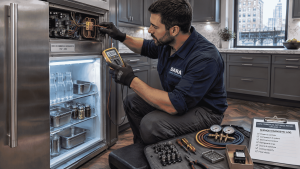
The technician begins with a full diagnostic before quoting any repair. This covers: verifying the symptom you described, running the oven through its heating cycle while testing electrical output at key components, inspecting the element or igniter for visible failure, testing the temperature sensor resistance against manufacturer spec, and checking the control board for error codes or failed outputs.
The diagnostic takes 20 to 40 minutes depending on the complexity of the oven. At the end, you receive a clear explanation of what failed, why it failed, and what the repair costs. There is no pressure to proceed — you make the decision with full information.
The Repair
If you approve the repair, the technician proceeds immediately using parts from the service vehicle where available. Most standard oven repairs — element replacement, igniter replacement, temperature sensor replacement, gasket replacement, hinge replacement — are completed within one to two hours. The technician tests the oven through a full heating cycle before leaving to confirm the repair has resolved the symptom.
If a specialized part needs to be ordered (common for premium brands and older discontinued models), the technician will provide a firm timeline for the return visit. Parts for most major brands are available within one to three business days from our suppliers.
After the Visit
Every repair comes with a written record of the work performed and the parts replaced. Sam and Dan are available by phone if a question arises after the visit. If the repair does not fully resolve the symptom — which is rare when the diagnostic correctly identifies the root cause — we return at no additional diagnostic charge.
Repair or Replace? How to Make the Right Call for Your Chicago Kitchen
The repair-or-replace question comes up in almost every oven service call for units over 10 years old. The 50 percent rule is the standard framework: if the repair estimate exceeds half the cost of a comparable new oven, replacement is generally the smarter investment. Applied to ovens specifically:
Repair Almost Always Makes Sense When
- The oven is under 10 years old and the repair involves a single standard component (element, igniter, sensor, gasket, hinge). These are wear items with predictable replacement costs well below the 50 percent replacement threshold.
- The oven is a premium brand (Viking, Thermador, Wolf, JennAir, Sub-Zero) of any age with a single failed component. A 15-year-old Viking range with a failed igniter is worth repairing because a comparable replacement costs $4,000 to $8,000. Even a $300 repair is trivial against that replacement cost.
- The oven is a freestanding gas range under 15 years old with any issue except a cracked burner body or heat exchanger failure. Gas ranges are mechanically simple and durable — most problems are isolated to a single replaceable component.
Replacement Deserves Serious Consideration When
- The control board has failed on a unit over 12 years old. Board replacement runs $200 to $400 and extends life, but a failing board on an aging unit suggests other electronic components are approaching the same threshold.
- Multiple components have failed in the same service visit. Two or three simultaneous failures on a 15-year-old unit is a signal about trajectory, not coincidence. The next repair is likely not far behind.
- The oven is an older electric range where the repair cost approaches 60 to 70 percent of a new comparable unit. This is the scenario where the math most clearly favors replacement.
- The oven has been repaired twice in the past 18 months and is failing again. Repeated repairs on aging units are a pattern, not a run of bad luck.
Sam and Dan will give you an honest assessment of this question after every diagnostic — including recommending replacement when that is the right answer. For more detail on how warning signs factor into the repair-or-replace decision, see our guide to signs your oven or stove needs professional repair.
Chicago-Specific Oven Repair Considerations
Chicago’s housing stock and climate create oven repair patterns that differ from national averages in a few specific ways that Chicago homeowners should know.
Older Gas Infrastructure in Pre-War Housing
Chicago has more pre-war bungalows, two-flats, and greystones than almost any other major American city. Many of these homes have gas lines and connections that have not been professionally inspected in decades. An oven igniter failure in a 1940s Lincoln Square greystone may be straightforward to replace, but a technician who is also verifying the gas connection condition is providing a service that goes beyond the appliance itself. Dara Appliance Repair technicians flag gas connection concerns during every gas oven service call.
Premium Appliances in North Shore Kitchens
Homes in Wilmette, Northbrook, Highland Park, and Deerfield frequently have Viking, Thermador, Wolf, and JennAir ranges that were installed during kitchen renovations 10 to 15 years ago. These appliances require technicians with specific brand experience — not every appliance repair company carries Viking igniter specs or Thermador control board configurations. Sam and Dan service all premium brands and carry the most commonly needed premium parts.
Holiday Season Demand Spike
Every year, oven repair calls across Chicago spike in October and November as holiday cooking season approaches and homeowners discover their oven has been degrading since spring. By mid-November, same-day availability becomes genuinely difficult. The homeowners who call in September and October get next-day appointments, standard rates, and enough lead time to order any specialty parts before the holiday rush.
If your oven has been behaving unusually for more than a few weeks — taking longer to preheat, cooking unevenly, requiring extra push to close the door — the time to call is before October, not after.
Oven Brands We Repair Across Chicago and the North Shore
Dara Appliance Repair handles oven appliance repair across all major brands in the Chicago market. We carry the most frequently needed parts for all major brands on every service vehicle and source specialty parts within one to three business days for premium and discontinued models.
Brands we regularly service include Viking, KitchenAid, Thermador, JennAir, Whirlpool, Samsung, GE, Maytag, LG, Kenmore, Bosch, and Frigidaire. Call us for any brand not listed here.
Ready to Book Your Oven Repair? Here Is How to Reach Us.
Dara Appliance Repair offers same-day and next-day oven appliance repair across Chicago and the North Shore, seven days a week, 8 AM to 8 PM. Most repairs are completed in a single visit. Our technicians, Sam and Dan, bring the most commonly needed parts on every service call so the diagnostic and repair happen in the same appointment wherever possible.
Our $89 diagnostic fee is waived when a repair is completed on the same visit. First-time customers receive 15% off their first repair. No hidden fees, no pressure — just a clear diagnosis and honest options.
Call Sam or Dan directly at (773) 377-4212 or book your oven repair online. Same-day appointments available — call before noon for same-day service in most areas.
We serve Chicago, Evanston, Skokie, Park Ridge, Niles, Glenview, Wilmette, Northbrook, Deerfield, Highland Park, Des Plaines, Oak Park, Berwyn, and Cicero. Monday through Sunday, 8 AM to 8 PM.
Call (773) 377-4212 or email dara.repairllc@gmail.com.
Frequently Asked Questions
How long does oven repair take in Chicago?
Most standard oven repairs are completed in a single visit of one to two hours. Bake element replacement, igniter replacement, temperature sensor replacement, gasket replacement, and hinge replacement are all typically completed on the first visit using parts from the service vehicle. Control board replacements and premium brand component repairs occasionally require a parts order of one to three business days, in which case a return visit is scheduled at no additional diagnostic charge.
Is it worth repairing a 10-year-old oven in Chicago?
In most cases, yes. A 10-year-old oven with a single failed component has 5 to 8 more years of reliable service life if properly maintained. The 50 percent rule is the standard decision framework: if the repair exceeds half the replacement cost of a comparable new unit, evaluate replacement. For most single-component failures on a 10-year-old oven, repair is well under that threshold. The one exception is a compressor-equivalent failure — the control board failing on an older unit that has already had other repairs — where the replacement conversation deserves more consideration.
Why is my oven taking so long to preheat?
Slow preheating on an electric oven is almost always a failing bake element. As the element degrades, it produces heat less efficiently and takes progressively longer to bring the oven to temperature. On a gas oven, slow preheating is almost always a weakening igniter — the igniter takes longer to reach the temperature needed to open the gas safety valve, which delays ignition and extends preheat time significantly. Both are straightforward repairs completed in a single visit.
Can I use my oven if the bake element is broken?
If the bake element is visibly damaged (you can see a break or burn mark), do not use the oven. A damaged element can arc electrically inside the oven cavity, creating a fire risk. If the element appears intact but the oven is simply not reaching temperature, you can use the broil function safely while awaiting repair — the broil element at the top of the oven is a separate component. Do not use self-clean mode if the bake element is compromised, as the self-clean cycle requires the element to operate at extremely high temperatures.
How do I find the model number of my oven for the repair appointment?
The model number is typically on a label inside the oven door frame on the left or right side — visible when you open the door and look at the inner edge of the door frame or the oven frame itself. On older freestanding ranges, the model number may also be on a label on the back of the range or inside a bottom drawer. Having the model number ready when you book allows the technician to pre-identify the most likely components for your specific unit and bring the right parts.
Does Dara Appliance Repair offer oven repair across Chicago suburbs?
Yes. Dara Appliance Repair makes same-day and next-day oven repair calls throughout Chicago and all surrounding suburbs including Evanston, Skokie, Park Ridge, Niles, Glenview, Wilmette, Northbrook, Deerfield, Highland Park, Des Plaines, Oak Park, Berwyn, and Cicero. Call (773) 377-4212 to check same-day availability in your area.
What is the difference between oven repair and stove repair?
Oven repair refers to problems with the oven cavity itself — the baking and broiling functions, the door, the thermostat, and the oven control system. Stove repair refers to the cooktop burners — the ignition system, gas valves, and surface elements on electric cooktops. Most full-size ranges combine both in a single unit. When you call Dara Appliance Repair, we handle both the oven and cooktop components of a range in the same service visit — you do not need to book separately for oven and stove problems on the same appliance.