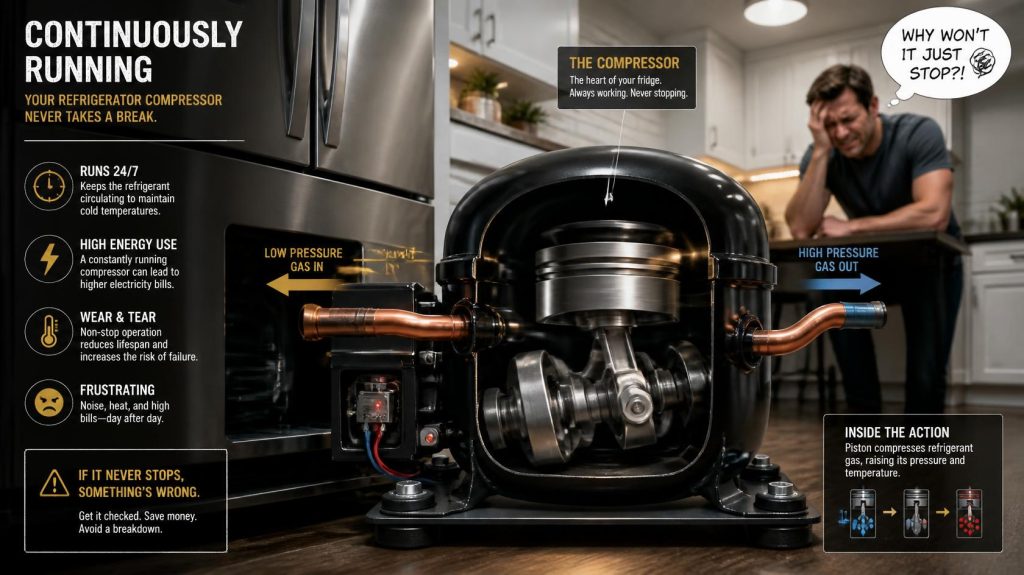
Why This Matters: The Energy-Bill Angle
Most homeowners notice a refrigerator compressor running constantly because of the sound, that low hum that never quite goes away. But the bigger problem is usually invisible: it’s sitting on your electric bill.
The refrigerator is one of the few appliances that runs 24/7, and the compressor is by far its biggest energy draw. ComEd’s residential supply rate has been trending upward through 2026, with the summer base rate sitting around 10.4 cents per kWh before delivery charges and taxes are added. When a compressor cycles normally, it might run 30-40% of the day. When it never shuts off, that number climbs toward 90-100%, which can roughly double or triple the refrigerator’s share of your monthly bill.
If your refrigerator runs all the time and you can’t explain why your electric bill has crept up, this is one of the most overlooked culprits in the kitchen. Chicago’s summer humidity makes it worse, since the compressor has to work harder just to keep up with the heat and moisture pulled in every time the door opens. It’s also one of the more common refrigerator repair calls we get during the hottest months, right alongside icemaker and cooling complaints.
The good news: most causes of a fridge compressor won’t stop situation are fixable, and a few of them cost nothing but ten minutes with a vacuum. Others need a trained eye, and that’s where knowing when to call for appliance repair versus when to try it yourself makes a real difference in cost.
How a Healthy Compressor Should Behave
Before troubleshooting, it helps to know what “normal” looks like. A properly functioning refrigerator compressor cycles on and off in intervals, typically running for 10-20 minutes, then resting for a similar stretch, more often in summer or right after the door has been open a lot.
Signs your compressor has crossed from “normal” into “constantly running” territory:
- You can’t remember the last time it went quiet
- The back or side panel near the compressor feels unusually warm to the touch
- The hum has gotten noticeably louder over the past few weeks
- Your electric bill jumped without a clear reason
- Food inside feels colder than usual, or inconsistently cold in different spots
If more than one of these sounds familiar, it’s worth working through the causes below before the compressor puts itself under more strain than it needs to.
6 Causes of a Refrigerator Compressor Running Constantly
1. Dirty Condenser Coils
The condenser coils release the heat the compressor pulls out of the fridge’s interior. When they’re coated in dust, pet hair, and kitchen grease, that heat has nowhere to go efficiently, so the compressor has to run longer and harder to hit the same temperature. This is the single most common cause of a refrigerator compressor running constantly Chicago homeowners report, and it’s also the easiest to fix yourself.
2. A Failing Thermostat (Temperature Control Board or Cold Control)
The thermostat tells the compressor when to start and stop based on the internal temperature. When it fails, it can get stuck in the “on” position, sending a continuous signal to run even after the fridge has reached temperature. This one usually isn’t a DIY fix, since it involves accessing internal wiring and control components that require refrigerator repair experience to diagnose safely.
3. Low Refrigerant (Sealed System Leak)
If refrigerant has leaked out of the sealed system, whether from a small crack in the line, a failed weld, or corrosion, the compressor can’t build enough pressure to cool efficiently. It compensates by running continuously, chasing a temperature it can’t reach. Refrigerant work legally requires EPA 608 certification, so this is never a homeowner repair. A sealed system leak is also one of the more serious causes on this list, since it can eventually damage the compressor itself if it’s left unaddressed.
4. Worn or Damaged Door Seals (Gaskets)
Warm air leaking in around a cracked, loose, or dirty door gasket forces the compressor to fight a losing battle. Even a small gap is enough to keep the compressor running well past its normal cycle. You can test this yourself with the dollar-bill trick: close the door on a dollar bill so it’s halfway in, halfway out. If it slides out with little resistance, the seal isn’t holding.
5. Blocked Airflow or an Overpacked Fridge
Vents inside the refrigerator and freezer circulate cold air throughout the unit. When they’re blocked by food packages pushed against the back wall, or when the fridge is packed so tightly that air can’t move, certain areas never reach set temperature. The compressor keeps running to compensate for the sections that stay warm.
6. A Compressor Nearing End of Life (or a Failing Start Relay/Capacitor)
Compressors typically last 10-15 years. As they age, the internal components that manage the start-and-stop cycle can wear down, causing the compressor to run longer than it should or fail to shut off cleanly. A worn start relay or capacitor produces similar symptoms and is a more affordable fix than a full compressor replacement, but it takes a trained technician to tell the two apart without guessing.
Simple Coil-Cleaning Tips You Can Do Today
Since dirty coils are the most common and most fixable cause, here’s how to clean them safely:
- Unplug the refrigerator. Always disconnect power before working near the coils.
- Locate the coils. On most modern refrigerators, they’re behind a grille at the bottom front. On older units, they may be on the back.
- Vacuum with a brush attachment. Work in the direction of the coils, not against them, to avoid bending the fins.
- Use a coil-cleaning brush for tight spots. A long, flexible brush (sold at most hardware stores) reaches between coils that a vacuum nozzle can’t.
- Wipe down the surrounding area. Dust and grease often build up on the floor and wall behind the fridge too.
- Plug back in and give it 24 hours. A properly cleaned unit should start cycling normally within a day.
Aim to do this every 6 months, more often if you have pets or the fridge sits near a cooking area. It’s the single cheapest thing you can do to head off a bigger repair bill later.
Diagnostic Checklist {#diagnostic-checklist}
| Symptom | Most Likely Cause | DIY-Fixable? |
| Coils visibly dusty, compressor warm to touch | Dirty condenser coils | Yes |
| Dollar bill slides out easily from closed door | Worn door seal | Sometimes (seal replacement) |
| Fridge runs nonstop but interior isn’t cold enough | Low refrigerant or failing compressor | No |
| Runs constantly, temperature swings unpredictably | Failing thermostat | No |
| One area warm, rest of fridge fine, packed tightly | Blocked airflow | Yes |
| Fridge is 10+ years old, hum has gotten louder over time | Aging compressor or start relay | No |
Brand-Specific Notes
- Side-by-side and French door models (common in many Chicago-area kitchens) tend to show blocked-airflow issues more often, since their narrower compartments are easier to overpack.
- Built-in and cabinet-depth refrigerators run condenser coils in tighter spaces with less airflow, so coil dust builds up faster and cleaning matters more.
- Refrigerators with electronic touch controls are more likely to show a failing thermostat as a control board issue rather than a simple mechanical switch, which usually means a technician visit rather than a DIY swap.
- Older units without electronic controls are more likely to have a straightforward mechanical thermostat or relay problem, which tends to be a faster, lower-cost appliance repair than a control board replacement.
Whatever the brand, our certified appliance technicians carry diagnostic tools that identify the exact cause without guesswork, so you’re not paying to replace a part that wasn’t the problem.
Prevention Checklist
- [ ] Vacuum condenser coils every 6 months
- [ ] Check door seals for gaps or cracking twice a year
- [ ] Avoid overpacking the fridge, especially near the back wall vents
- [ ] Leave a few inches of clearance behind and around the unit for airflow
- [ ] Keep the fridge out of direct sunlight and away from the stove or dishwasher
- [ ] Note how long your compressor typically runs so you’ll recognize when it changes
- [ ] Schedule an annual checkup if your fridge is 8+ years old
FAQs
1. Is it normal for a refrigerator compressor to run all the time? No. A healthy compressor cycles on and off, typically running 30-40% of the time. If your refrigerator runs all the time without ever cycling off, something is forcing it to work harder than it should, and it’s worth having it checked before it leads to a bigger repair.
2. How much does a constantly running refrigerator add to my electric bill? It varies by model and how long the issue has gone on, but since the compressor is the refrigerator’s biggest energy draw, running nonstop instead of cycling normally can meaningfully increase the appliance’s share of your monthly ComEd bill.
3. Can I clean the condenser coils myself? Yes. Unplug the fridge, locate the coils (usually behind the bottom front grille), and vacuum them with a brush attachment every 6 months. It’s one of the easiest ways to prevent the compressor from overworking, and it’s the first thing most refrigerator repair technicians check anyway.
4. Is a refrigerator compressor running constantly dangerous? It’s not an immediate safety hazard, but it does put extra wear on the compressor and can shorten its lifespan. Left unaddressed, some causes (like a refrigerant leak) can lead to a full compressor failure.
5. Can low refrigerant cause the compressor to run nonstop? Yes. When refrigerant has leaked out of the sealed system, the compressor can’t reach the target temperature and keeps running to try. This requires an EPA-certified technician to diagnose and repair legally and safely.
6. How do I know if it’s my door seal or something else? Try the dollar-bill test: close the door on a dollar bill so it’s halfway in. If it pulls out with little resistance, the seal has likely lost its grip and warm air is leaking in.
7. How old is too old for a refrigerator compressor? Most compressors last 10-15 years. If yours is in that range and running constantly, it’s worth getting a professional opinion on whether a repair makes sense or if replacement is more cost-effective.
8. When should I stop troubleshooting and call a technician? If cleaning the coils and checking the door seal don’t resolve it within 24-48 hours, or if the fridge isn’t reaching a safe temperature, it’s time to call. Continuing to run a struggling compressor can turn an affordable appliance repair into a full replacement.
When to Call a Certified Technician
Coil cleaning and a door-seal check are worth trying first, since they’re free and take minutes. But a refrigerator running non-stop for more than a day or two after those checks is a sign something bigger is going on. If your refrigerator compressor running constantly doesn’t improve, or if you suspect low refrigerant, a failing thermostat, or an aging compressor, it’s time to bring in a professional. Refrigerant handling in particular is not a homeowner job. It requires EPA certification and the right equipment to do safely and legally.
Dara Appliance Repair has been serving Chicago and the surrounding suburbs since September 2019, with a 4.9-star rating from local customers. Our certified appliance technicians diagnose the exact cause of a compressor that won’t cycle off and give you a straight answer on repair versus replacement, no guesswork, no unnecessary parts. Whether it’s a quick coil cleaning consultation or a full refrigerator repair, we’ll walk you through what’s actually wrong before any work begins.
Ready to stop the constant hum and the climbing electric bill?
📞Call (773) 377-4212
💰 Ask about 10% Off Your First Repair
$89 diagnostic fee, waived with repair
We serve Chicago, Evanston, Skokie, Park Ridge, Niles, Glenview, Wilmette, Northbrook, Deerfield, Highland Park, Des Plaines, Oak Park, Berwyn, Cicero, and Lincoln Park.