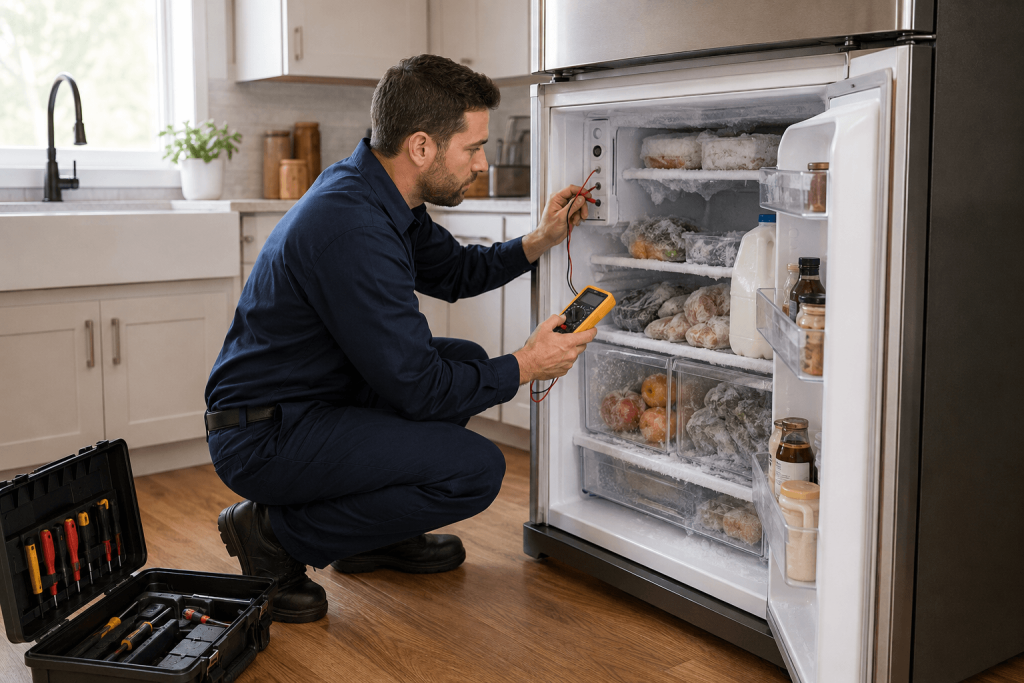
Quick Answer: A refrigerator too cold freezing food is almost always caused by one of five things: a bumped or miscalibrated thermostat, a damper stuck open, a faulty temperature sensor, overpacked or blocked vents concentrating cold air in one spot, or a worn door seal forcing the compressor to overcompensate. A simple fridge thermometer test (below) can usually tell you which one you’re dealing with in about 30 minutes. If it’s still freezing food after the easy fixes, same-day refrigerator repair is available: call (773) 377-4212 or book online.
How Fridge Temperature Actually Works: Cold air is made in the freezer, then shared with the fridge compartment through a vent and damper system. In a properly working fridge, most of that cold air stays in the freezer, with only a smaller share diverted into the fresh food section to keep it in the mid-30s to low 40s. When the balance shifts, whether from a stuck damper, a bad sensor, or a vent that’s gotten blocked, the fridge side ends up running far colder than it’s set to, sometimes cold enough to freeze produce, eggs, and drinks solid.
The FDA recommends keeping refrigerator temperature at or below 40°F and freezer temperature at 0°F, and specifically flags overpacking as a risk since cold air needs room to circulate around food to keep it properly chilled. Most manufacturers suggest targeting closer to 37°F rather than the coldest setting available, since anything consistently below the mid-30s starts putting high-water-content foods like lettuce, milk, and soft drinks at risk of freezing before harder items like condiments or hard cheese.
Table of Contents
- Cause 1: Thermostat Set Too Cold or Bumped
- Cause 2: Damper Stuck Open
- Cause 3: Faulty Temperature Sensor (Thermistor)
- Cause 4: Overpacked or Blocked Vents
- Cause 5: Worn Door Seal Forcing Overcompensation
- The At-Home Temperature Test
- DIY Fixes vs. When to Call a Pro
- Brand-Specific Notes
- Prevention Checklist
- FAQs
Refrigerator Too Cold Freezing Food? Here’s Why
Most homeowners searching for a refrigerator too cold freezing food fix assume something expensive has failed, when in reality this is often one of the cheaper refrigerator problems to diagnose. Unlike a fridge that’s not cooling at all, a fridge that’s overcooling means every major system (compressor, evaporator, fans) is working. Something is just telling it to work too hard, or letting too much of what it makes reach the wrong compartment. Here are the five causes, roughly in order of how often we see them.
1. Thermostat Set Too Cold or Bumped
The simplest and most common cause. On dial-style thermostats, “coldest” settings often push the fridge compartment close to or below freezing, not just “extra cold.” Dials also get bumped accidentally when loading groceries or cleaning shelves.
- What it looks like: Freezing started right after cleaning the fridge, moving items around, or letting kids “help” put groceries away.
- The fix: Set the dial to the middle of its range (or 37°F on a digital control) and wait 24 hours before judging the result. Refrigerators take time to stabilize after any setting change.
2. Damper Stuck Open
The damper is a small motorized flap that controls how much cold air crosses from the freezer into the fridge. When it sticks in the open position, usually from ice buildup or a failed actuator, cold air floods in nonstop regardless of what the thermostat says.
- What it looks like: One specific area of the fridge (often the top shelf, directly under the vent) freezes items consistently while the rest of the fridge stays normal. This localized freezing pattern is one of the more reliable signs of a stuck damper.
- The fix: The damper is usually behind a vented plastic cover at the top rear of the fridge compartment. Confirming it’s stuck typically means removing that cover, which is a reasonable DIY step, but replacing the damper itself is better left to a technician.
3. Faulty Temperature Sensor (Thermistor)
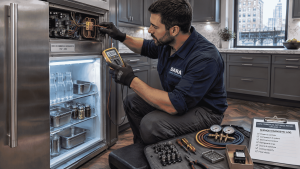
The thermistor reads the fridge’s actual temperature and reports it to the control board, which decides how hard to run the compressor and how long to keep the damper open. When the thermistor misreads the temperature, usually by drifting or failing, the control board runs the system harder than it needs to.
- What it looks like: Gradual, worsening overcooling rather than a sudden change. Refrigerator temperature too low readings on an appliance thermometer with no corresponding dial change is the clearest sign.
- The fix: Testing a thermistor requires a multimeter and knowledge of the expected resistance range for your model, which puts this one solidly in professional-repair territory.
4. Overpacked or Blocked Vents
Vents distribute cold air across the fridge compartment. When shelves are overpacked, or containers are pushed directly against a vent opening, cold air concentrates in that one spot instead of spreading evenly. This is also the exact habit the FDA specifically warns against, since it interferes with the circulation the whole system depends on.
- What it looks like: Fridge ice on food that’s specifically stored near a vent, back wall, or top shelf, while food on lower shelves or in the door stays at a normal temperature.
- The fix: Rearrange contents so nothing sits directly against a vent, and leave a small gap between food and the back wall of the fridge, where the coldest air typically concentrates.
5. Worn Door Seal Forcing Overcompensation
This one’s less intuitive: a bad door seal usually gets blamed for a fridge running warm, but it can also cause overcooling. When warm air constantly leaks in, the thermostat reads that as the fridge needing to run colder and longer, which can overcorrect and freeze items closest to the evaporator and vents.
- What it looks like: Fridge freezing food in refrigerator section combined with visible condensation around the door frame or a seal that fails the dollar-bill test.
- The fix: Clean the gasket first, since grime alone can prevent a proper seal. Replace it if it’s visibly cracked or doesn’t grip a dollar bill when the door is closed on it.
The At-Home Temperature Test
You don’t need special tools for this. An appliance thermometer (or even a reliable kitchen thermometer) and about 30 minutes are enough to narrow down which of the five causes you’re dealing with.
- Place a thermometer in a glass of water on the middle shelf, away from vents and the door. Wait at least 30 minutes for a stable reading. This tells you the fridge’s actual average temperature, not just the display setting.
- Repeat the test near the vent (usually top rear) and near the door. A big gap between these readings (5°F or more) points toward a damper or vent-blockage problem rather than a thermostat or thermistor issue, since a true thermostat or sensor failure tends to overcool the whole compartment evenly.
- Turn the thermostat dial from lowest to highest and listen for a click. No click when crossing from “off” to “on” usually means the thermostat itself needs replacing.
- Run the dollar-bill test on the door seal. Close the door on a dollar bill and try to pull it out. If it slides out easily, the seal isn’t holding, which can contribute to overcompensation.
If the whole fridge reads evenly too cold, suspect the thermostat or thermistor. If one spot reads far colder than the rest, suspect the damper or a blocked vent.
DIY Fixes vs. When to Call a Pro
| Step | DIY-Safe? | What to Do |
| Adjust thermostat to mid-range setting | Yes | Wait 24 hours before judging results |
| Rearrange food away from vents | Yes | Leave a small gap near the back wall and top vent |
| Run the dollar-bill door seal test | Yes | Clean gasket first, replace if it fails the test |
| Run the thermometer test above | Yes | Takes about 30 minutes, no tools required |
| Inspect the damper for visible ice or debris | Yes, inspection only | Remove the vented cover to look, don’t force the flap |
| Replace a stuck or broken damper | No | Involves interior panel removal and sometimes wiring |
| Test or replace a thermistor | No | Requires a multimeter and model-specific resistance values |
| Diagnose a control board issue | No | Involves electrical diagnostics best left to a certified technician |
If you’ve worked through the checks above and your refrigerator too cold freezing food problem hasn’t resolved, it’s time to call for appliance repair. Damper and thermistor issues don’t resolve on their own and tend to get more inconvenient (and occasionally more expensive) the longer they run unaddressed. Same-day service is available: call (773) 377-4212 or book online.
Brand-Specific Notes
- Whirlpool, Kenmore, GE, and most builder-grade models: Standard damper-and-thermostat design; the diagnostic order above applies directly.
- Samsung and LG: Digital temperature controls are more precise than dial thermostats but can still drift out of calibration over time, and their dual-cooling designs sometimes make one compartment overcool independently of the other.
- Sub-Zero and Viking: Dual refrigeration systems mean an overcooling issue is usually isolated to one compartment’s specific thermistor or control module rather than a shared damper. Our certified technicians have experience working on dual refrigeration systems in these builds.
- Older units (10+ years): Mechanical dial thermostats in older refrigerators are more prone to drifting out of calibration than the digital sensors in newer models, so if your fridge is older and reasonably reliable otherwise, start with the thermostat before assuming a bigger problem.
Prevention Checklist
- Avoid setting the thermostat to the coldest setting unless you’ve confirmed with a thermometer that it’s actually needed
- Keep food a few inches away from vents and the back wall, since the FDA specifically warns against overpacking for exactly this reason
- Run the dollar-bill door seal test twice a year
- Keep an appliance thermometer in the fridge year-round so you catch drift early, before food is lost
- After any deep clean or reorganization, wait 24 hours before assuming a temperature change is a real problem rather than the fridge re-stabilizing
FAQs
Why is my refrigerator too cold freezing food? The most common causes are a thermostat set too cold or bumped, a damper stuck open, a faulty temperature sensor, overpacked vents, or a worn door seal forcing the system to overcompensate. A simple at-home thermometer test can usually narrow it down.
Why is only one area of my fridge freezing food, not the whole thing? Localized freezing, especially near the top rear vent, almost always points to a stuck damper or a blocked vent rather than a thermostat or sensor problem, since those tend to overcool the entire compartment evenly.
What temperature should my refrigerator actually be? The FDA recommends 40°F or below for the fridge and 0°F for the freezer, with most manufacturers suggesting a target closer to 37°F. Anything consistently below the mid-30s puts high-water-content foods at risk of freezing.
Can a bad door seal really cause a fridge to freeze food? Yes. A leaking seal makes the thermostat think the fridge needs to run colder and longer than it actually does, which can overcool the areas closest to the vents and evaporator even though the root cause isn’t the cooling system itself.
How do I know if it’s the damper or the thermostat? Test the temperature in multiple spots. An even, whole-fridge overcooling points to the thermostat or thermistor. A big difference between one spot and the rest points to the damper or a blocked vent.
Can I fix a refrigerator that’s too cold myself? Adjusting the thermostat, rearranging food away from vents, and checking the door seal are all safe DIY steps. Damper replacement and thermistor testing involve panel removal and multimeter diagnostics best left to a certified technician.
Is refrigerator temperature too low dangerous, or just inconvenient? Mostly inconvenient and wasteful (frozen produce and drinks usually just get thrown out), but a fridge running that cold is also a sign something in the system isn’t regulating correctly, and it’s worth diagnosing before it develops into a bigger issue.
Do you offer same-day refrigerator repair for overcooling issues in Chicago? Yes. Same-day refrigerator repair is available across Chicago and the surrounding suburbs for damper, thermostat, and thermistor issues.
Closing Service Bio
Dara Appliance Repair LLC diagnoses refrigerator too cold freezing food calls for homeowners across Chicago and 14 surrounding suburbs, including Evanston, Skokie, Park Ridge, Niles, Glenview, Wilmette, Northbrook, Deerfield, Highland Park, Des Plaines, Oak Park, Berwyn, Cicero, and Lincoln Park. Our certified technicians can usually tell within minutes whether you’re looking at a five-minute thermostat fix or a damper and thermistor repair. Same-day appointments are available, along with a 10% discount on your first refrigerator repair. Call (773) 377-4212 or book online.