You have a repair quote in one hand and a ten-year-old dryer in the other. Paying to fix something that old feels risky, and buying new feels like spending on a machine that might have had years left.
That tug-of-war is the classic repair or replace dryer dilemma, and there is a clear way through it. Here is the short answer first, then the reasoning behind it.
Is it worth repairing a 10-year-old dryer?
Often, yes. A 10-year-old dryer sits a few years short of the roughly 13-year average lifespan, so a modest repair on an otherwise sound machine usually pays off. Replacing starts to win when the quote is high, several parts are failing together, or this is a repeat repair.
Age is only the starting point, though. The sections below cover the numbers behind that answer and the three checkpoints that settle it for your dryer.
Where a 10-Year-Old Dryer Sits on the Lifespan Curve
The home inspectors’ association InterNACHI puts a clothes dryer at 13 years in its life expectancy chart. It calls its figures guidelines rather than guarantees, since use and upkeep change the outcome.
At ten years old, then, your dryer is roughly three years shy of the average. That is worth knowing, but it does not mean the machine is on borrowed time.
Dryers are also among the simpler appliances in the house. Consumer Reports says they have fewer parts than washers and typically run for around a decade. It also reports that 90 percent of the dryers bought between 2015 and 2025 were still in use.
Rule Out the Cheap Culprit First
Before you settle on either path, check airflow. A clogged lint screen or a crushed vent duct can make a healthy dryer look broken.
Consumer Reports found in its 2025 survey of 86,609 dryer owners that the most common complaint, at 12 percent, was a dryer that simply was not drying. Its advice is to clean the lint screen, check the exterior ducting, and replace any vinyl or foil duct with a metal one.
Look up your model number on the manufacturer’s website too. If your problem ties back to a recall, the fix may be covered.
If clothes are still damp after all that, it is time for a real diagnosis.
Three Checkpoints for a Repair or Replace Dryer Decision
Age sets the stage, and three checkpoints decide the outcome. It is the same logic behind any good appliance repair recommendation, and the one our certified appliance technicians walk homeowners through.
Checkpoint 1: What Actually Failed
Not every dryer problem costs the same to fix.
A heating element, a thermal fuse, or a similar single wear part is usually worth repairing on a machine that is otherwise healthy. What matters is whether the drum and motor are still in good condition.
If the drum bearings, the motor, and the heating element all need work, the picture changes. You would be paying to fix a dryer that is wearing out everywhere at once.
Checkpoint 2: What the Repair Costs
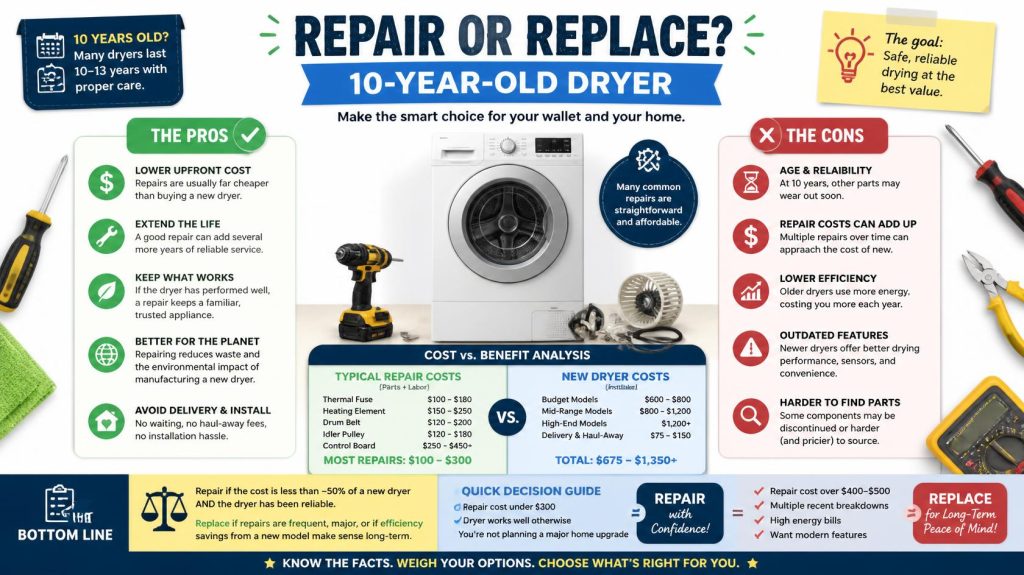
Our rule of thumb starts with two numbers. When only a wear part has failed and the drum and motor are sound, a repair under about $250 is generally worth making. Once a quote passes roughly $350 to $400, replacing deserves serious thought.
Treat those numbers as a guide, not a hard line. Between them, original price and workload break the tie. Consumer Reports notes that pricier dryers stay worth repairing longer, because a typical repair is a smaller share of what the machine is worth. Its 2024 survey put median repair costs at $116 to $200 for gas dryers and $118 to $188 for electric ones, rising with the dryer’s price.
Consumer Reports also gives a cautionary example: a $600 electric dryer bought nine years ago and run about seven loads a week. Even a median $118 repair, it says, makes little financial sense in that case.
You may have heard of the 50 percent rule, which says to replace when a repair costs more than half of a comparable new dryer. It is a fair sanity check, but a dollar range is easier to hold against a real quote.
When you compare costs, count the whole price of replacing, not just the sticker. Delivery, installation, hauling away the old dryer, and any new cord, vent, or hookup can add up.
One point in favor of replacing: Consumer Reports notes that ENERGY STAR certified dryers use about 20 percent less energy than conventional ones. Over several years, that counts for something.
Checkpoint 3: Your Repair History
One repair after ten years is normal. A second major repair within about two years is a pattern.
If that describes your dryer, it points toward replacing instead of paying for another fix.
The Checkpoints at a Glance
This is the whole framework in one place, so you can hold it against a quote before making a repair or replace dryer call.
| Checkpoint | Lean toward repair | Lean toward replace |
|---|---|---|
| What failed | A heating element, thermal fuse, or similar single wear part | Drum bearings, motor, and heating element all need work |
| Drum and motor | In good condition | Worn or failing |
| Repair quote | Under about $250 | Over about $350 to $400 |
| Repair history | No major repair in the last couple of years | Second major repair in about two years |
If your dryer lands mostly in the left column, repairing is usually the sound choice. If it lands mostly in the right column, replacing usually makes more sense. A split result, or a quote between $250 and $350, is where an honest second opinion earns its keep.
Safety Comes Before Savings
Some symptoms are not a price question. Stop using the dryer and have it inspected if you smell burning during a cycle or the outside of the machine gets very hot.
Clothes that need two or more cycles to dry are a warning sign too, and a good reason to check the vent. Lint and restricted airflow can cause overheating, which is why we take these signs seriously.
Questions to Ask Any Appliance Repair Company Before You Say Yes
A fair appliance repair quote makes a repair or replace dryer choice easier, so ask whoever gives you one:
- What exactly failed, and how did you confirm it?
- Did you check the drum, motor, and other major parts, or only the one that failed?
- Is the price itemized into parts, labor, and any diagnostic fee?
- Does the repair come with a warranty?
- If this were your own dryer, would you fix it?
A straight answer to that last question tells you a lot.
At Dara Appliance Repair, our certified appliance technicians will not recommend a repair that does not make sense for your budget. If the honest answer is to replace, we will say so, and our diagnostic fee is waived when you go ahead with a repair.
So, Repair or Replace?
For most 10-year-old dryers with one failed wear part and a fair quote, repairing is the sensible move. When the drum, motor, and heating element all need attention, when the quote runs past $350 to $400, or when this is a second major repair in two years, replacing deserves a real look.
If you want a second opinion, our certified appliance technicians handle dryer repair in Chicago and the surrounding suburbs, seven days a week. We diagnose the problem, explain it in plain language, and tell you straight if replacing makes more sense. You decide what happens next.
Ready to talk it through? Book a dryer diagnostic or contact our team with your quote in hand. We are glad to help with your repair or replace dryer question, even when the answer is not to book a repair.
If a matching washer is showing its age too, our washer repair page covers what we service.
Frequently Asked Questions
How long does a dryer last?
InterNACHI’s chart lists 13 years for a clothes dryer. Use, upkeep, and venting can move that number up or down, so treat it as a guide rather than a deadline.
How much does dryer repair cost?
In Consumer Reports’ 2024 survey, median repair costs ran from $116 to $200 depending on the dryer type and price. Our typical appliance repair falls between $129 and $400. Your own quote depends on the part and the model.
What if my dryer is older than 13 years?
Age alone does not settle it. The same checkpoints apply, but a dryer past its average lifespan has less room for an expensive repair, so a high quote or a second major repair counts for more.
Is a burning smell a reason to replace my dryer?
Not automatically, but it is a reason to stop using the dryer right away and have it inspected. The cause could be lint, airflow, or a part that is failing. The answer might be a simple repair, or it might tip the decision toward replacing.