By the Dara Appliance Repair Team | Serving Chicago and the North Shore
If your refrigerator sits in a garage or back porch, Chicago’s winter temperature swings are quietly damaging it right now. Here is what every Chicago homeowner needs to know about refrigerator repair Chicago and cold weather damage before the first hard freeze.
Every November, Chicago homeowners fire up their heating systems, dig out their coats, and do exactly one thing they probably shouldn’t: forget completely about the refrigerator sitting in the garage.
That secondary fridge — the one holding overflow groceries, holiday drinks, and leftovers from last Sunday’s family dinner — is about to spend the next four months exposed to some of the most punishing temperature swings in the country. And most Chicago homeowners have no idea that those swings are quietly destroying the compressor inside it.
Chicago winters are not just cold. They are unpredictable. A single week in January can swing from 5 degrees Fahrenheit to 42 degrees and back again. For a refrigerator designed to operate in a climate-controlled kitchen, that kind of thermal chaos is a stress test it was never built to pass.
In this post, we break down exactly why cold weather is so damaging to refrigerators, the warning signs most homeowners miss, and what you can do right now to protect your appliance before the temperature drops below 35 degrees and the damage begins.
Why Your Garage Refrigerator Repair Chicago Struggles Winter Temperatures
Here is something the appliance manual never mentions: every refrigerator sold in the United States is calibrated to operate within an ambient temperature range of roughly 60 to 90 degrees Fahrenheit. That is the range engineers assume when they set the compressor cycling logic, the thermostat sensitivity, and the refrigerant charge pressure.
Your garage in February does not care about any of that. On a cold night in Rogers Park or Des Plaines, an uninsulated garage can drop to 10 or 15 degrees. A back porch in Evanston or Berwyn offers almost no protection at all. Once the ambient temperature around your refrigerator falls below the temperature it is trying to maintain inside the cabinet, the entire system starts to behave erratically.
The compressor stops cycling because the thermostat reads the ambient air as already cold enough. The freezer section warms up. Food spoils. Refrigerant thickens and flows poorly. And the compressor, when it does run, works harder than it should to compensate — wearing down components that were never designed for that kind of strain.
The Science Behind Cold Weather Compressor Failure
The compressor is the heart of your refrigerator. It pressurizes the refrigerant that circulates through the system, pulling heat out of the cabinet and releasing it through the condenser coils at the back or bottom of the unit. When it fails, the refrigerator stops cooling entirely. Compressor replacement is one of the most expensive refrigerator repairs in Chicago — often running between $300 and $600 in parts and labor.
Cold weather creates three specific conditions that accelerate compressor damage:
- Refrigerant viscosity changes. Most household refrigerators use refrigerant blends that are optimized for moderate temperatures. In extreme cold, the refrigerant becomes more viscous and does not circulate as efficiently. The compressor has to work harder to push it through the system, generating excess heat and mechanical stress.
- Oil pooling. Compressor oil lubricates the moving parts inside the compressor housing. In very cold temperatures, this oil can pool at the bottom of the compressor rather than circulating properly. When the compressor starts up with insufficient lubrication, the internal components begin to wear — and that wear is cumulative and irreversible.
- Thermostat confusion. Many refrigerators use the ambient temperature to help regulate cooling cycles. When the outside air is already at or below the target refrigerator temperature, the thermostat may not trigger the compressor at all. The result is a freezer that barely freezes and a refrigerator section that slowly creeps above safe food storage temperatures.
The Chicago-Specific Problem: Temperature Swings Are Worse Than Sustained Cold
A refrigerator sitting in a consistently cold environment — say, a properly insulated cold storage room held at 40 degrees — will generally function better than one exposed to Chicago’s signature temperature chaos.
The real damage comes from the swings. When temperatures cycle repeatedly between sub-freezing and above-freezing — which happens multiple times per week throughout a Chicago winter — several damaging processes repeat over and over:
- Refrigerant lines expand and contract, stressing seals and joints
- Moisture condenses and refreezes inside and around components, accelerating rust and corrosion
- Door gaskets stiffen in the cold and crack over time, compromising the seal that keeps cold air in
- The compressor starts and stops erratically, far more frequently than it would in a stable indoor environment
Homeowners in Skokie, Niles, Park Ridge, and Cicero who keep a garage refrigerator often call us in late February or March wondering why their unit suddenly stopped working. In most cases, the damage has been accumulating since November. By the time the failure is obvious, multiple components have been affected.
Warning Signs Your Refrigerator Is Struggling With the Cold
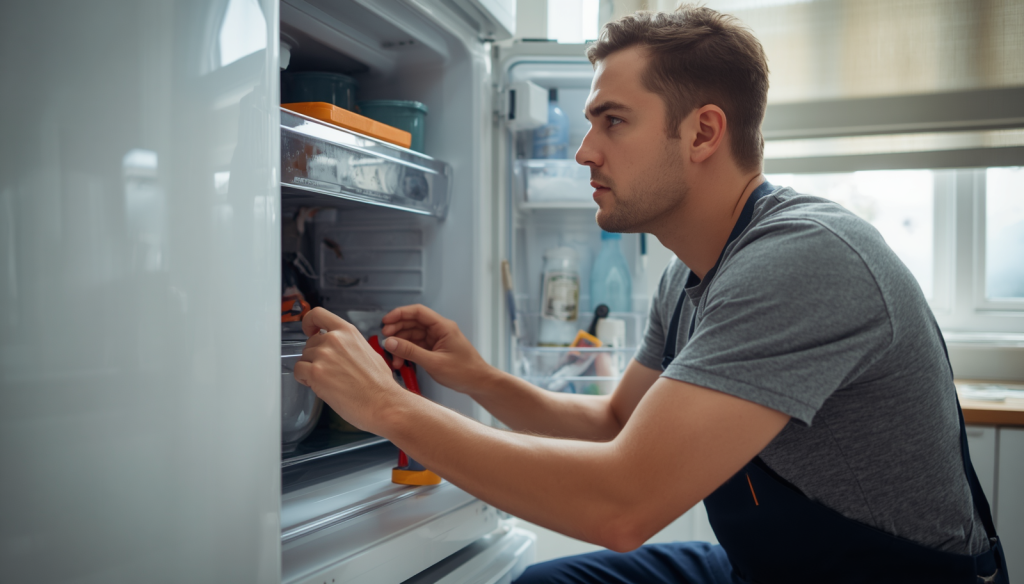
Cold weather refrigerator damage is rarely a single catastrophic failure. It tends to show up as a series of small, easy-to-dismiss symptoms that get progressively worse. Watch for these signs:
- Freezer items are thawing or developing freezer burn faster than usual. This often signals the compressor is not running consistently. If the problem persists, freezer repair may be needed to prevent full food loss.
- The refrigerator is running constantly but not maintaining temperature. Overworked compressor, possibly low on refrigerant due to a cold-weather seal failure.
- Unusual noises — clicking, buzzing, or a loud startup sound. These are classic compressor strain sounds, especially prominent when the unit has been sitting in the cold overnight.
- Condensation or frost buildup inside the cabinet. A damaged door gasket lets warm air in, which freezes on contact with the cold interior.
- Food in the main compartment is freezing. Counterintuitively, this can indicate a thermostat malfunction caused by low ambient temperatures.
If you are noticing any of these signs, the best time to call a technician is now — before the compressor fails completely and the repair cost jumps significantly.
How to Protect Your Garage or Porch Refrigerator This Winter
The good news is that most cold weather refrigerator damage is preventable. Here is what Chicago homeowners should do before temperatures drop below 35 degrees:
1. Check if your model has a garage kit
Several major brands — including Whirlpool, Maytag, and GE — offer optional garage kits that add a small heating coil near the thermostat. This tricks the system into cycling normally even when ambient temperatures drop well below freezing. If your model supports this, it is a low-cost solution worth considering before winter arrives.
2. Insulate the space around the refrigerator
You do not need to insulate the refrigerator itself — insulating the garage or the immediate area around the unit can significantly buffer temperature swings. Even basic weatherstripping on the garage door and a small space heater set to hold the temperature above 40 degrees can extend the life of a garage refrigerator by years.
3. Inspect and replace door gaskets before winter
Gaskets that are already slightly worn will crack and shrink significantly in cold temperatures. Run your hand around the closed door of your garage refrigerator. If you feel cold air escaping at any point, the gasket needs to be replaced before winter. This is a straightforward repair that a technician can complete in under an hour.
4. Have the compressor and refrigerant levels checked
If your garage refrigerator is more than five years old and has never been serviced, a pre-winter diagnostic is a smart investment. A technician can check refrigerant levels, inspect the compressor, and clean the condenser coils — all of which directly affect how well the unit handles cold-weather stress. At Dara Appliance Repair, our $89 diagnostic fee is waived when a repair is completed, making it a no-risk way to catch problems early.
When to Repair vs. Replace a Cold-Damaged Refrigerator
If your refrigerator has already been through multiple Chicago winters and is showing symptoms, the repair-or-replace question is worth thinking through carefully.
As a general rule, if the repair cost is less than 50 percent of what a comparable new unit would cost, repair is almost always the right call — especially for higher-end brands like Samsung, LG, and GE where replacement costs are significant. If the compressor itself has failed and the unit is more than ten years old, that math starts to shift toward replacement.
Our technicians, Sam and Dan, have built a 4.9-star reputation across Chicago by giving homeowners straight answers after every diagnostic. We do not quote repairs we would not recommend to our own families.
Don’t Wait Until February to Find Out Something Is Wrong
Chicago temperatures typically drop below 35 degrees by late October. Once temperatures fall and your garage refrigerator starts struggling, getting a technician out quickly — before the compressor fails completely — can be the difference between a $150 repair and a $500 one.
If your garage refrigerator is more than five years old and has never been serviced, that window is closing fast. Call Sam or Dan directly at (773) 377-4212 to schedule a refrigerator diagnostic. The $89 fee is waived when a repair is completed — so you have nothing to lose by finding out now before a small problem becomes a $500 compressor replacement.
Dara Appliance Repair serves Chicago, Evanston, Skokie, Park Ridge, Niles, Glenview, Wilmette, Northbrook, Deerfield, Highland Park, Des Plaines, Oak Park, Berwyn, and Cicero. We offer same-day and next-day availability, a 15% first-repair discount, and a flat $89 diagnostic fee that is waived when a repair is completed.
Call us today at (773) 377-4212 or email dara.repairllc@gmail.com.
Frequently Asked Questions
Can a refrigerator be kept in a cold garage in Chicago?
Yes, but it requires preparation. Most standard refrigerators are not rated for ambient temperatures below 60 degrees Fahrenheit. In a Chicago garage that drops into the teens or below, you will need either a garage-rated model, a manufacturer-approved garage kit, or a way to keep the surrounding temperature above 40 degrees. Without these measures, compressor failure and thermostat problems are likely over time.
What temperature is too cold for a garage refrigerator?
Most refrigerators begin to malfunction when ambient temperatures drop below 35 to 40 degrees Fahrenheit. Below 35 degrees, the thermostat may stop triggering the compressor entirely, causing the freezer to warm up even as the surrounding air is freezing cold. Some newer models are built to handle temperatures down to 0 degrees, but these are specifically marketed as garage-ready units.
Does Dara Appliance Repair service garage refrigerators in Chicago suburbs?
Yes. Dara Appliance Repair makes same-day and next-day service calls throughout Chicago and all surrounding suburbs including Evanston, Skokie, Niles, Park Ridge, Des Plaines, Glenview, Wilmette, Northbrook, Deerfield, Highland Park, Oak Park, Berwyn, and Cicero. Call (773) 377-4212 to check availability in your area.
How do I know if my refrigerator compressor is damaged?
Common signs of compressor damage include loud clicking or buzzing when the unit starts up, the refrigerator running constantly without maintaining temperature, the freezer failing to stay frozen, and the unit being warm inside despite running. If you notice any of these symptoms, especially after a stretch of very cold weather, schedule a diagnostic appointment as soon as possible. Early intervention almost always results in a lower repair cost.
How much does refrigerator repair cost in Chicago?
Refrigerator repair costs in Chicago vary by the type of repair needed. Thermostat replacements typically run $150 to $250 including parts and labor. Door gasket replacements are generally $100 to $200. Compressor repairs or replacements are the most significant, typically $300 to $600 depending on the brand and model. Dara Appliance Repair charges an $89 diagnostic fee that is waived when a repair is completed, so you only pay for the actual work.