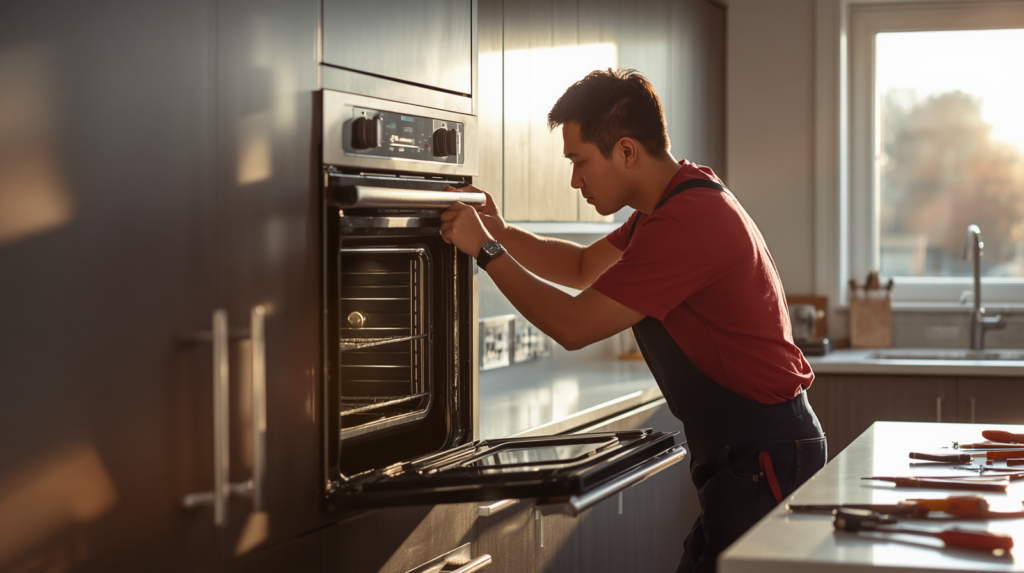
Your wall oven stopped heating, and it sits snug inside a cabinet that was built around it. Before you book anyone, it helps to know how that setup changes built-in oven repair.
The short version: the oven itself works much like any other oven. What changes is how a technician reaches the parts, and in a compact Chicago kitchen, that access is where most of the extra care goes.
What makes built-in oven repair different from range repair?
A built-in wall oven is screwed into a cabinet cutout and wired directly to the house. A technician fixes what they can from the front and slides the oven out only when the fault sits behind it. A freestanding range simply pulls forward. That access step is the main difference in time and labor.
Here is how the two setups compare when something breaks:
| Built-in wall oven | Freestanding range | |
|---|---|---|
| How it’s installed | Mounted in a cabinet cutout, usually hardwired | Stands on the floor, plugs in or connects to a gas line |
| Typical access | Front first; slides out of the cabinet for rear repairs | Pulls forward from the wall |
| Common front-access fixes | Bake element, temperature sensor, door gasket, hinges | Same, plus cooktop parts from above |
| What it takes to reach the back | Two people, trim removal, support for the oven’s weight | Clear floor space and room to pull out |
| Main risk during service | Scratched cabinet faces, bent trim | Damaged flooring, missed anti-tip bracket |
| Replacement fit | Must match the cutout size | Usually fits any space of the same width |
Why Chicago homes raise the stakes
A big share of the city still lives in buildings designed a century ago. According to the Chicago Bungalow Association, more than 80,000 bungalows are still standing, close to a third of the city’s single-family homes. Two-flats and their larger cousins add even more, making up over 30 percent of Chicago’s housing according to the Chicago Architecture Center.
Those kitchens were laid out for the appliances of their day. When owners remodel a narrow bungalow or two-flat kitchen, a wall oven paired with a separate cooktop is a popular way to win back counter space. The result looks great, but it also means the oven lives in tight quarters.
Tight galley and corner layouts
In a galley kitchen, a wall oven may sit beside a refrigerator, a pantry cabinet, or a doorway. There is often just enough room to open the oven door, and not much more. A technician has to plan where the oven will rest if it comes out, and how to protect the cabinets on both sides.
Condo and vintage building logistics
High-rise condos and older walk-ups bring their own steps. Some buildings ask contractors to reserve the service elevator, check in with management, or use a back entrance. Narrow back stairs in a vintage two-flat also limit what a technician can carry in at once.
None of this blocks the repair. It just means a little planning before the visit saves time on the day.
Older electrical systems
Most built-in wall ovens are electric and run on a dedicated 240-volt circuit. In older buildings, kitchen wiring may have been updated at different times by different owners. When an oven comes out of its cabinet, a careful technician looks at the connection and the wiring behind it, not just the part that failed.
Repairs a technician can often do from the front
Many common failures can be handled without moving the oven at all. Depending on the model, these are often front-access jobs:
- Bake or broil element: mounted inside the oven cavity
- Oven temperature sensor: the probe inside the back wall of the cavity
- Door gasket, hinges, and door glass: all reachable with the door open or removed
- Oven light: inside the cavity
- Gas igniter: on gas wall ovens, usually under the oven floor panel
- Control panel or keypad: some models allow front access after removing the trim
Every brand builds its ovens a little differently, so the model number decides what’s possible. That is why we start every built-in oven repair with a proper diagnosis, before any quote.
When a built-in oven has to come out of the cabinet
Some parts only show up from behind or above. Wiring and terminal connections, cooling fans, thermal fuses, and certain control boards can all require pulling the oven forward.
Here is what that looks like when it’s done right:
- Turn off power at the breaker panel.
- Remove the mounting screws that hold the oven’s side trim to the cabinet.
- Slide the oven forward onto a stable support with two people. A single wall oven is heavy, and a double wall oven is heavier still.
- Protect the cabinet faces, countertop edges, and floor while the oven is out.
- Make the repair, then slide the oven back, square the trim, and reset the mounting screws.
- Restore power and run a test cycle to confirm the oven heats correctly.
Please don’t try to pull a built-in oven out on your own. It is wired directly to the house and heavy enough to hurt someone or crack a cabinet.
Freestanding ranges have their own Chicago catches
A freestanding range is usually easier to service, but older homes can still make it tricky.
New flooring can trap the range. If new tile or hardwood was laid around the range instead of under it, the range may not roll out without lifting it over the edge.
The anti-tip bracket must go back on. Freestanding ranges are anchored by a bracket at the back. After any service, that bracket has to be re-engaged so the range can’t tip forward.
Gas connections need care. On a gas range, the flexible connector and shutoff valve sit right behind the unit. Pulling the range out in a tight kitchen has to be done slowly so the line isn’t strained.
If your kitchen has a freestanding unit, our stove repair service covers ranges and cooktops in Chicago and nearby suburbs.
Repair or replace a built-in oven?
With a freestanding range, replacement is fairly simple. A new 30-inch range fits where the old 30-inch range stood.
A built-in oven is different. Wall ovens come in a few standard widths, but the exact cutout size can vary from one brand and model to another. If a new oven doesn’t match the existing opening, the cabinet may need to be modified. That turns a simple swap into a carpentry project.
So if your wall oven is otherwise in good shape, a repair often makes more sense than a replacement. Most repairs fall between $129 and $400. Your exact price depends on the issue, and we quote it before any work starts.
What to do before your technician arrives
A few quick steps help any appliance repair visit go faster:
- Find the model and serial number. On most wall ovens, the label is on the oven frame, visible when you open the door.
- Write down the symptom. Note any error code, odd smell, or sound, and when it happens.
- Check the breaker. A tripped breaker can look like a dead oven.
- Clear a path. Make room in front of the oven and along the route from the door.
- Share building details. Let us know about elevator reservations, parking, or entry rules.
Built-in oven repair help from Dara Appliance Repair
Dara Appliance Repair has served Chicago homeowners since 2019, from Rogers Park and West Ridge to Lake View, Evanston, and Skokie. The person at your door may be Darkhan, Dara’s owner, who still goes out on repair calls himself, or one of our certified technicians, like Sam or Dan.
We repair all major and luxury appliance brands, including single and double wall ovens. Every repair is backed by a warranty, and coverage terms depend on your appliance brand. We’re available 8 AM to 8 PM, seven days a week, and first-time customers get 10% off their first repair.
Learn more about our oven repair service, or skip the wait and book online. The online form is the easiest way to request a visit for built-in oven repair or any other appliance repair you need.
Frequently asked questions
Can a built-in oven be repaired without taking it out of the cabinet?
Often, yes. Elements, temperature sensors, door gaskets, hinges, and gas igniters are usually reachable from the front. Wiring, cooling fans, and some control boards may require sliding the oven out.
Will I pay more for built-in oven repair than for range repair?
Not always. Many parts cost about the same. When a wall oven has to come out of its cabinet, the job takes more time, and that is reflected in the quote you approve before any work starts.
Do you repair luxury wall ovens?
Yes. We repair all major and luxury appliance brands. Our certified appliance technicians have experience across premium built-in models as well as everyday brands.
My condo building has rules for contractors. Can you work with that?
Yes. Tell us about elevator reservations, check-in steps, or parking when you book, and we’ll plan the visit around them.