You set a pan down, tap the controls, and nothing happens. Or the zone flashes a pan symbol, beeps, and shuts itself off.
Induction cooktops work very differently from gas or radiant electric burners, so the usual fixes don’t apply. The good news is that many problems come down to the pan, a setting, or a safety feature doing its job. This guide shows you what to check first and when the problem points to a real repair.
Why Is My Induction Cooktop Not Working?
The most common reasons an induction cooktop isn’t working are a pan it can’t detect, a child lock that’s switched on, or a safety shutoff from overheating. Power supply problems and failed electronics are less common. Start with the pan and the control panel, since those are free to fix.
What the Symptom Is Telling You
| What you see | Most likely cause | Can you fix it yourself? |
|---|---|---|
| Pan symbol flashes, zone won’t heat | Pan isn’t magnetic, is too small, or isn’t centered | Yes. Test the pan and reposition it |
| Controls don’t respond, lock icon shows | Child lock or panel lock is on | Yes. Turn the lock off |
| All displays flash or beep | Wet control panel or something resting on it | Yes. Dry and clear the panel |
| Zone shuts off mid-cooking | Overheat protection or automatic time limit | Usually yes. Let it cool and restart |
| Zones show a demo code and never heat | Showroom demo mode left on | Yes. Turn demo mode off |
| Nothing lights up at all | Breaker, power supply, or control board | Check the breaker once; then call |
| Error code returns after a reset | Electronics, coil, or board fault | No. Call a technician |
| Crack in the glass | Damaged cooktop surface | No. Stop using it |
Step 1: Check the Pan
Induction doesn’t heat the glass. It uses a magnetic field to heat the pan itself. That means the pan has to work with the magnet, or nothing happens.
The Department of Energy puts it simply: a flat-bottomed pot or pan that a magnet sticks to will work on induction.
The magnet test:
- Grab a fridge magnet.
- Hold it against the bottom of the pan.
- If it sticks firmly, the pan is induction-ready. If it slides off or barely holds, it won’t work reliably.
Cast iron, enameled steel, and many stainless pans with a magnetic base pass. Plain aluminum, copper, and glass usually fail.
Other pan problems to rule out:
- Too small. A small pan may not cover enough of the zone for the cooktop to sense it. KitchenAid’s guidance is to match the pan’s base to the size of the cooking zone.
- Partly magnetic. Some pans only have a magnetic disc in the center. They may heat unevenly or drop out of detection.
- Warped or rounded bottom. A pan that rocks or doesn’t sit flat can lose contact with the field.
- Off center. Slide the pan so it sits in the middle of the marked zone.
If the pan passes all of these and the zone still won’t heat, try the same pan on a different zone. If it works there, the problem is with that one zone, not the pan.
Step 2: Check the Child Lock and Control Panel
Many induction cooktops have a child lock or panel lock. When it’s on, the controls ignore your taps, and it can look like the cooktop is dead.
Look for a lock or key icon on the display. On Bosch induction cooktops, for example, Bosch says to hold the lock key for four seconds to switch the child lock off. Other brands use a similar press-and-hold. Your owner’s manual will show the exact key.
Touch controls are also sensitive to water and clutter. Bosch notes that a wet control panel, or something resting on it, can make all the displays flash. Wipe the panel dry and move spoons, towels, and pot lids away from the controls.
Step 3: Let It Cool if It Shut Off Mid-Cooking
Induction cooktops protect themselves. If a zone or the electronics underneath get too hot, the cooktop shuts that zone off and may show a code.
On Bosch models, codes such as F1, F2, F4, and F6 mean a zone or the electronics overheated. Bosch’s fix is to let the cooktop cool, then switch the zone back on. An F5 code means hot cookware is sitting too close to the control panel.
Some cooktops also have an automatic time limit. If a zone runs a long time with no input, it turns off as a safety feature.
What helps prevent overheating shutoffs:
- Don’t leave an empty pan on high heat.
- Keep hot pans off the control area.
- Make sure nothing blocks the cooktop’s cooling vents. On many models, the vents sit under or behind the cooktop.
Is the fan supposed to run after I turn it off? On many models, yes. A cooling fan keeps the electronics safe and may keep running for a few minutes after cooking. A fan that never runs, or that grinds or rattles, is worth a technician’s look.
Step 4: New or Remodeled Kitchen? Check These Setup Problems
Induction problems in a brand-new kitchen often aren’t faults at all. They’re setup issues.
- Demo mode. Showroom units are sometimes left in demo mode. The display lights up, but the zones never heat. Bosch lists dE as its demo code and explains how to turn it off from the breaker.
- Breaker sized wrong or tripping. Induction ranges and cooktops draw a lot of power and usually need their own circuit. If the breaker trips when you turn on several zones, have the electrician who installed it check the circuit.
- Power supply codes. Some cooktops show a code when the incoming voltage is outside the normal range. On Bosch models, U400, E9000, and E9010 point to the household power supply, and Bosch directs owners to their electric utility.
- Blocked ventilation. A cooktop installed over a drawer or wall oven still needs the airflow its installation guide calls for.
If your cooktop is new, also check whether it’s still under the manufacturer’s coverage before paying for a repair.
When to Call About an Induction Cooktop Not Working
Once you’ve ruled out the pan, the lock, overheating, and the power supply, the remaining causes live inside the cooktop.
Call a technician if:
- One zone stays dead with a pan that works on the other zones.
- An error code comes back after you’ve cut power for 30 seconds and restored it.
- The cooktop trips the breaker every time you use it.
- Nothing lights up, and the breaker is on and hasn’t tripped.
- You smell burning or hear crackling from under the glass.
- The cooling fan stops working or makes grinding noises.
These usually point to a failed induction coil, a power board, a control board, or a cooling fan. All of them sit behind high-voltage electronics, so this isn’t a do-it-yourself job.
Cracked glass is a stop-now problem. If you see a crack, switch the cooktop off at the breaker and don’t use it. Our guide to a cracked stove surface explains why and what happens next.
Have a radiant or coil electric stove instead? Those work differently from induction. See our guide to an electric stove burner not heating.
How a Dara Technician Diagnoses an Induction Cooktop
Editor note (remove before publishing): The diagnostic order below is a draft. Please have Darkhan or the technician review it and adjust it to match how Dara actually works on induction cooktops. If a real job fits, add one or two sentences describing it. Add PHOTO here: a real induction board or coil from a Dara job, used with the customer’s permission. Suggested file name: Induction-Cooktop-Board-Repair-Chicago.jpg. Suggested alt text: “Induction cooktop power board removed during a Dara Appliance Repair service call.”
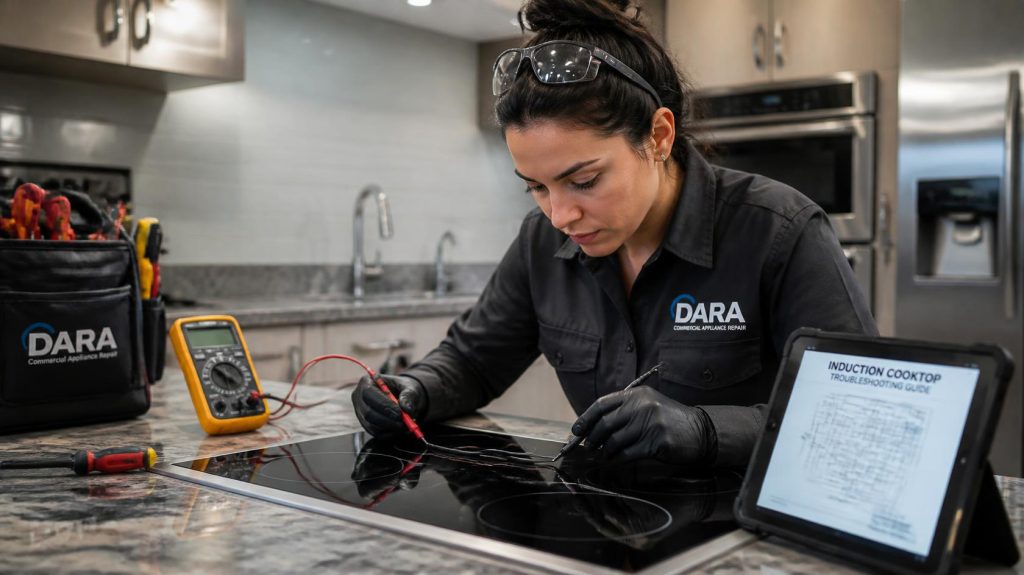
When we come out for an induction cooktop not working, we follow the same order you just did, then go further:
- Confirm the symptom with a pan we know is induction-ready.
- Read the error code and check the model’s service information for what it means.
- Check the power supply at the cooktop to rule out a household wiring problem.
- Inspect the cooling fan and vents, since overheating causes repeat shutoffs.
- Test the coil, power board, and control board for the affected zone.
- Quote the repair before any work starts.
Honest appliance repair starts with telling you when you don’t need us. If the fix was a pan or a setting, we’ll say so.
Darkhan, Dara’s owner, still goes out on repair calls himself alongside our certified appliance technicians. If a part is needed, you’ll know the price before any work starts. Most repairs fall between $129 and $400, and your exact price depends on the issue.
We repair cooktops and ranges from all major and luxury appliance brands across Chicago and the surrounding suburbs, seven days a week from 8 AM to 8 PM. Every repair is backed by a warranty. Learn more about our stove and cooktop appliance repair service.
Frequently Asked Questions
Why does my induction cooktop say no pan detected? The cooktop can’t sense a pan it can use. The pan may not be magnetic, may be too small for the zone, or may not be centered. Try the magnet test and reposition the pan.
Why is my induction cooktop beeping and turning off? Usually it’s a safety feature. Overheating, a hot pan near the controls, water on the panel, or an automatic time limit can all trigger a shutoff. Let it cool, clear the panel, and restart.
Can I use my old pots on an induction cooktop? Only if a magnet sticks firmly to the bottom and the base is flat. Cast iron and many stainless pans work. Plain aluminum, copper, and glass usually don’t.
Is it normal for an induction cooktop to hum or buzz? A light hum or buzz is common at high power with some pans, especially multi-layer ones. Loud crackling, grinding, or a burning smell is not normal.
How do I reset an induction cooktop? Turn the cooktop off, switch off its breaker for 30 seconds to a minute, then turn it back on. If the same error returns, the cooktop needs a technician.
Do you repair induction cooktops? Yes. Cooktop and range repair are part of what we do, including induction models from all major and luxury brands.
Induction Cooktop Still Not Working? We Can Help
Still dealing with an induction cooktop not working after you’ve tested the pan, cleared the lock, and checked the breaker? It’s time for a closer look. Book online to schedule a visit, or contact our team with questions.