
Quick Answer: A refrigerator compressor not starting Chicago homeowners deal with is scary, but it’s usually not as expensive as it sounds. In most cases, the compressor itself is fine and a small, inexpensive part (a start relay, capacitor, or overload protector) has failed instead, a repair that typically runs in the low hundreds. True compressor burnout is less common and costs significantly more, sometimes approaching what a new refrigerator costs. The clearest way to tell the difference: a fridge that clicks every few minutes is usually the cheap fix, while a fridge that’s completely silent needs a closer look. Same-day refrigerator repair and diagnosis is available: call (773) 377-4212 or book online.
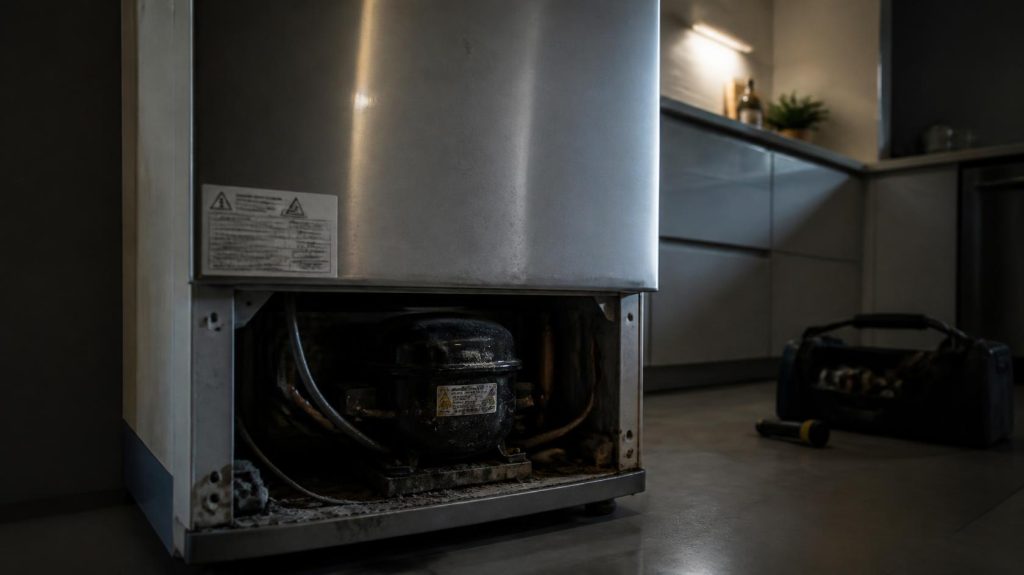
Start Components vs. the Compressor Itself: A refrigerator compressor doesn’t start on its own. It relies on a small set of supporting parts: a start relay (gives the compressor the initial electrical push), a start capacitor on some models (stores charge for that same push), and an overload protector (a safety device that cuts power if the compressor overheats or draws too much current). <cite index=”49-1″>The most common compressor-related complaint is a clicking sound every 2 to 5 minutes combined with a warm fridge, and this is almost always a failed start relay, the best-case scenario when diagnosing a compressor problem</cite>. The compressor motor itself, the actual mechanical pump, is a separate and far more expensive part to replace.
Table of Contents
- The Best-Case Scenario: Start Relay, Capacitor, or Overload Failure
- The Worst-Case Scenario: True Compressor Burnout
- How to Tell Them Apart
- Realistic Repair Cost Ranges
- Repair vs. Replace: The Real Signals
- DIY Steps vs. When to Call a Pro
- Brand-Specific Notes
- Prevention Checklist
- FAQs
Why a Silent Fridge Doesn’t Automatically Mean a Dead Compressor
A refrigerator compressor not starting Chicago repair calls come in for is one of the most anxiety-inducing appliance problems there is, mostly because people assume the worst immediately. A dead-silent fridge feels final. In reality, the compressor is protected by several small, cheap components specifically so that it doesn’t destroy itself trying to start under bad conditions, and those protective components are what fail most often, not the compressor itself.
The Best-Case Scenario: Start Relay, Capacitor, or Overload Failure
Here’s what typically happens: the fridge senses the interior is too warm and signals the compressor to start, but a faulty relay can’t provide the correct startup voltage, so the compressor’s thermal overload protector trips as a safety measure. The compressor itself never actually gets damaged in this sequence. It’s simply prevented from running by a safety system doing exactly what it’s designed to do.
- Start relay failure: The most common of the three. Fridge compressor not working combined with a repeating click (not a constant hum) is the classic sign.
- Start capacitor failure: Found on some models, particularly larger or older units. Similar symptoms to a relay failure, sometimes with a slightly longer or louder click.
- Overload protector failure: Can fail in the “open” position, permanently cutting power even when the compressor temperature is normal. This can look identical to a relay failure from the outside.
The Worst-Case Scenario: True Compressor Burnout
This is what homeowners fear, and it does happen, just less often than the alternatives above. True burnout means the compressor’s internal windings have failed, usually from age, years of minor electrical stress, or a refrigerant/sealed-system problem that forced the compressor to overwork for an extended period.
- What it looks like: Complete silence, no click, no hum, nothing, even when you can confirm the fridge has power. A compressor that’s genuinely seized or burned out won’t attempt to start at all.
- Why it’s more expensive: Replacing a compressor means opening the sealed refrigerant system, which requires reclaiming refrigerant, brazing in a new compressor, evacuating the system, and recharging it, all specialized work that goes well beyond swapping a small electrical part.
How to Tell Them Apart
You can get a strong read on which scenario you’re in just by listening, before calling anyone:
| What You Hear | Most Likely Cause | Ballpark Severity |
| Clicking every 2-5 minutes, fridge warm | Start relay failure | Minor, inexpensive |
| A single hum, then silence, no further attempts | Overload protector tripped | Minor, inexpensive |
| A longer buzz or hum before clicking off | Start capacitor failure | Minor to moderate |
| Complete silence, no sound at all, confirmed power | Possible true burnout | Major, requires diagnosis |
| Compressor housing warm to the touch, constant running, never cycles off | Compressor running but sealed-system issue (different problem) | Moderate to major |
If you hear any clicking or humming at all, that’s actually reassuring. It means the compressor is being told to start and something upstream is stopping it safely, which is a very different (and cheaper) problem than a compressor that’s truly dead.
Realistic Repair Cost Ranges
These are the numbers behind a refrigerator compressor not starting Chicago repair call, once a technician has actually confirmed which of the two scenarios above applies. The figures come from a synthesis of independent appliance-repair industry sources, not a Dara-specific quote. Your actual cost depends on the brand, the specific part, and labor in your market.
- Start relay or capacitor replacement: Typically $150 to $300 installed, sometimes lower depending on the model and whether labor is bundled with the diagnostic visit. This is the cheapest and most common fix.
- Sealed-system leak repair and recharge: Typically $500 to $1,000, covering finding the leak, repairing it, and recharging the refrigerant.
- Full compressor replacement: Typically $700 to $1,200 on a mainstream brand, covering the part, labor, and recharge. Built-in and luxury units (Sub-Zero, GE Monogram, and similar) tend to run higher due to OEM part cost and more difficult access to the sealed system.
- A new refrigerator, for comparison, generally runs from the high hundreds into the low thousands depending on size and features, which is the number that ultimately matters most for the repair-vs-replace decision below.
A proper diagnostic visit (which includes our $89 diagnostic fee, waived if you move forward with the repair) is what actually tells you which of these ranges applies to your specific situation, rather than guessing from symptoms alone.
Repair vs. Replace: The Real Signals
- Repair usually makes sense if: the fridge is under 8 to 10 years old, the failure is isolated to a start component or the sealed system, and the rest of the unit (ice maker, shelving, electronics) is in good shape.
- Replacement starts to make more sense if: the refrigerator is already past 10 to 12 years old, this isn’t the first major repair, or a full compressor replacement quote is approaching what a comparable new unit would cost.
- The honest middle ground: a start relay or capacitor fix is almost always worth doing regardless of the fridge’s age, since it’s inexpensive relative to any refrigerator’s value. The replacement conversation really only becomes relevant at the full compressor replacement or sealed-system tier.
DIY Steps vs. When to Call a Pro
| Step | DIY-Safe? | What to Do |
| Confirm the fridge has power (outlet, breaker) | Yes | Rule out the simplest explanation first |
| Listen and match the sound to the table above | Yes | Takes a few minutes, tells you a lot |
| Check that nothing is blocking the compressor compartment’s ventilation | Yes | Poor airflow around the compressor can contribute to overheating trips |
| Test or replace a start relay, capacitor, or overload protector | No | Requires multimeter testing and correct part matching |
| Diagnose true compressor burnout | No | Requires professional-grade testing to confirm before committing to a major repair |
| Open the sealed refrigerant system for any reason | No | Requires EPA-certified handling and specialized brazing equipment |
Refrigerator won’t turn on compressor situations are one of the few appliance problems where we’d actively discourage extensive DIY troubleshooting beyond the listening test above, since misdiagnosing a relay as a dead compressor (or vice versa) can mean paying for the wrong repair entirely. This is exactly the kind of call where booking refrigerator repair through a certified technician pays for itself in accurate diagnosis alone. Call (773) 377-4212, book online, or reach out through our contact page for an accurate diagnosis before committing to any repair.
Brand-Specific Notes
Whatever the brand, appliance repair for a compressor issue starts with the same listening test above, though a few things are worth knowing by brand:
- Whirlpool, Kenmore, GE, and most mainstream brands: Standard relay/capacitor/overload assembly; repair costs generally fall within the ranges above.
- Samsung and LG: Some models use inverter-driven compressors with different start electronics than traditional relay-based systems, which can shift diagnosis and part costs somewhat.
- Sub-Zero, Viking, and other built-in luxury brands: Dual refrigeration systems and harder-to-access compressor placement generally push both diagnosis time and repair cost higher. Our certified technicians have experience working on dual refrigeration systems in these builds.
- Older units (12+ years): Compressor failure signs at this age are more likely to tip the repair-vs-replace decision toward replacement, simply because other components are also more likely to be near end of life.
Prevention Checklist
A little maintenance now can mean the difference between routine appliance repair and a full compressor replacement later:
- Keep the area around and behind the fridge clear for ventilation, since poor airflow makes the compressor and overload protector work harder
- Clean condenser coils every 6 months. A compressor working against dirty coils runs hotter and stresses the same components covered here
- Avoid plugging the fridge into an extension cord or a circuit shared with high-draw appliances, which can contribute to electrical stress on start components
- Address a clicking or cycling sound as soon as you notice it. This is almost always the cheap fix, but it won’t stay that way if ignored indefinitely
FAQs
Why is my refrigerator compressor not starting Chicago repair techs get called for so often? Most of these calls turn out to be a failed start relay, capacitor, or overload protector rather than a dead compressor. These small parts protect the compressor and fail more often than the compressor itself does.
How can I tell if it’s a cheap fix or a real compressor problem? Listen. Clicking every few minutes with a warm fridge is usually a relay issue. A single hum followed by silence is usually a tripped overload. Complete, total silence with confirmed power is the scenario that needs a closer look for possible burnout.
What are the signs of a failing refrigerator compressor specifically, versus a failed start part? Compressor failure signs include complete silence with no clicking or humming at all, or a compressor housing that runs constantly hot without ever cycling off. A failing start relay or capacitor, by contrast, usually produces a repeating click.
How much does it cost to fix a refrigerator compressor that won’t start? It depends entirely on which component failed. A start relay or capacitor fix typically runs in the low hundreds. A full compressor replacement is a larger repair, often in the high hundreds to low thousands depending on brand and accessibility.
Is it ever worth replacing a compressor instead of the whole refrigerator? Sometimes, especially on a unit under 10 years old with no other major issues. Once a full compressor replacement quote starts approaching the cost of a comparable new refrigerator, replacement usually makes more sense.
Can I test or fix a start relay myself? Testing requires a multimeter and knowing the correct values for your specific compressor. It’s within reach for a comfortable DIYer, but misdiagnosing this can lead to replacing the wrong part, so most homeowners are better served by a professional diagnostic.
My fridge compressor not working is completely silent. Is that always the worst-case scenario? Not always, but it’s the scenario most likely to actually be compressor burnout rather than a start-component failure, so it’s worth a professional diagnosis sooner rather than later, especially since food safety is also on the clock.
Do you offer same-day diagnosis for a refrigerator won’t turn on compressor situation in Chicago? Yes. Same-day diagnostic visits are available across Chicago and the surrounding suburbs, and getting an accurate diagnosis quickly matters most here, since it’s the difference between a low-hundreds repair and a much larger decision.
Closing Service Bio
Dara Appliance Repair LLC diagnoses refrigerator compressor not starting Chicago calls for homeowners across the city and 14 surrounding suburbs, including Evanston, Skokie, Park Ridge, Niles, Glenview, Wilmette, Northbrook, Deerfield, Highland Park, Des Plaines, Oak Park, Berwyn, Cicero, and Lincoln Park. Our certified technicians can usually tell within minutes whether you’re looking at an inexpensive relay swap or a genuine compressor replacement, and we’ll walk you through the real cost and the repair-vs-replace math honestly before any work begins. Same-day appointments are available, along with a 10% discount on your first refrigerator repair. Call (773) 377-4212, book online, or visit our contact page.