
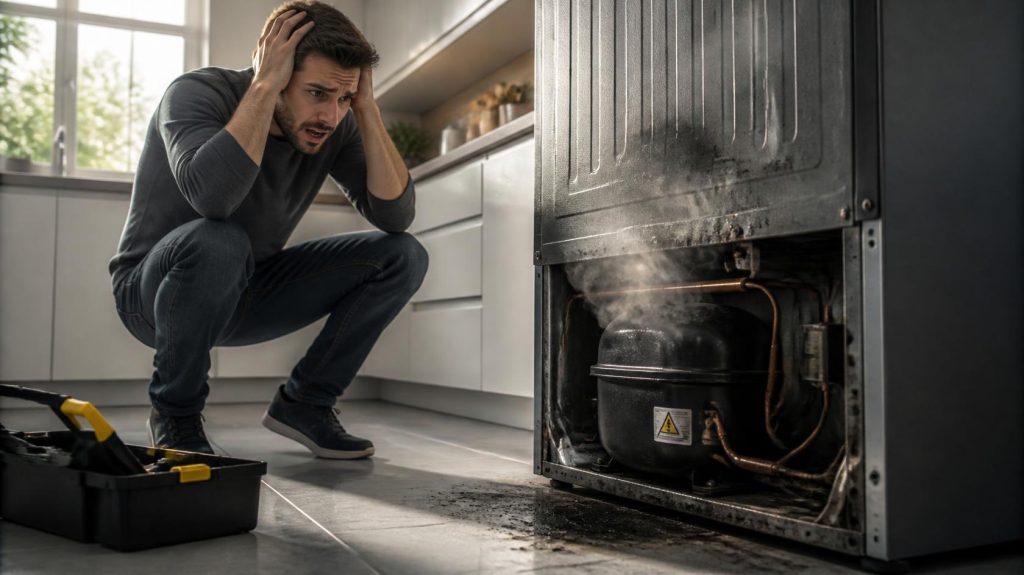
A refrigerator that never cycles off is one of the most common complaints we hear, and it’s also one of the most misdiagnosed. Most homeowners assume refrigerator compressor problems the moment the fridge starts running nonstop, but the compressor is actually the least likely of the three usual suspects. Dirty condenser coils and a worn door seal cause the same symptom far more often, and telling the three apart is the difference between a 20-minute fix and an expensive repair.
A refrigerator is also one of the only major appliances that runs around the clock, so how efficiently it’s operating has an outsized effect on your electricity bill. ENERGY STAR’s own guidance notes that an inefficiently running fridge can use significantly more energy than one operating normally, which is exactly why a unit stuck running nonstop shows up on your bill fast, whether the cause turns out to be simple or one of the pricier fixes.
This guide walks through how to tell dirty coils, a bad door seal, and genuine refrigerator compressor problems apart, plus how to think about repair cost versus replacement if it does turn out to be the compressor.
Table of Contents
- Quick Diagnostic Checklist: Coils vs. Seal vs. Compressor
- Is It Dirty Condenser Coils?
- Is It a Bad Door Seal?
- Is It Actually a Failing Compressor?
- Repair or Replace: What Refrigerator Compressor Problems Cost
- Brand-Specific Notes
- What to Do Next
- FAQ
Quick Diagnostic Checklist: Coils vs. Seal vs. Compressor
Run through these checks in order. Each one rules a cause in or out before you move to the next:
- Check the coils. Pull the fridge out and look at the condenser coils (back or bottom, depending on model). Covered in dust or pet hair? Clean them and wait 24 hours before doing anything else. This alone resolves a large share of “running constantly” cases.
- Test the door seal. Close the door on a dollar bill. If it slides out with little resistance, warm air is getting in and the compressor is compensating for a leak, not a mechanical failure.
- Listen and feel. If the coils are clean and the seal passes the dollar-bill test but the fridge is still running nonstop, put a hand near the compressor (the black, motor-like unit at the back bottom of the fridge). Excessive heat, a loud humming or clicking, or a burning smell point toward the compressor itself.
- Check the temperature. If the fridge is running constantly but still isn’t reaching a safe temperature despite clean coils and a good seal, that’s a stronger signal of refrigerator compressor problems or a refrigerant issue than either of the first two causes.
If you stopped at step 1 or 2, you likely just found and fixed the issue. If you made it to steps 3 or 4, keep reading.
Is It Dirty Condenser Coils?
This is the most common cause of a fridge that won’t cycle off, and it’s also the easiest to rule out. Dust and pet hair insulate the coils, so the compressor runs longer to compensate for heat that can’t escape efficiently. We’ve covered the full cleaning process, including a dollar-bill-style test schedule for pet owners and older Chicago homes, in our refrigerator condenser coil cleaning guide. If you haven’t cleaned your coils in the last 6 to 12 months, start there before assuming anything more serious is going on.
Is It a Bad Door Seal?
A worn or torn door seal lets warm air in continuously, so the compressor cycles more often trying to hold temperature. It’s a different mechanism than dirty coils but produces the same “running constantly” symptom, along with a few extras: condensation near the door, frost buildup, or an interior temperature that drifts even though the fridge sounds like it’s working overtime. We’ve broken down the dollar-bill test and the food safety and mold risks that come with a failing seal in our refrigerator door seal repair guide. If your seal fails that test, that’s very likely your answer.
Is It Actually a Failing Compressor?
If the coils are clean and the seal passes the dollar-bill test, genuine refrigerator compressor problems become a lot more likely. A handful of signs point specifically to the compressor rather than coils or the seal:
- Excessive heat or vibration coming from the compressor unit itself, well beyond normal warmth
- Loud humming, clicking, or a knocking sound coming from the back bottom of the fridge, especially if it’s new or has gotten noticeably louder
- The fridge runs constantly but never reaches a safe temperature, even with clean coils and a good seal
- A burning or electrical smell near the compressor, which warrants unplugging the fridge and calling for refrigerator repair right away rather than continuing to trial-and-error it
- The compressor short-cycles, turning on and off in rapid bursts rather than running in normal, longer cycles
Refrigerator compressor problems are less common than dirty coils or a bad seal, but they’re also the one cause on this list that isn’t a DIY fix. A failing compressor needs a technician to confirm with actual diagnostic tools rather than guesswork, since the same symptoms can also point to a failing start relay or a refrigerant leak, which are different appliance repair jobs entirely.
Repair or Replace: What Refrigerator Compressor Problems Cost
Our standard diagnostic fee is $89, waived when you move forward with the repair, and most refrigerator repairs run $129 to $400 depending on the part and labor involved. Compressor work tends to sit toward the higher end of that range, since it’s a more involved repair than a coil cleaning or a gasket swap.
The general rule we use to help homeowners decide between repair and replacement: if the repair costs less than half the price of a new comparable unit and the fridge is under 10 years old, repair is almost always the better value. A refrigerator older than that, or a compressor repair quote that creeps close to half the cost of a new fridge, tips the math toward replacement instead.
A diagnostic visit is the fastest way to get an actual number instead of guessing, since compressor repair costs vary by brand, whether the unit is still under any manufacturer coverage, and how accessible the compressor is on your specific model.
Brand-Specific Notes
Compressor design and accessibility vary by brand. Some higher-end lines, including Sub-Zero and Viking, use dual-compressor systems that separate the fresh food and freezer compartments, which changes both the diagnosis and the repair approach compared to a standard single-compressor fridge. Our certified appliance technicians with experience across major and luxury refrigerator brands can identify which system your unit uses and diagnose accordingly.
What to Do Next
- Start with the coils, since that’s the fastest and most common fix
- Test the door seal next if the coils were already clean
- If both check out and you’re seeing compressor-specific signs, stop troubleshooting on your own and book a diagnostic
- Never continue running a fridge that smells like it’s burning or overheating; unplug it and call for refrigerator repair
FAQ
How do I know if it’s my compressor and not something simpler?
Rule out dirty condenser coils and a worn door seal first, since those cause the same “running constantly” symptom far more often. If the coils are clean, the door seal passes a dollar-bill test, and you’re still hearing loud noises, feeling excessive heat, or smelling something burning near the compressor, that points toward the compressor itself.
Can a refrigerator run constantly and still be fine?
Some cycling is normal, especially in hot weather or right after the door’s been open a lot. The concern is a fridge that never cycles off at all, runs noticeably louder or hotter than before, or still isn’t reaching a safe temperature despite running nonstop.
Is it worth repairing a refrigerator compressor?
Often, yes. If the repair costs less than about half the price of a comparable new refrigerator and the unit is under 10 years old, repair is usually the better value. Past that point, or on an older fridge, replacement starts to make more financial sense.
How much does refrigerator compressor repair cost?
Our diagnostic fee is $89, waived when you proceed with the repair, and most refrigerator repairs fall between $129 and $400. Compressor repairs tend to land toward the higher end of that range since the work is more involved than a coil cleaning or seal replacement.
Can dirty condenser coils actually damage the compressor?
Yes, over time. Dust-insulated coils force the compressor to run longer and harder than it should, and that extra strain, repeated for months or years, can shorten the compressor’s lifespan even if it isn’t the original problem.
Should I try to fix a compressor problem myself?
No. Unlike coil cleaning or a seal test, compressor diagnosis and repair involves refrigerant lines and electrical components that need a trained technician. If your checklist points toward the compressor, it’s time to book a diagnostic rather than keep troubleshooting.
What does a failing compressor sound like?
Common signs include a loud humming, clicking, or knocking noise from the back bottom of the fridge, or a compressor that short-cycles, turning on and off in rapid bursts instead of running normal, longer cycles.
Do all three causes, coils, seal, and compressor, feel the same to a homeowner?
The main symptom, a fridge that won’t cycle off, is the same, but the details differ. Dirty coils are a quiet, gradual buildup. A bad seal often comes with visible condensation or frost near the door. A failing compressor tends to bring in noise, heat, or smell that the other two don’t.
Get an Actual Diagnosis Instead of Guessing
A fridge that runs constantly almost always has a real, findable cause, and it’s dirty coils or a worn seal more often than it’s the compressor. If you’ve worked through the checklist above and everything still points toward refrigerator compressor problems, our certified appliance technicians provide fast, affordable refrigerator repair and appliance repair throughout Chicago and the North Shore. Book a diagnostic or contact us and we’ll tell you exactly what’s going on before any work starts.